Hiatus

FeaturedHiatus

I started this blog at the beginning of 2021, initially with the intention to keep it going for one year. After three years and 157 posts, I am now taking a break from posting weekly updates. I’ve increasingly found it difficult to find inspiring new topics to write about, and I do not want this to become a chore. The blog will stay online and, if I find myself excited about something interwar, I may add a post ad-hoc, but they will no longer appear weekly.

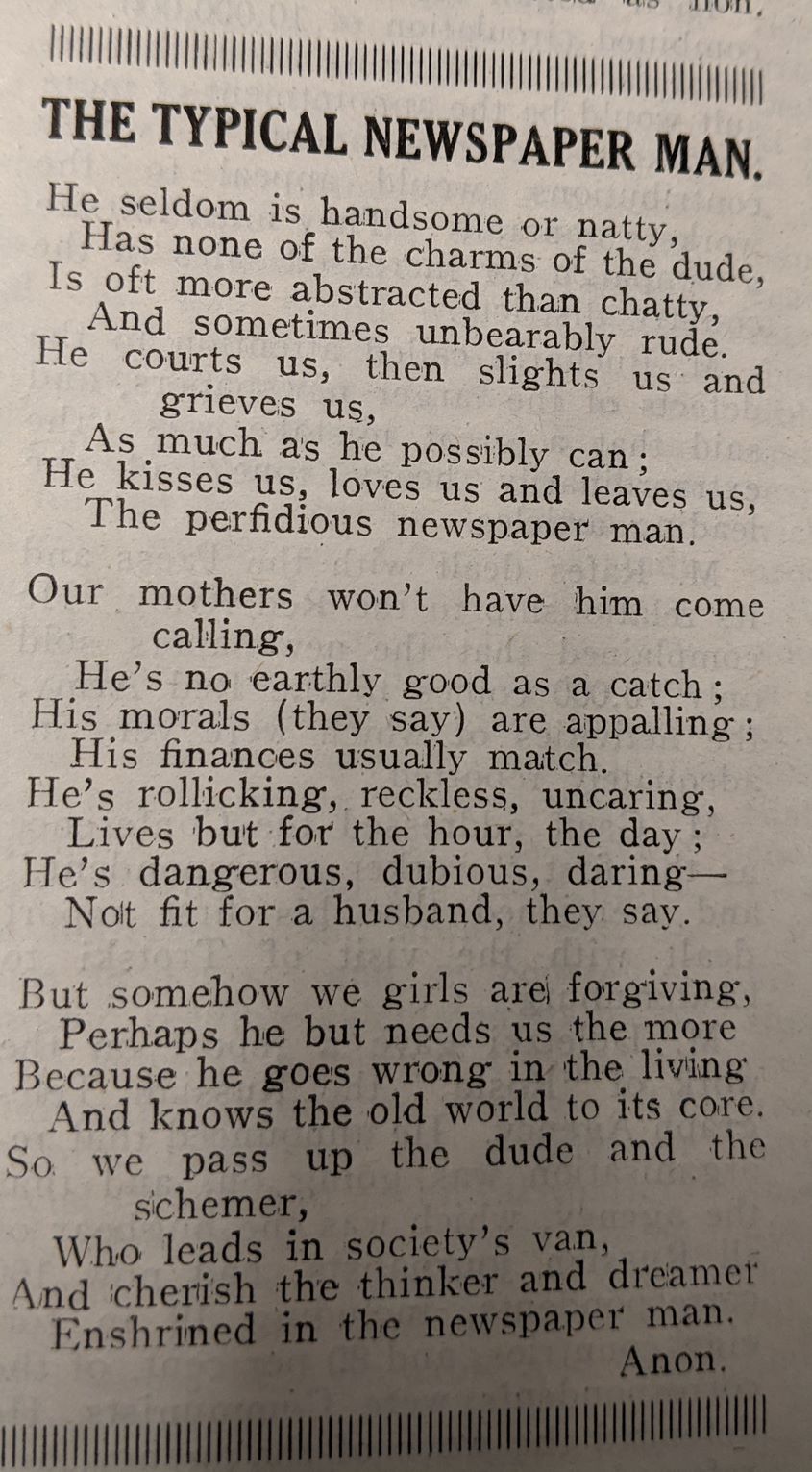
Thank you for your continued readership, support and messages over the years. I’ll leave you with this rhyme, written up by an anonymous contributor and published in the National Union of Journalists’ monthly membership bulletin:

Featured

The Bow Cinema Murder – Aftermath

This is the eleventh and final part in the investigation into the 1934 ‘Bow Cinema Murder’. You can read all entries in the series here.

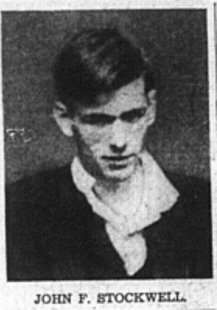
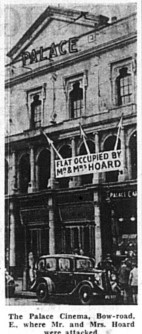
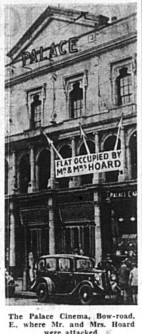
After John Stockwell’s execution on 14 November 1934, the Bow Cinema murder case had formally come to a close – but its impact on the people caught up in it lasted beyond the execution. Most significantly, Maisie Hoard continued to recuperate from the substantial injuries that Stockwell had inflicted on her. The psychological damage was naturally also serious. On the day of the execution an interview with Maisie appeared on the front page of the Daily Mirror, under the headline ‘Life Ruined by Murder’. Still in hospital at this stage, Maisie revealed that she would have a scar in her face for the rest of her life. She also pointed out that, as a new cinema manager had been appointed to the Eastern Palace Cinema, she was now effectively homeless:

I have now no home – nothing. I have nowhere to go, for I have no mother, brother or sister. My husband was uninsured – so I have no money. I do not ask for charity. All I want is work. Will someone give me a job as housekeeper?[1]

In the end, Maisie did not have to work as a housekeeper, or at least not for long. By 1939 she had remarried to a Henry White and moved to Ashford in Kent.

The other woman whose life had been most affected by John Stockwell was his girlfriend, Violet Roake. As noted in the previous instalment of this series, she had also gone public and was interviewed in the Daily Herald, reframing her story as a romance novel. Violet was only 18 in 1934 and although she had anticipated marrying John Stockwell before he committed his crime, she clearly had enough opportunity to find another life partner. It is possible that her reputation in the East End was irrevocably tainted though; while her brother and sister stay local, Violet marries a Navy officer and moves to Portsmouth. The couple married in 1939 and had a son in the same year, and a daughter ten years later. Violet lived until 1991. Her husband, Joseph Brimley, survived her and lived until 1995.

For Fred ‘Nutty’ Sharpe, the Chief Inspector who investigated the case, the Bow Cinema murder investigation was significant enough to warrant a full chapter in the memoirs he published in 1938. Sharpe retired from the CID in 1937. In his book, Sharpe of the Flying Squad, he calls Stockwell ‘the calmest, most coldblooded individual I have ever met and he wasn’t the least bit nervous.’[2] Throughout the chapter Sharpe uses superlatives to stress the violence of the murder: it was ‘one of the most savage [murders] a man has ever committed’ and the attack had been committed with ‘utmost violence.’[3] He juxtaposes this with his descriptions of Stockwell as’ completely unmoved and in entire possession of his nerve.’[4]

Sharpe’s descriptions reinforce the newspaper reporting that had taken place during the case, which also largely described Stockwell as calm and weirdly devoid of emotion. Despite this, though, John Stockwell never entered the popular imagination as a notorious calculating killer. There are plenty of well-known murder cases from the interwar period, but this is not one of them. For a case that was considered at the time to be extremely brutal, and a killer who was unusually young and unemotional, it may seem surprising that this case did not gain the same notoriety as others.

It is not because this case was satisfactorily solved – most of the best-known interwar murders were resolved at the time and their convictions are largely considered sound. Like many of the other famous cases, celebrity pathologist Sir Bernard Spilsbury worked on this case, and it received extensive press reporting. It raised concerns about the callousness of youth, and whether it was appropriate to execute a 19-year old.

I suspect that it is the combination of victim and killer that has made this murder less appealing than others of the same period. Unlike many of the most famous interwar murders, there was no love or domestic angle to this case. There were no betrayed husbands or deserting wives; Stockwell hadn’t murdered a girlfriend like Patrick Mahon or Norman Thorne, or tried to fake his own death due to having too many girlfriends, like Alfred Rouse. He also had not been convicted of killing his own mother, like Sidney Fox. Instead, he was a man killing another, unrelated man, for financial gain. Most years during the interwar period, a handful of men got executed for similar crimes, yet the cases are largely forgotten. Instead, the interwar years are remembered for their colourful domestic dramas, with cases like Edith Thompson’s being so well-known she has a dedicated website.

As this series has demonstrated, the killing of a man by another man can be no less interesting than a murder case involving a jilted lover; and it can reveal much about the attitudes towards masculinity, class, money, and local communities.


[1] ‘Life Ruined by Murderer’, Daily Mirror, 14 November 1934, front page

[2] Frederick Sharpe, Sharpe of the Flying Squad (London: John Long, 1938), p. 126

[3] Ibid., pp. 126-7

[4] Ibid., p. 131

Featured

The Bow Cinema Murder – Execution

This is the tenth part in the investigation into the 1934 ‘Bow Cinema Murder’. You can read all entries in the series here.

On 14 November 1934, just over three months after an intruder had repeatedly hit Dudley Hoard over the head with a hatchet to access the safe of the Eastern Palace Cinema, which he managed, John Frederick Stockwell was executed for the murder in Pentonville Prison. Because John had pled guilty to the charges, the death sentence was automatically passed under the provisions of the Capital Punishment Amendment Act 1868.

This Act set out that executions had to take place within prison walls; until 1868 executions in Britain had been public events. It also described the administrative provisions around the execution, proscribing the presence of ‘The Sheriff charged with the Execution, and the Gaoler, Chaplain, and Surgeon of the Prison, and such other Officers of the Prison as the Sheriff requires’. Although not explicitly spelt out in the Act, the method of execution was hanging.

The archival documents relating to the execution of John Stockwell show the extent to which capital punishment was part of the administrative business of state. Although there were relatively few executions in Britain during the interwar period (never more than 21 in a year, and some years as few as 3 across the whole country), the process was supported by proformas and other formal documentation.

On the day of Stockwell’s trial, the Governor of HMP Pentonville put in a formal request to the Prison Commission for a list of available executioners and records of their “conduct and efficiency”.[1] Two days later, on 24 October, the High Sheriff of the County of London formally fixed the time and date of the execution as 9am on 14 November (subject to appeal). On 12 November the Home Office formally notified the Prison Commission that Stockwell’s appeal was not upheld.

The day before the execution, Violet Roake visited her former boyfriend in prison one last time. She sold her story to the Daily Herald, who gave her a front-page article on 14 November in which she related her goodbye to John. The article claimed that Stockwell had been quite calm on the eve of his arrest, and had explained that he had committed the violent attack because he wanted to offer Violet a better life and future. The article further claimed that Stockwell accepted the consequences of his actions. The tone of the article was romantic, bordering on soppy. Violet was quoted as saying that Stockwell had looked ‘so well and handsome’ and that the prison wardens were ‘taking him away from [her]’.[2]

The article caused a stir in HMP Pentonville, and caused the Governor to write to the prison office and dispute some of the assertions made in the article, particularly around allegations made by Violet that she had struggled to get approval to visit John. Of course, by the time most people read the article, the execution had already taken place; it was an attempt to capitalise on the ‘human interest’ of what was framed as a tragic love story, not any serious protest against Stockwell’s execution.

The executioner was Mr R Barter of 25 Wellington Road, Hertfordshire. His assistant was Mr R Wilson of 15 Barnard Road, Manchester. Executions were always conducted by two men; due to the low numbers of executions each year, executioners usually had day-jobs and were called up as appropriate. As part of the proceedings, the Governor confirmed that the executioners were ‘respectable and of appropriate demeanour’; would not ‘lecture, interview or otherwise discuss the execution and thus discredit their office; and would not ‘create a public scandal through their (mis)performance of the execution.’[3] Just over ten years’ prior, the execution of Edith Thompson was rumoured to have gone badly wrong; clearly the Home Office were keen to avoid any scandals. The executioners’ responsibility to keep all details of the execution to themselves further worked to create an aura of mystery around capital punishment.

In the formal Notice of Execution completed the day after the execution, it was noted that John Stockwell had died of a broken neck, specifically because of a fracture between his 5th and 6th vertebrae. It was much preferred that prisoners died of a broken neck rather than of asphyxiation – the latter took longer and would be more uncomfortable for the prisoner. The British government prided itself on what it considered to be a most efficient and therefore superior system of capital punishment.

In line with the provisions made in the Capital Punishment Amendments Act, an autopsy was conducted on Stockwell’s body; this was undertaken by Bernard Spilsbury, who had also co-operated in the autopsy on Dudley Hoard’s body. Stockwell was then buried in the grounds of Pentonville Prison. At Scotland Yard, Detective Inspector Frederick Sharpe made his final report on the case, putting forward nine of the officers who had worked with him for rewards. All officers involved in the case received a commendation. Frederick Sharpe retired from the police in July 1937.


[1] PCOM 9/333 ‘STOCKWELL, John Frederick: convicted at Central Criminal Court (CCC) on 22 October 1934’, National Archives

[2] ‘Smile Recalled Many Times We Kissed’, Daily Herald, 14 November 1934, p. 2

[3] PCOM 9/333

Featured

The Bow Cinema Murder – Crown Court and beyond

This is the ninth in a 11-part investigation into the 1934 ‘Bow Cinema Murder’. You can read all entries in the series here.

After numerous appearances in the Thames Police court, the presiding magistrate ruled that the case for the murder of Dudley Hoard and the theft of the Eastern Palace Cinema earnings, was to be heard at the Old Bailey. Compared to today, court cases in interwar Britain moved through the system very quickly. The murder had taken place on 7 August; the arrest was made on 11 August; the Police court completed its work on 18 September; and the case was set to be heard at the Crown Court on 22 October.

The key feature which distinguished the crown court from the police court was the presence of a jury. In England, the jury consisted of twelve individuals; since 1920, women could be called for jury duty as well as men. By 1934, the presence of women on the jury of a murder case was still considered worthy of comment in the newspapers, as women’s perceived delicate sensibilities were thought to suffer from having to hear violent testimony.

For the trial, John Stockwell was assigned legal counsel through the 1903 Poor Prisoners’ Defense Act: he had no means to pay for his own defense. He was represented by Frederick Levy; a Vincent Evans represented the prosecution. Although the police ostensibly had a written confession from Stockwell, they felt far from secure that he would get convicted. John Stockwell had made his main confession when he was being driven down from Yarmouth to London On the occasion, Detective Inspector Sharpe had decided not to explicitly re-read Stockwell his rights, as he did not want to put Stockwell off. Sharpe had also not taken notes during Stockwell’s confession, instead opting to jot Stockwell’s words down from memory upon arrival in London. A skilled lawyer could argue that the confession was inadmissible.

Additionally, the police were never able to confirm that the hatchet they found at the site of the murder, was the axe used in the household where Stockwell lived. Stockwell had said that he had taken this household axe, used for chopping down coals, and used it to hit Dudley Hoard over the head. Yet when the family Stockwell was lodging with, the Roakes, were shown the hatchet found at the crime scene, all of them separately confirmed that this was not theirs.

Maisie Hoard, who had been in hospital since the attack, was unable to identify Stockwell during an identity parade staged at Brixton Prison on October. There were also persistent rumours that the attack had been carried out by two people, and that John Stockwell was shielding the real attacker. There were enough question marks, in short, to allow a defense team to challenge the police evidence.

In the end, however, none of these issues were unpicked in the courtroom. On the morning of 22 October, after the jury were sworn in and the judge opened the trial, Frederick Levy announced that John Stockwell changed his plea from ‘not guilty’ to ‘guilty’.[1] This was unusual and unexpected, and left the jury no choice but to formally confirm the verdict. This, in turn, lead to an automatic death sentence, although the jury ‘strongly recommended him to mercy, taking in to account the parental guidance which he never received.’[2] The trial was over in a matter of minutes, allowing the court administrators to use the same jury to hear a second case on the same day.

Immediately after the verdict, John Stockwell’s defense team started up a petition. If one was found guilty of a capital offence, such as murder, and there was no question of perpetrator being found insane, there was only one route available to avoid an execution: for the King to offer mercy and commute the sentence to life imprisonment. In practice, the King would offer mercy at the recommendation of the Home Secretary, so applications were made to the Home Office. There was a distinct time pressure, as prisoners were traditionally given only ‘three Sundays’ between sentencing and execution.

One way to persuade the Home Secretary that a sentence should be commuted was to demonstrate widespread popular support for the prisoner. Frederick Levy and his team therefore immediately started a petition in favour of a mercy ruling. The petition primarily argued that Stockwell, at 19 years old, was still very young, and that execution would therefore not be appropriate. The lawyers visited the Home Office on 6 November to argue their case, and on 12 November presented several petitions. On 13 November they even delivered a letter of the foreman of the jury which had convicted Stockwell, pleading for a commuted sentence.

It was to no avail: the Secretary of State concluded that there was no sufficient ground in this case to justify advising the King to “interfere with the due course of law.”[3] The Home Office’s case was primarily one of precedent: the law considered everyone over the age of 18 to be an adult, and there had been cases in 1922, 1925, 1928 and 1932 where men of 18 or 19 years old had been executed.[4] Additionally, the Home Office considered it proven that John Stockwell had set out to kill or grievously harm the Hoards; this despite Stockwell’s insistence that he had no such intention. The Home Office’s thinking here was influenced by that of Inspector Sharpe, who in his final report noted that Dudley Hoard knew John Stockwell, and would have been able to identify him if Stockwell had let Hoard live.

Despite the efforts of John Stockwell’s defence team, then, his execution was scheduled for 14 November at Pentonville Prison. All condemned men who lived in London and north of the river were executed here; and executions always took place at 9am sharp. After the flurry of publicity around the murder, manhunt and police court proceedings, this final chapter of the story received very little public attention. Most papers did not report on the execution at all; it was, after all, the expected outcome which reaffirmed to the public that those who transgressed received due punishment.


[1] ‘Two death sentences in one day,’ Daily Mirror, 23 October 1934, p. 23

[2] Ibid.

[3] PCOM 9/333 ‘STOCKWELL, John Frederick: convicted at Central Criminal Court (CCC) on 22 October 1934’, National Archives

[4] HO 144/19719. ‘CRIMINAL CASES: STOCKWELL, John Frederick Convicted at Central Criminal Court (CCC) on 22 October 1934 for murder and sentenced to death’, National Archives

Featured

The Bow Cinema Murder – the Magistrate’s Court and Newspaper Reporting

This is the eight in a 11-part investigation into the 1934 ‘Bow Cinema Murder’. You can read all entries in the series here. 

As alluded to in previous instalments in this series, the Bow Cinema Murder was heavily reported on in the popular press. The murder itself was brutal enough; but the fact that a nation-wide man-hunt was called for the prime suspect, and that it took several days to locate and arrest John Stockwell, gave the press irresistible material. The press quickly framed the events in a recognisable narrative format, featuring colleagues and acquaintances of John Stockwell as an ensemble cast of characters. Although the initial press interest culminated with Stockwell’s arrest in Yarmouth on 11 August, and return to London the next day, journalists continued to report on the case as it started to progress through the legal system. Stockwell himself changed from a mysterious figure to a named suspect who could be interpreted through his appearances in court.

As I have described previously on this blog, interwar newspapers reported on court cases on a daily basis, and the reporting conventions in this area provided the reading public with a framework through which to understand criminal and deviant behaviour. The reports on the Bow Cinema Murder both worked within these established conventions and further contributed to them.

In 1934, as today, the English justice system had two ‘tiers’ of courts: the police or magistrate courts, which dealt with minor crimes, and the crown court, which considered more serious crimes. Cases at the crown court were decided by a jury; at the lower court a magistrate heard the case and decided the outcome. Unlike today, however, all cases had to first be heard in the police court, where a magistrate would establish the facts of the case. He would then formally decide whether a case should be referred to the crown court to be heard by a jury. Also unlike today, proceedings in the police court started almost immediately upon arrest, and as the name implied, the majority of the evidence heard was provided by the police officers who had investigated the case and made the arrest.

In the case of the Bow Cinema Murder, Inspector Fred Sharpe played a key role in the magistrate court proceedings. Already during the early stages of the investigation, whilst he and his men were tracking down John Stockwell, they were also ensuring that they had sufficient evidence to put the case forward to trial. The police inspectors continued with this after Stockwell’s arrest – (re)interviewing witnesses to ensure that there were no gaps in their narrative that could be exploited by the counsel for the defence.

Stockwell made his first appearance in the Thames Police Court on 13 August, only two days after his dramatic arrest in a Yarmouth hotel. That was a Monday, and from then on the case was heard weekly on Tuesdays until 18 September, when Stockwell was formally committed to trial at the Old Bailey. All of these hearings were reported on in the national press. The reports were standalone articles, outside of the regular ‘today in court’ columns. This underlined the relative importance the press gave to this particular criminal investigation, which was set apart from the daily churn of magistrate court proceedings.

Stockwell’s appearance in court gave reporters the first opportunity to have a good look at him. Although the attack on Dudley Hoard was described as ‘A murder as grim and mysterious as any enacted on [the Eastern Palace Cinema’s] flickering screen’[1], its alleged perpetrator was repeatedly described as quiet, ‘very pale’ and even physically weak.[2] The Daily Mirror went further than most in describing Stockwell as ‘a young man of medium height, with wavy blonde hair, and as he faced the magistrate he stood with his hands clasped behind his back and started straight in front of him.’[3] The reference to ‘wavy blonde hair’ makes Stockwell akin to a romantic hero. He was also noted to be wearing an open-necked shirt and tennis shoes – hardly the outfit of a killer. At the end of the proceedings Stockwell was reported to have asked ‘in a quiet voice’ for leave to see his girlfriend and some other friends.

Even more than John Stockwell’s hair and clothes, newspapers made repeated references to his young age – he was only 19 at the time of the murder and trial. His age usually appeared with the first line of every article about the case. The Daily Mail landed upon the description of him as a ‘lad’.[4] Multiple headlines in the paper referred to the ‘Cinema Lad’ throughout his arrest and trial. ‘Lad’ provides a compromise between ‘man’ and ‘boy’: it refers to Stockwell’s relative youth without suggesting that he should be tried as a juvenile.

The police court proceedings heard evidence of Inspector Sharpe, setting out week by week the case against Stockwell. He first established that Hoard had been murdered; and then that Stockwell had made a full confession to him in the drive back from Yarmouth. The court was also presented with a letter which John Stockwell had sent to Lowestoft police, when he was attempting to fake his own death through suicide. This letter contained another confession of the murder. The people Stockwell interacted with in Lowestoft and Yarmouth were called to give their evidence, as was Sir Bernard Spilsbury, who had been involved in the autopsy of Dudley Hoard.

At the final hearing, Violet Roake, John Stockwell’s one-time girlfriend, was called to testify. Stockwell had written her a letter while he was in Lowestoft, claiming that he was not guilty but also asking her to call him by a different name going forward.[5] Although Stockwell had been granted permission to receive visits from Violet, it appears that she had retained her distance from him; the Evening Standard reported that Violet did not look at Stockwell when she entered court.[6]

Although the police court hearings had given the press and public a first overview of the details of the murder and manhunt, they were considered a preliminary to the inevitable referral of the case to the Crown Court. There, at the Old Bailey in central London, the real drama of the case was expected as a jury of twelve men and women had to decide whether John Stockwell was guilty of murder – and a guilty verdict would automatically lead to a death sentence.


[1] ‘Midnight Murder in a London Cinema’, Daily Mail, 8 August 1934, p. 9

[2] ‘Stockwell Accused of Cinema Murder’, Evening News, 13 August 1934, front page; “I did not mean to kill Mr Hoard”, Daily Mirror, 14 August 1934, p. 8

[3] “I did not mean to kill Mr Hoard”, Daily Mirror, 14 August 1934, p. 8

[4] For example: ‘Cinema Lad Found’, Daily Mail, 11 August 1934, p. 9; ‘Cinema Lad in Court’, Daily Mail, 14 August 1934, p. 10
[5] ‘Cinema Tragedy’, Daily Mail, 19 September 1934, p. 6

[6] ‘Girl’s Talk on Crime with Stockwell’, Evening Standard, 18 September 1934, p. 12

Featured

The Bow Cinema Murder – The Manhunt

This is the seventh in a 11-part investigation into the 1934 ‘Bow Cinema Murder’. You can read all entries in the series here. 

The murder on Dudley Hoard took place on Tuesday 7 August 1934. For John Stockwell, the cinema attendant who had committed the crime, Tuesday was his regular day off work. The police and his colleagues where therefore not surprised that John did not show his face around the Eastern Palace Cinema on that day. Instead, it later transpired that John that day found somewhere to stash the money he had stolen; took a brief trip to the Essex seaside; and in the evening took his girlfriend Violet to a West End cinema.

On Wednesday morning, John was still behaving like everything was normal. He knew, however, that the police were still investigating the crime scene, and he was not keen to return to the cinema. So on the morning of 8 August, he pretended to leave for work as usual, but instead took a train from Liverpool Street to Lowestoft, on the Suffolk coast. He made sure to buy a return ticket; John may have read some of the popular crime stories in which culprits often buy return tickets to avoid raising suspicion. John had no intention of coming back to London any time soon, however. He had packed most of his meagre belongings in a small suitcase, which he had managed to carry out of the house unnoticed.

Back in London, the fact that John did not show up for his regular shift at the cinema immediately raised the suspicions of the police. They started questioning the other cinema employees about Stockwell, and also questioned the family with which John was lodging. In the evening, police officers were stationed at the small house where John lived, in case he decided to return for the evening.

John had no such plans, however. He had taken a room in Lowestoft with a Mrs Alice Alberta Tripp, a short-sighted housewife. He gave his name as Jack Barnard, and claimed he wanted to stay in Lowestoft for a month’s holiday. ‘Jack’ paid 35 shillings for the first week without any protest. The first day in Lowestoft passed without incident, but by 10 August Scotland Yard had circulated a photo of John Stockwell to all the major newspapers; descriptions to all police stations; and had even arranged for an announcement to be broadcast on the BBC. They were using all modern media and technology at their disposal to circulate John’s description. It was unusual for the police to coordinate such an intense campaign, but the murder of Dudley Hoard was considered especially violent and heinous.

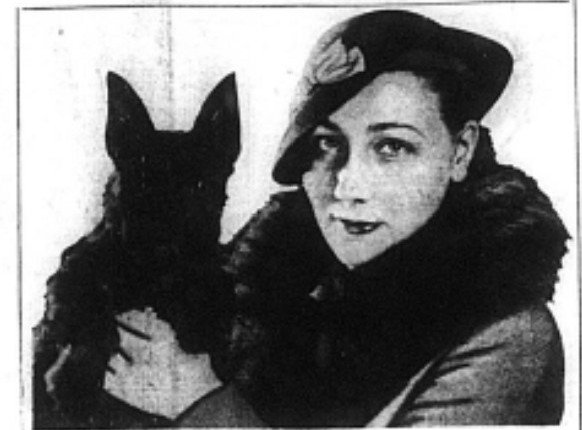
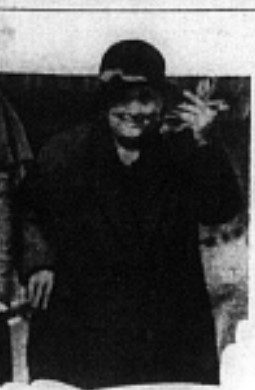
Mrs Alberta Tripp, left, with a friend

The popular newspapers were grateful for the copy provided by the police, and in that second week of August the hunt for the Bow Cinema Murderer dominated the front pages of all the tabloids. In Lowestoft, John Stockwell read the Sketch newspaper with his breakfast, and then told Mrs Tripp he was going to go to nearby Yarmouth for the day. After he’d left, Mrs Tripp went to see her daughter, who ran a newsagents across the road. Mrs Tripp’s daughter showed her John’s picture in the newspaper. After Mrs Tripp had returned home to pick up her glasses, she had a good look at the photograph, and realised that her lodger was the man wanted by the police in connection with a violent murder. Lacking a phone, Mrs Tripp asked her next-door neighbour to ring the police for her. When they arrived, they were able to confiscate the clothes that John had left behind; but the wanted man himself had eluded them.

Later that day, John Stockwell walked into the Metropolitan Hotel in Yarmouth, and asked for a room. When he signed the hotel register, he wrote that his name was J.F. Smith, and that he was from Luton, Hertfordshire. The hotel receptionist, Kenneth Margetson Dodman, thought he recognised ‘Mr Smith’ from the description given in the newspaper. Additionally, he noticed that ‘Smith’ had made a mistake when he was signing in: Luton was in Bedfordshire, not Hertfordshire – something that anyone from Luton would surely know. Keeping his wits about him, Dodman put ‘Mr Smith’ in a room and then rang the police. John Stockwell was arrested by a local police officer at the hotel around 6.30pm. The manhunt which had gripped the nation was finally over.

Kenneth Dodman (left), the receptionist at the Metropolitan Hotel in Great Yarmouth

At Great Yarmouth police station, ‘Mr Smith’ admitted that he was John Stockwell, and also that he had murdered Dudley Hoard. The local police chief put a call through to Scotland Yard, and Chief Inspector Fred Sharpe drove up to Yarmouth that very evening to collect his suspect. On the way back to London on 11 August, Stockwell told Sharpe how he’d committed the crime, where he had hidden the money, and how he had spent the days between 7 and 11 August. Sharpe, not wanting to put Stockwell off, decided not to take any notes in the car. Instead he listened, and wrote up Stockwell’s confession from memory as soon as he got back to the station.

The Metropolitan Hotel in Yarmouth, where John Stockwell was arrested

This decision would later cause some headaches: because Sharpe had not properly cautioned Stockwell, and had not given him the opportunity to check his statement, the information Stockwell had provided in the car could not be admissible in court. For now, though, the police were relieved that they had gotten their man. When Sharpe’s car arrived back at Bow Road police station just before 9pm on 11 August, a great crowd had gathered, keen to catch a glimpse of the Bow Cinema murderer, who until so recently had been living in their midst.  

The Bow Cinema Murder – Forensic Evidence

FeaturedThe Bow Cinema Murder – Forensic Evidence

This is the sixth in a 11-part investigation into the 1934 ‘Bow Cinema Murder’. You can read all entries in the series here. 

Once the police were on site at the Eastern Palace Cinema, they started gathering forensic evidence. This was partially to aid the investigation, but also to start building an evidence base to use if and when the case would go to court. The items which were recovered from the crime scene included a piece of flooring; human hair and samples of bloodstains. After a thorough search of the cinema, the police also recovered the murder weapon: a small axe, or hatchet. This was also handed over for investigation. Forensic investigations were undertaken by the same specialists who also did the post-mortems of the victims of crime: forensic pathologists.

The pathologist initially appointed to the Bow Cinema Murder case was Dr Francis Temple Grey, a retired Royal Navy surgeon and previously employed as pathologist for the Ministry of Pensions. He was in his late 40s in 1934 and had a deep scientific interest in biochemistry. On 8 August, the day after the murder, he presided over the autopsy of Dudley Hoard at Poplar Mortuary. The post-mortem was also attended by Donald Summers, the police surgeon who had attended Hoard immediately after the attack; Dr Normal Brown, who had treated Dudley in St Andrew’s Hospital; and the most famous pathologist in Britain, Sir Bernard Spilsbury.

Dr Temple Grey (left), pathologist assigned to the Bow Cinema Murder

Bernard Spilsbury was a Home Office pathologist and a celebrity. He had made his name during the notorious murder trial of Dr Crippen, where Spilsbury’s expert evidence nailed Crippen’s conviction. Spilsbury was also responsible for the conviction of a host of other notorious killers, from George Smith, the ‘Brides in the Bath murderer’, in 1915; to Patrick Mahon in 1924. Spilsbury was a workaholic and a brilliant orator, which made him successful both as a pathologist and as an expert witness. His reputation remained untarnished during his lifetime, although in recent years some of his assertions, including those on which basis Crippen was convicted, have been refuted.

In 1934 though, Bernard Spilsbury was considered the best pathologist to have on a case. He was specifically asked to attend the postmortem of Dudley Hoard, and undertake forensic examinations, by Norman Kendall, the Assistant Commissioner for Crime at the Metropolitan Police. As Kendall later wrote to the Director of Public Prosecutions, Tindal Atkinson, he considered Temple Grey a ‘notoriously untrustworthy witness’ when it came to giving evidence in court.[1] Kendall was worried that, if the case were to go to court, Grey would potentially make incorrect or unclear statements that may confuse the jury and jeopardize a conviction. To avoid having to call Grey to the stand, Kendall wanted to make sure that Spilsbury was involved in every step of the forensic investigation, so that he could act as a witness instead. Throughout the investigation, the police continued to worry that they had not built a sufficiently strong case, and be on the look-out for anything that may undermine a ‘guilty’ verdict.

There’s no record of how Temple Grey felt about having Sir Bernard Spilsbury watching over his every move. His report of Dudley’s autopsy noted that Dudley had suffered from nine cuts, six fractures, and three brain injuries. It seemed that Dudley got hit on his head from behind; fell onto the carpet; then got up again; and moved with his assailant out of his flat and up the stairs to the cinema balcony, where he eventually collapsed. There were copious amounts of blood on the floors and walls of the flat and cinema which marked out this trajectory. The pathologist took a photo of Dudley’s skull, and drew a diagram to indicate where the cuts and fractures had been found.

When examining the axe, it was found that it mostly contained blood on the back and left-hand side, implying that Dudley and Maisie had been hit with the blunt back of the axe head. Hairs of both Maisie and Dudley were found on the axe; his below hers, which showed that he had been attacked first. It provided irrefutable proof that the axe had been the weapon used in the attack; that both Dudley and Maisie had been attacked with the same weapon and therefore presumably by the same person; and that Maisie’s initial statement on how the attack had panned out matched the evidence. It did not, however, bring the police any closer to catching their killer.

The murder weapon, a small hatchet

DNA was of course completely unknown during the 1930s, so there was no possibility to match any of the blood found in the cinema to either the victims or the perpetrator. Fingerprints were known, and had first been used to successfully convict two murderers in 1905. That case, the murder of a shopkeeper and his wife in Deptford, bore some striking resemblances to the Bow Cinema Murder.[2] Yet as soon as fingerprinting evidence became commonplace, would-be criminals knew to wear gloves. The Bow Cinema murderer had followed this advice too, and fingerprints played no significant role in the investigation. Instead, the police were to rely on the killer’s behaviour after the murder, which was so erratic that it very quickly made them sure they had found the guilty man.


[1] ‘Defendant: Stockwell, John Frederick. Charge: Murder’, CRIM 1/734, National Archives

[2] Colin Beavan, Fingerprints: Murder and the race to uncover the science of identity (London: Fourth Estate, 2002), pp. 1-19

150th blog post!

Featured150th blog post!

In a first for the blog, there are going to be two posts this week – the next instalment of the Bow Cinema Murder series will be published on Wednesday but I wanted to mark the occasion as we are now at 150 posts in total! I started this blog at the beginning of 2021 and have managed to put a post out every week since then. Last year, for the 100th post, I shared some stats about the blog. Those haven’t changed much (although my dive into interwar car ownership has overtaken the Amami shampoo ad as the most popular post) so I thought I’d do something a bit different this time around, and share some great interwar history resources that I draw on a lot. When I have used source materials for a particular posts I’ll always reference them at the bottom, but hopefully this list is useful if you want to explore the period more broadly.

Academic books

As is probably evident, I’ve studied interwar popular culture in an academic context, so I do reference academic sources quite a lot. I appreciate these are not always accessible, but if you are lucky enough to have access to an academic library or similar resource, I would recommend the following:

D.L. LeMahieu – A Culture for Democracy: Mass Communication and the Cultivated Mind in Britain between the Wars (Clarendon Press, 1988)

Judith Walkowitz – Nights Out: Life in Cosmopolitan London (Yale University Press, 2012)

Robert James – Popular Culture and working-class taste in Britain, 1930-1939: A round of cheap diversions? (Manchester University Press, 2010)

Jeffrey Richards – The Age of the Dream Palace: Cinema and Society in 1930s Britain (I.B. Tauris, 2010)

Matt Houlbrook – Queer London: Perils and Pleasures in the Sexual Metropolis, 1918-1957 (University of Chicago Press, 2005)

Lawrence Napper – British Cinema and Middlebrow Culture in the Interwar Years (University of Exeter Press, 2009)

And I’d be remiss not to include my own book: Mara Arts – Interwar London After Dark in British Popular Culture (Palgrave Macmillan, 2022)

Popular books

These books are published by generalist publishers and are therefore easier to get hold of:

Martin Pugh – We Danced All Night: A Social History of Britain Between the Wars (Penguin, 2008)

D.J. Taylor – Bright Young People: The Rise and Fall of a Generation, 1918-1940 (Vintage, 2008)

Marek Kohn – Dope Girls: The Birth of the British Drug Underground (Granta, 2003)

Roy Porter – London: A Social History (Hamish Hamilton, 1994)

Lucy Lethbridge – Servants: A Downstairs View of Twentieth-Century Britain (Bloomsbury, 2013)

Films

Accessing British films from the interwar period can be tricky, and a large number of them are only available by accessing film archives. There are however some good online resources:

The Internet Archive usually has copies of films that are out of copyright.

Youtube can also be a good resource, although the quality of films can be variable.

Within the UK, the British Film Institute has films available on their BFI Player (some free, some paid for) and if you are able to travel to London, you can view lots of films for free in their Mediatheque on the Southbank.

Additionally, there are quite a few films which have been issued on DVD. Naturally, well-regarded or famous films such as Hitchcock’s early works are readily available on DVD. Now-defunct film distributor Network on Air used to supply a wide range of British films on DVD, including many films of the 1930s. Second-hand copies of these should still be in circulation.

Podcasts

The BBC History Extra podcast puts out new episodes nearly every day, and there are a number of past episodes which discuss elements of interwar Britain’s culture and history. Likewise, the Rest is History podcast has some episodes relating to interwar Britain.

A more specific podcast is Shedunnit, which is an independently produced podcast devoted to interwar crime and crime fiction.

For a more academic take, the Institute of Historical Research has a back catalogue of podcasts in which academics discuss their research. A number of them touch on interwar history, such as an episode on the 1926 General Strike.

I hope these resources can provide a good starting point for anyone interested in learning more about interwar Britain. Thank you for your continued support!

The Bow Cinema Murder – the Police Investigation

FeaturedThe Bow Cinema Murder – the Police Investigation

This is the fifth in a 11-part investigation into the 1934 ‘Bow Cinema Murder’. You can read all entries in the series here. 

When Dudley and Maisie Hoard were found, critically wounded, around 8.30am on 7 August 1934, the first police officer on the scene was PC Duncan Mackay. He was patrolling the local area at the time, and was therefore able to get to the cinema quickly. PC Mackay was part of the army of patrolling Bobbies who worked all over London, each walking their regular ‘beat’ so that they could be on hand if anyone in the neighbourhood needed police assistance. After arriving at the cinema, PC Mackay quickly rang his local station for back-up. The Metropolitan Police had divided London in a series of divisions; Bow Road was part of ‘H’ Division, which covered the wider Whitechapel area. There were a few police stations near the cinema – Bow Road station was the closest, but there was also a station at Arbour Square, a short distance away.

Each police division had a team of detectives: plain-clothes officers who were tasked with investigating crimes and tracking down criminals. In addition, there was the Criminal Investigation Department (CID), commonly known as Scotland Yard. This team worked across all of London and specialised in the most difficult crimes, as well as criminal activity that was not confined to one area – for example, during the 1920s Scotland Yard spent a fair amount of time investigating crooked racecourse betting gangs.[1] Working for Scotland Yard was prestigious, as the small team often dealt with high-profile cases.

After PC Mackay’s phone call, the first officers to arrive at the cinema were the detectives attached to ‘H’ Division. Most of these men were born locally, and they would spend many hours over the next weeks to not only catch the murderer, but also put together sufficient evidence to ensure a conviction. In the interwar period, the police’s remit was wider than it is today, and the police took on some tasks which would now sit with the Crown Prosecution Service. Detectives were responsible for ensuring that all the evidence fit together and made a convincing court case. This meant that even after a criminal was caught, they would still have significant work in (re)interviewing witnesses, tying up loose ends, and getting additional expert opinions.

The detectives who were the first to arrive at the cinema were Detective Sergeant James Rignell, a 34-year old born in Poplar who had joined the Met shortly after the First World War; Detective Inspector Henry Giddins, who had only been promoted to this rank less than a week before the murder took place; and Detective Sergeant Claud Smith, who was born in Mile End and also joined the police immediately after completing his First World War service. Between them, they started a physical investigation of the murder scene and questioned the cinema staff who had started to arrive for their shifts. James Rignell went to the hospital and took the very first statement from Maisie Hoard.

One of the detectives, possibly James Rignell

Very quickly, a decision was made that Scotland Yard needed to be involved in the investigation. The attack had been brutal, and DI Giddins was very new to his role. Around 3pm on the same day, Detective Inspector Fred ‘Nutty’ Sharpe of Scotland Yard arrived at the cinema. He would be in charge of the investigation from that point onwards, leading the ‘H’ Division team and drawing on staff in other parts of London as needed. As it transpired, the investigation would lead the police out of London to the Norfolk/Suffolk borderlands, and Sharpe’s position in the CID gave him the authority to instruct police forces outside of the capital, too.

Frederick Sharpe, from his memoir Sharpe of the Flying Squad (1938)

Fred Sharpe had joined the Metropolitan Police in 1911, and spent most of the first decades of his police career chasing criminal gangs, pickpockets and car thieves. In his memoirs, which he published in 1938 after his retirement, he advocated that police detectives should cultivate friendly relations with professional criminals. He argued that there was a reciprocal relationship and a level of respect between criminals and the police, in which both groups knew the rules of the game they were involved in. This approach got him in hot waters after his retirement, when Sharpe himself came under police investigation for engaging in bookmaking activities.[2]

Murder, however, appears to have been a separate category for Sharpe. He devoted an entire chapter to the Bow Cinema Murder in his memoirs, in which he referred to the murder as ‘one of the most savage a man has ever committed.’[3] He underscored this supposed savagery by describing his physical reaction to the crime scene: “The flat itself and the hall presented a horrible and ghastly scene, showing that the utmost violence had been used in the attack on this unfortunate couple. (…) the sight of that room and the passageway nearly made me sick.”[4] Sharpe ensured that the details of the crime scene were captured by ordering a police photographer to attend the scene on the day of the murder. These photographs show copious amounts of blood on the staircase where Dudley was found, as well as the blood-soaked bedsheets which Maisie had left behind.

At the close of 7 August, the police did not yet have any clear leads. The staff who had been arriving at the cinema had not been able to share much useful information. Most of the crimes they investigated were committed by criminal gangs, and this guided their initial thinking. Newspaper reports stated that the police were speaking to their contacts in criminal gangs to gather information – using that network which Fred Sharpe often relied on.[5] Police officers remained stationed at the cinema overnight, and some materials had been taken away for forensic examinations. It was not until the next day, however, that a clear suspect would emerge.


[1] Heather Shore, ‘Criminality and Englishness in the Aftermath: The Racecourse Wars of the 1920s’, Twentieth Century British History, vol. 22, no. 4 (2011), 474-497

[2] ‘Ex-Chief Inspector Sharpe of the Flying Squad: bookmaking activities under the name of Williams’, MEPO 3/759, National Archives

[3] Frederick Sharpe, Sharpe of the Flying Squad, (London: John Long, 1938), p. 126

[4] Ibid., p. 127

[5] ‘“Yard” reconstructs the crime,’ Daily Herald, 8 August 1934, p. 2

The Bow Cinema Murder – the East End family

FeaturedThe Bow Cinema Murder – the East End family

This is the fourth in a 11-part investigation into the 1934 ‘Bow Cinema Murder’. You can read all entries in the series here. 

When John Stockwell decided to attack and rob his employer, he was living as a lodger with a local East End family. He had met Eliza Roake, the head of the family, through the charitable activities she undertook for her Church. After John lost his place in the Salvation Army Boys Home after being convicted of theft, Ellen took him in. After the events of 7 August 1934, their association with John drew this poor but respectable family into a police investigation and a tabloid press sensation.

Ellen Eliza Roake was born Ellen Hoare in 1876; when she was 26, she married Henry George Roake who was five years her junior. The couple had five surviving children: Nellie, born in 1903; William, born in 1906; Eva, born in 1909; Frederick, born in 1913; and Violet, born in 1915. In addition, there were at least two other sons who did not survive past early childhood. All the children were born in Bromley-by-Bow, where Ellen and Henry settled after their marriage. Henry worked as a railway porter in nearby Liverpool Street Station.

Ellen Roake. This photo appeared in the Daily Herald on 12 Sept 1934

In 1926, Henry passed away; five years later, William and Eva both married and moved out of the family home on Empson Street in Bromley. The space that was freed up by their departure is perhaps one of the reasons why Ellen felt able to invite John Stockwell to move into the family home in early 1932.

The Empson Street house was considered small even at that time; the police inspector investigating the murder of Dudley Hoard commented on the house’s small size in one of his reports. There was only one bedroom, which Ellen shared with Nellie and Violet. Beyond the bedroom, there were no other rooms on the house’s first floor. The ground floor consisted of a sitting room, kitchen and scullery. John and Frederick had to make up their beds in the sitting room floor every night. The toilet was attached to the back of the house and needed to be accessed through the garden.

Nellie Roake, who was around 30 at the time of the murder, worked as a ‘chocolate finisher’ in Millwall, an adjacent neighbourhood. The manufacture of chocolates and sweets was an industry that typically employed women, who were believed to be better suited to the detailed work. In addition to her job, Nellie also took care of part of the household chores including cooking meals. She was engaged to William Hilsdon, a labourer who lived around the corner from the Roakes with his parents. William was also born in Bromley; also had a number of siblings; and his parents were also working-class. Although he and Nellie moved in together (with William’s mother) some time in the late 1930s, they did not get married until 1953, after Ellen Roake passed away. There does not appear to have been any bad blood between Ellen and William, however; on the night before the murder on Dudley Hoard in 1934, William spent the evening at the Roake’s house playing cards with the family until nearly midnight.

Unlike his elder sister, Frederick Roake appears to have provided less support to the family. At the time of the murder, he was unemployed due to a knee injury for which he was receiving outpatient treatment at St Andrew’s hospital, where Maisie and Dudley were also taken after the attack. Beyond that, Frederick seems to have spent considerable time loafing around the neighbourhood; he was able to immediately go over to the cinema once news of the attack broke. Frederick and John were not friendly; after John’s arrest, Frederick reported that he usually did not have ‘a lot to say’ to the other man. Despite sharing a bed together every night, the pair appear to have tried to avoid one another as much as possible. Frederick had a girlfriend, Henrietta, who was also born locally. They married in 1938 and stayed in the East End, where Frederick ended up working as a transporter of goods on horse cart.

Violet Roake was the youngest of the family, and the one most closely involved with John Stockwell. They were of the same age, and had been going out from around 1931, when they were both 16. Violet worked as a biscuit packer in a Bethnal Green factory; for many young working class women, light factory work had replaced domestic service as the career of choice. Every morning, John walked Violet to the bus stop around 7.30am. Her shifts started at 8am and finished at 6pm. Because John’s hours at the cinema did not finish until 11pm, most days the only time they had together was that half hour in the morning. The exception was Tuesday, when John was off work and they could do something in the evening. If they were at home, it was likely that there were other people around, and the small size of the house would have afforded them no privacy.

Violet Roake. This photo appeared in the Daily Herald on 14 November 1934

Until the murder, Violet had assumed that she and John would be getting married some day. She eventually married a naval officer in 1939 and moved down to Portsmouth with him. They had a son in 1939 and a daughter in 1949. Unlike most other participants in this story, Violet left the East End definitively when she was in her early twenties. It is possible that her association with a murderer, however unwitting, left a lasting mark on her reputation in the local area.

The Roakes were a typical East End family, with blue collar jobs, little money, a small living space, and a lot of family and friendship ties to the local area. Despite their small house, Ellen invited John to live with them when he became homeless, which speaks to her civic-mindedness. If it had not been for their involuntary involvement in the story of the Bow Cinema murder, they would have been absorbed in history without a trace. The case no doubt had a lasting impact on Violet in particular, whose expectations for her life were radically changed as a result of the case. As part of the fall-out, the family were exposed to police investigators, which came onto the scene within minutes of the crime being discovered. The next blog post will unpick who got involved in the police investigation, and how they approached the East End community in which the crime had taken place.

The Bow Cinema Murder – the Killer 

FeaturedThe Bow Cinema Murder – the Killer 

This is the third in a 11-part investigation into the 1934 ‘Bow Cinema Murder’. You can read all entries in the series here. 

So who was the man who rang the Hoard’s doorbell on the morning of 7 August 1934 and attacked Dudley and Maisie with such deadly consequences? The initial police investigation assumed that the crime was committed by one or perhaps two criminals, who potentially allowed themselves to be locked into the cinema the night before. Investigators were reported to be questioning known criminals in the East End for clues.[1]

The truth was somewhat different, and closer to home. The attack on Dudley and Maisie was committed by a nineteen-year-old employee of the Eastern Palace Cinema: John Frederick Stockwell. John had only worked at the cinema for a few months, after being hired by Dudley. As an attendant, it was his duty to check tickets and show patrons to their seats. Like many neighbourhood cinemas at the time, the Eastern Palace operated on a ‘continuous performance’ basis, meaning that once the first screening of the day started, screenings continued on a loop until the end of the day. Patrons could show up at any time and stay as long as they liked. A crew of male and female attendants were therefore constantly occupied with letting people in and out of the auditorium.

Like many people in the East End, John Stockwell came from an impoverished background – but he was not brought up locally. He was born on 2 March 1915 near King’s Cross. His father had died at the front at Mons before John was even born. His mother re-married, but died in 1926 when John was 11. John had a brother, Horace, who was three years’ his senior – by the time the men had grown up they were no longer close. After his mother’s death, John went to live with an aunt, Elizabeth Brown. Because John’s father had died in the war, Elizabeth received a financial contribution from the state for John’s upkeep. Elizabeth decided around 1930 to move away from central London, and out to Bromley in Kent.

For the teenage John, who was no longer required to attend school, the change from Kings Cross to Bromley was not beneficial. Elizabeth reported that John no longer accepted her as a parental authority; he appears to have been out and about with a group of other young men. Eventually, Elizabeth decided she could no longer support John living with her, and he moved to a Salvation Army Boys Home in Bow Road some time in 1930. These homes were designed exactly for people like John: young men who lacked family or community support. They intended to give these men the skills to get employment and become independent. The SA arranged for John to get a job at a cloth manufacturer at Barbican. During his time there, John stole some cloth; he was caught and appeared before the Magistrate’s court in December 1931. John was sentenced to two year’s probation, meaning he had to meet up with a probation officer regularly.  

The Salvation Army had a zero-tolerance policy when it came to criminal activity, so John lost his lodgings. He had met, through the Army’s church activities, a local widow, Ellen Roake, and had become particularly close to Eliza’s youngest daughter Violet. Ellen agreed to take John on as a lodger, and he moved into the tiny Roake family home in early 1932. John and Violet became an official couple. After a short period working for a pastry chef, John was unemployed until he found the job at the Eastern Palace Cinema, which was only a 15-minute walk from the Roake’s home. One of the cinema’s other attendants, Charles Whitnell, lived practically next door to the Roakes.


As an attendant, John earned 32 shillings and sixpence a week. He paid 15 shillings a week for his board and lodging, leaving him with less than £1 a week for any other expenses. At the time of the murder, he did have a savings account with the Post Office, but it contained only 30 shillings (£1.50). Clearly, John had always lived in poverty. The nearly £90 that he stole from the cinema safe after attacking Dudley and Maisie was probably more money than he had ever seen together in his life; it was certainly more than he could ever imagine to save up himself. By August 1934, John and Violet had been going out for several years, but he could probably not imagine how he would ever make enough money to enable them to get married and start their own family.

He also had virtually no contact with his family at this point, and no social community to fall back on; he’d been removed from the community in King’s Cross in which he had grown up. The East End neighbourhood in which he lived from 1930 was one in which family ties counted for a lot, and he was perceived as an outsider. During the police investigation, his colleagues reported that they had found John odd, and his previous conviction for theft was known and made people suspicious of him.

None of these things justify his attack on the Hoards, but they do illustrate that the lack of structural social care in interwar Britain left individuals vulnerable. If you did not have a strong personal support network, you could very quickly find yourself in a situation that felt interminable. Once John committed the theft of cloth in 1931, what little social support he had been able to count on was also removed. In addition, rigid class boundaries made it even less likely for someone in his position to materially improve his circumstances. It is understandable, then, that someone of his young age, with little adult supervision to guide him, came to the conclusion that the only way to get ahead was to break the rules and commit a theft.

Once John had committed his attack and stolen the money, he managed to leave the Eastern Palace Cinema unseen. Tuesday was his weekly day off work. That evening, when Violet finished her shift at the Kearley & Tonge biscuit factory in Bethnal Green, John treated her to a trip to the Stoll cinema in the West End. Unbeknownst to Violet, he used part of the stolen money to pay for the tickets. On the way to the cinema, they discussed Dudley Hoard’s murder, as it was splashed over the evening papers. It would be the last evening they spent together, as the next day John used his stolen money to escape London, triggering a multi-day manhunt that captured the attention of the nation.


[1] ‘“Yard” reconstructs the crime,’ Daily Herald, 8 August 1934, p. 2

The Bow Cinema Murder – the Victim

FeaturedThe Bow Cinema Murder – the Victim

This is the second in a 11-part investigation into the 1934 ‘Bow Cinema Murder’. You can read all entries in the series here.

One of the effects of a well-publicised murder investigation is that it can put ordinary people into the press spotlight. This was as true in the interwar period as it is today. The Bow Cinema murder was briefly on the front pages of all major newspapers, and the victims, the perpetrator, and the people around them all got dragged onto those front pages too. This can make a murder story a valuable source for the historian: it highlights and preserves the stories of ordinary people as they are put into extraordinary circumstances.

Dudley Henry Hoard, the victim of the Bow Cinema Murder, was one such an ordinary person. If not for the extremely violent end to his life, it’s unlikely his name would ever have entered into the annals of history. He was born in Wandsworth, south-west London, in 1892. His family moved to Croydon when Dudley was a child, and his parents remained in that area. Dudley had an elder sister, Dorothy, and two younger sisters, Avery and Winifred. His father, William, was born in Devon; his mother Mary was from Chelsea in London. Dudley’s father worked as a clerk, indicating the family were in the lower middle class. This is also borne out by the fact that Dudley attended the independent Whitgift School in Croydon.

By the time he was eighteen, Dudley considered himself to be an actor. At 5 ft. 9.5in he was quite tall, and he may have cut a dashing figure on stage. According to his father, Dudley left school to take part in a production at Sadler’s Wells theatre, and toured the country as part of a travelling theatre group. At the same time, he was interested in cinema, which was becoming increasingly popular. Dudley briefly ran his own cinema, the Hippodrome, in Sutton (near Croydon) in the early 1910s.[1]

During the War, Hoard served as a Private in the London Regiment. He did not have a distinguished war record; the most the newspapers can say about it after his death is that he served in France and Greece, and got gassed in an enemy gas attack.[2] After the war he returned to repertoire acting, including a stint working for the Melville Brothers, who were part of a theatre producing dynasty.

At some point, Dudley met Maisie Tait, a native of Newcastle who was close to him in age and also an actor. According to Dudley’s father, the pair met when they were in their late teens; however, they did not get married until 1933, when Dudley was 41 and Maisie was 38. Details of Maisie’s early life are difficult to trace; she was also known as Maisie Robson, and it is not clear whether either Tait or Robson was her birth name, or whether both were assumed names. One thing that is certain is that Maisie had a daughter from a previous marriage; after the attack in 1934, this adult daughter came to visit Maisie in hospital. Her existence may be what stopped Dudley and Maisie getting married any sooner.

Around the time of their wedding, Dudley apparently decided to give up the touring life and to return to the cinema. In 1933, he got his first appointment as cinema manager in London, at the Brittania Picture Theatre in Camden. By the 1930s, cinemas had become enormously popular in Britain, and the industry had professionalised significantly since Hoard’s last foray into cinema management in 1911. The average cinema had upwards of a dozen staff members, and cinema managers were required to ensure that all operations went smoothly; staff were trained appropriately; and the cinema drew as many patrons as possible. Marketing was a significant part of the cinema manager’s role. Trade magazine Kinematograph Weekly highlighted in each issue the innovative and successful marketing stunts that managers up and down the country came up with to draw in audiences.

At the same time, cinemas became increasingly consolidated into chains, such as Odeon and ABC. Within the chains, the patrons’ experiences were increasingly homogenised. Rather than being rewarded for originality and innovation, managers in chains were expected to comply with central directives on how their cinemas should be managed. Dudley never worked for a chain cinema; at the Brittania in Camden he had to make two men redundant to save the cinema money. These men had families to maintain, and they threatened Dudley after he had fired them. This probably was one of the reasons why Dudley swiftly moved on to work at the Cinema House in Oxford Street and then, finally, the Eastern Palace Cinema in Bow.

These three posts in the space of 18 months indicate how fast-moving and insecure the work of cinema management was. For Dudley and Maisie, the job at the Eastern Palace was a step up, as it came with their own private apartment (although they had to pay rent for its use). With it, though, they arrived into a close-knit East End neighbourhood, where many of the staff were neighbours or even family members of one another. The Hoards were outsiders; and as it turned out, so was the man who attacked them.


[1] ‘London Manager Murdered’, Kinematograph Weekly, 9 August 1934

[2] ‘Actor and Producer’, Daily Mirror, 8 August 1934, p. 2; ‘London Cinema Outrage’, Evening Standard, 7 August 1934, p. 2

The Bow Cinema Murder (1934)

FeaturedThe Bow Cinema Murder (1934)

This is the first in a 11-part investigation into the 1934 ‘Bow Cinema Murder’. You can read all entries in the series here.

This blog is no stranger to interwar murder stories. Over the next ten weeks, posts will investigate one 1934 murder case in depth. Unlike some of the other cases covered previously, this murder is no longer well known – it has not been adapted in any novels, plays or films (to the best of my knowledge) and did not become a byword for evil. At the time it was committed, however, it caused a media storm and thrust a group of working-class East Enders into the limelight. It was the Bow Cinema Murder.

The murder took place on Tuesday morning, 7 August 1934, at the Eastern Palace Cinema in Bromley-by-Bow, in the East End of London. The Eastern Palace cinema was a neighbourhood cinema, co-owned by two local Jewish professionals. It was located on the busy Bow Road, in between a café and a general store. It could seat around 1000 patrons in its auditorium and balcony, where audiences could enjoy the ornate (if somewhat shabby) ‘Oriental’ decorations on the walls.

The facade of the Eastern Palace Cinema. This photo appeared in the Daily Express the day after the murder

The day-to-day management of the cinema fell to 41-year-old Dudley Henry Hoard. As part of his role, Dudley and his wife Maisie were required to live in a flat adjacent to the auditorium – the lease of the building required that it was partially used for domestic occupancy. Dudley got the cinema manager job in March 1934, and he and Maisie moved in a few weeks later. It was the first time since their wedding in spring 1933 that they had their own flat; they had previously been staying with Dudley’s parents in Croydon.

On the morning of 7 August, Dudley and Maisie were sleeping in after a busy Bank Holiday weekend. Ordinarily, one of Dudley’s first tasks every day was to deposit the cinema’s previous day’s takings at the Midland Bank on Mile End Road. Due to the banks having been shut on the Bank holiday Monday, there were now three days’ worth of ticket earnings in the safe in Dudley’s office, one floor below the flat. For the Eastern Palace, the Bank holiday weekend had resulted in total takings of 89 pounds, 5 shillings, and tuppence. By comparison, Dudley earned about £5 a week as cinema manager, and he was the best-paid member of staff in the cinema. Even for him, the nearly £90 in the safe represented around 10 months’ worth of wages.

Around quarter to eight, someone rang the door of the flat – not the doorbell at the cinema’s entrance, but the door of the flat specifically. Dudley quickly put on some trousers over his nightshirt and went to open the door. Maisie had only half woken and was about to doze off, when she heard Dudley shout out. When Maisie walked into the living room, she saw a man standing over her husband, wielding a hatchet. Dudley had a head wound and was trying to fend off the other man. Maisie shouted out to the attacker, a young man. He then turned to her and hit her over the head with the hatchet – she blacked out immediately.

About thirty minutes later, the cinema’s regular team of cleaning women arrived for their morning shift. These three women came in six days a week to clean and tidy the cinema before the first screenings started. Because they arrived hours before any of the other staff, the head cleaner, Mrs Emily Brinklow, had her own set of keys. She let herself and her colleagues in, and they started to get their cleaning materials out. Emily noticed that the post and milk, dropped by the milkman, had not yet been taken upstairs by either Dudley or Maisie. This did not worry her unduly; she would bring them up herself in a minute. Before she could do so, a scream ripped through the building. Nellie Earrey, one of the other cleaners and sister to one of the cinema’s projectionists, had found a heavily injured Dudley Hoard on the staircase leading to the auditorium balcony. He was covered in blood, as were the walls and the staircase he was on. Emily rushed to the flat and banged on the door; after a short while, Maisie opened it. She, too, was covered in blood, and seemed completely dazed.

Nellie ran out onto the street, where a passerby quickly alerted the local Bobby who was patrolling the area. PC Mackay swiftly went over to the cinema and tried to provide emergency aid, as well as alerting his local police station by telephone. The divisional surgeon (the police doctor) is on the scene quickly, as he was still at his home further down Bow Road when the station officer rang him. He too provides emergency aid, and arranges for both Dudley and Maisie to be transported to the nearby St Andrews hospital. They arrive shortly after 10am. Although Dudley is immediately examined and treated by multiple surgeons, the fractures to his skull are too severe. He dies at 3.07pm, without regaining consciousness.

The police know that they now have a murder case on their hands. Maisie is less severely injured, but unable to give more than a brief, confused statement before she needs to rest. Detectives attached to the local police department, known as ‘H’ Division, start questioning all the cinema’s staff as they arrive for their shifts. Most of them live very close to the cinema, and they are aware very quickly that something has happened. The police realise that the cinema’s safe has been opened by the keys which would normally be carried around by Dudley, and that the full weekend’s takings have been stolen. They have a victim and a motive, but not yet a clue as to the killer’s identity.

Featured

The Poplar Rates Rebellion (1921)

In 1921, a group of thirty Labour councillors of the London Borough of Poplar were imprisoned as a result of their approach to poor relief in the borough. This almost forgotten episode, known as the Poplar Rates Rebellion or Poplar Rates Revolt, highlights the fraught relationships between national and local politicians in interwar Britain, as well as the diverging approaches to how poverty should be treated.

The Labour Party was founded in 1900 and it grew steadily in popularity in the first decades of its existence. The Party primarily targeted working-class voters. Two extensions to the franchise helped Labour gain more votes and seats in parliament: the 1918 Representation of the People Act gave the vote to all men over 21, regardless of their income or background. It also gave the vote to women over 30 who met a property qualification. In 1924, Labour delivered its first Prime Minister, Ramsey McDonald. In 1928 the vote was given to all men and women over 21, leading to the 1929 general election being dubbed the ‘flapper election.’  

For some in the Conservative Party, the extension of the franchise to include ‘the poor’ risked corrupting democracy. If those from poor backgrounds were allowed to vote, they argued, politicians could in effect ‘bribe’ voters by promising high rates of poor relief.[1] As historian Liam Ryan has pointed out, this argument echoes Victorian values which equate poverty with ‘a lack of the moral qualities needed to sustain independence in society.’[2] The actions of the Poplar Labour Party in 1921 would serve to evidence this argument.

In addition to the national party, Labour was active at a local level. The party controlled 34 out of 85 local authorities in London for at least part of the interwar period.[3] Poplar was one of London’s poorest boroughs at this time: in 1932, nearly a quarter of residents lived below the poverty line.[4] By focusing on providing generous poor relief, the Poplar Labour Party was able to build up a sold voter base even before the First World War.[5] The local councillors were themselves from the East End and from working-class backgrounds, which further embedded them in the community.[6]

Immediately following the First World War, the Poplar Labour Party decided to implement an extensive, and expensive, poor relief programme including a minimum wage of £4 a week for municipal workers. Such a local initiative had to be funded from ‘rates’, taxes on property levied on local inhabitants and businesses. A proportion of the rate income was for the local council, but some of it was supposed to be passed on to fund the London County Council, the police, and the Water Board.

Due to the high levels of poverty in the area, rate income was low, and rates could not be raised without harming the local community. When an application for financial support from the national government was denied, the local party refused to collect the proportion of the rates that was supposed to fund London-wide initiatives.[7] When the council ignored a court order to levy the rates, almost all the councillors were arrested and sent to prison for contempt of court – the men to Brixton and the women to Holloway. They remained imprisoned for six weeks, during which they received much popular support.

The Poplar Rates Protest gave rise to what became known as ‘Poplarism’ – ‘a polemical epithet used by Conservatives to refer to high-spending, left-wing poor law guardians in the 1920s.’[8] The leader of the revolt, George Lansbury, who had been a Labour MP between 1910 and 1912, returned to Parliament in 1922 and became leader of the Labour Party from 1932 to 1935. He remained on the left of the party for the rest of his career. The Conservative governments of the interwar period eventually abolished local poor law boards, which prevented a repeat of the Rates Rebellion.[9] Ultimately, though, it became accepted at both sides of the political aisle that offering poor relief did not equate to political corruption.


[1] Liam Ryan, ‘Socialism and corruption: Conservative responses to nationalisation and Poplarism, 1900–40’, in The many lives of corruption: The reform of public life in modern Britain, 1750-1950, eds. Ian Cawood and Tom Crook (Manchester: Manchester University Press, 2022), 239-258, (248)

[2] Ibid.

[3] Dan Weinbren, ‘Building Communities, Constructing Identities: The Rise of the Labour Party in London’, The London Journal, vol. 23, no. 1 (1998), 41-60 (41)

[4] Gillian Rose, ‘Imagining Poplar in the 1920s: contested concepts of community’, Journal of Historical Geography, vol. 16, no. 4 (1990), 425-437 (427)

[5] Weinbren, 45

[6] Rose, 432

[7] Ryan, 248

[8] Ibid., 240

[9] Ibid., 254

The Woman from China (1931)

FeaturedThe Woman from China (1931)

As has been covered on this blog before, in 1927 the British Government adopted the Cinematograph Films Act, a legal measure which prescribed a minimum volume of British-made films which each exhibitor had to show. It was no longer possible for a cinema to solely show Hollywood films. The intention of the Act was to boost the British film industry; its unintended consequence was that American studios set up cheap studio contracts in Britain and started churning out low-quality films which became known as ‘quota quickies’.[1]

Shortly after the Act was passed, Britain started transitioning to sound film, with the earliest ‘talkies’ with continuous sound appearing in 1929/1930. The transition was rapid, with sound film becoming the norm within just a few years. Yet for the ‘quota quickie’ industry, sound film could be an expensive business. It was generally the aim of American studios to shoot their British films as cheaply as possible, often for as little as £1 per foot of film.[2] Shooting sound film required additional technology such as microphones, and also forced on-set shooting in the early years, as location shooting was too noisy and complicated. It is not surprising, then, that quota quickie producers continued to make silent films into the early 1930s.

One of these is The Woman from China, which was made in 1930. According to Steve Chibnall, the film was produced in a rush. Under the 1927 Act, the ‘quota year’ ran from 1 April to 31 March, meaning that by 31 March each year exhibitors had to be able to evidence that they had shown the appropriate proportion of British films in the preceding twelve months. In January 1930, the major American studio MGM commissioned two British producers to create a film by the end of March that year. The result was The Woman from China, for which shooting and editing was completed within four weeks, with a half-finished script.

The final scenes were shot five days before the scheduled trade show, and director Dryhurst was obliged to double as editor with the help of one young assistant. The two worked ninety hours without sleep to meet the deadline, although the first of the two shows as lacking the final reel.[3]  

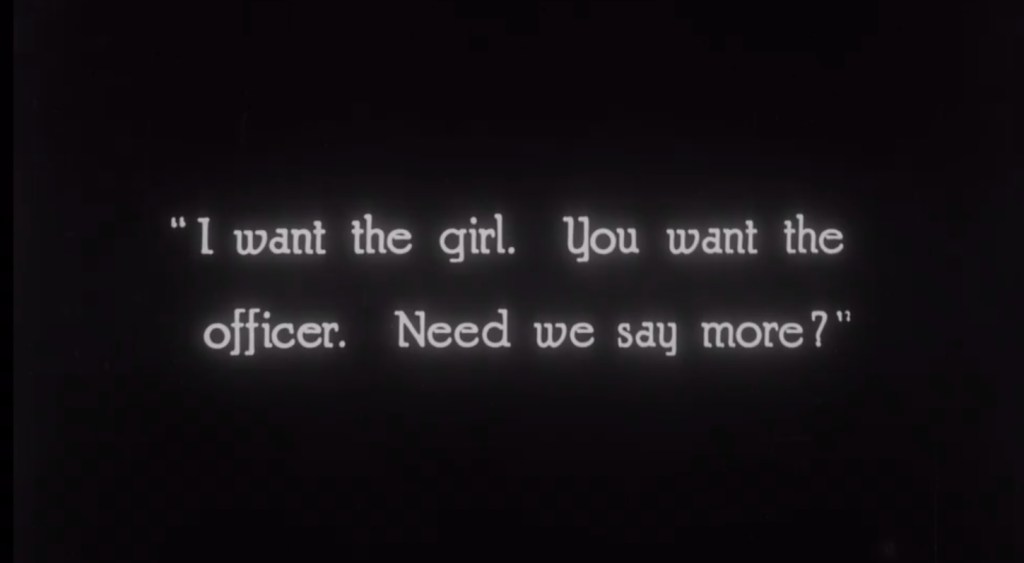
Considering those circumstances, The Woman from China can be considered a fairly accomplished film from a technical perspective, although it perpetuates many obvious and damaging stereotypes in its narrative, staging and costuming. The plot is one familiar from films of this period: a young secretary and a naval officer are engaged, but their relationship is thwarted by a mysterious British woman who has recently arrived from China, and who is in love with the naval officer. The ‘woman from China’ is being blackmailed by a Chinese Svengali, Chung-Li, who in turn wants to marry the secretary. The Chinese man directs his henchmen to kidnap both the officer and the secretary, and proceeds to emotionally torture them until they can break free. The ‘woman from China’ has a change of heart and sacrifices herself to save the naval officer; the Chinese man and his henchmen are killed; and the original couple are able to get away unscathed.

Frances Cuyler and Tony Wylde as the protagonists in The Woman from China

There was already an established history of racist depictions of Chinese characters in popular culture in Britain. The most successful proponent of this was pulp writer Sax Rohmer, who started his ‘Fu Manchu’ series of books just before the First World War. In these books, a Chinese evil mastermind is working to reinstate China as a superior power. Fu Manchu is associated with Limehouse, which at that time was London’s Chinatown. The Woman from China acknowledges its debt to these earlier pulp novels by a character noting that Laloe Berchmans, the woman who has made a deal with Chung-Li, is ‘like a character from an Edgar Wallace novel.’

Julie Suedo as ‘the Woman from China’ and Tony Wylde in The Woman from China

Chung-Li is played by white British actor Gibb McLaughlin in yellowface. The second most prominent Chinese character, an anonymous ‘Chinaman’, is played by Japanese actor Kiyoshi Takase. The Woman from China incorporates such racist tropes as Chung-Li having pointedly filed fingernails; leering after the secretary; and working to increase China’s power in the world. (I’ve deliberately not included any stills from the film featuring McLaughlin in this post as his costume and appearance throughout is offensive).

Chung-Li proposes his deal to the woman under his control

Although The Woman from China may appear to be a good example of a 1930s British film that is best forgotten about, it also allows us to explore the conditions of film production during this volatile period of the British film industry; contemporary portrayals of race; and a late example of a British silent film which includes on-location shooting. Its preservation allows us to appreciate the full range of British film output of this period, and to engage with the challenging legacy of racial discrimination which was pervasive in Britain during the interwar years.

Readers based in the UK can watch The Woman from China for free on the BFI Player.


[1] Steve Chibnall, Quota Quickies: The Birth of the British ‘B’ Film (London: BFI, 2007), p. 4

[2] Ibid., p. xii

[3] Ibid., p. 19

A Week in Whitechapel (1933)

FeaturedA Week in Whitechapel (1933)

In early 1933, international politics was increasingly tense, with Mussolini having overseen a Fascist regime in Italy for over 10 years, and the inexorable rise of Hitler and the National Socialist Party in Germany. It had become increasingly clear to Britons that anti-Semitism was a key tenet of Nazism.

In the run-up to the March 1933 German federal election, which Hitler hoped to use to reach a majority in parliament, the Daily Express printed a 6-part series of articles headlined ‘A Week in Whitechapel.’ Although the Express was in no way a left-wing paper, it used this series of articles to shine a positive light on Whitechapel’s Jewish community. Although the articles are not labelled as explicitly political, and present as ‘human interest’, they were printed for six consecutive days on page 3 of the paper, a prominent position otherwise reserved for national and international news reports.

The headline of the first article, which appeared on Monday 27 February 1933, states ‘Jewish Youth Looks Westward’. Although the body of the article makes it clear that this is meant to be London’s West End, the headline holds the double connotation of Jewish people looking to Western Europe as the basis for its future. According to the article, Jewish people have ‘found sanctuary’ in Whitechapel after persecutions in ‘Europe’.[1] A young Jewish woman is described as ‘lusciously pretty’ and dressed ‘magnificently.’ Although the young Jews are presented as dressing slightly more loudly than British (white) people, the overall tone of the article is not derogatory and the Jewish woman is presented as desirable.

The second article, printed the next day, champions a Jewish business owner who, according to the article headline, had a ‘£5,000 business built up in four years – Photographic studio opened with a capital of 6s 6d.’[2] In contradiction to the anti-Semitic stereotype of money-obsessed Jews, this anonymous photographer is held up as a savvy businessman. The man argues that ‘The Gentile [a non-Jewish person] works for an old-age pension: the Jew to be his own master.’ The reporter has to conclude that the Jewish photographer has made the better deal – he has £5,000 in capital, whereas ‘the old-age pension is only 10s a week.’[3]

On the same day, the front page of the Express was given over to a large report on the Reichstag fire, which had occurred the previous night. Historians agree that this fire, for which Hitler blamed Communists, was a key event in the establishment of Nazi power. It allowed Hitler to argue for emergency powers, which allowed him to order the arrest of thousands of Communists, only days before the federal election. The Daily Express’s juxtaposition of this story with the positive depiction of Jewish Londoners in the ‘A Week in Whitechapel’ series highlights how much attitudes towards Jewish people were contested in this period.

The series of reports continues on 1 March with a description of a Jewish wedding, which was again positive although it followed a tried-and-tested tabloid reporting method by highlighting the custom of shattering glass: this would have appeared unusual to any readers not familiar with Jewish traditions. Nevertheless, the article is not exploitative in its tone. For the fourth instalment, the reporter visited a Jewish pub. Again, a potential stereotype – Jewish people eat a lot of food – is touched on but turned into a positive: ‘Everywhere was food, for the Jew eats as he drinks, and so surpasses a Gentile in sobriety.’[4]

For the penultimate article, the reporter attended a Christian mission attempting (and failing) to convert Jews, and a synagogue. The rabbi is described as ‘a marvel of learning’ and the Jewish school as a place where ‘the seed is lovingly sown. The shoot is exquisitely nurtured.’[5] The Christian mission, by contrast, is described as providing free healthcare to the poor only as long as they attend a Christian gospel service.

Only for the final article, printed on Saturday 4 March, the day before the German elections, does the series touch on the other thing that made Whitechapel famous: the Jack the Ripper murders.[6] This is the only of the articles which does not focus on the Jewish community, instead quoting an East End housewife whom the author encountered. Several pages further in the same paper, a Sidney Strube cartoon was very clear about what he thought about the German elections – a shaking old man is intimidated and led up to a ballot box placed under a guillotine.[7]

A Sidney Strube cartoon, printed in the Daily Express, 4 March 1933, p. 8

Although the Daily Express was not as politically explicit as some of its competitor papers like the Daily Mail or the Daily Herald (on the right and left of the political spectrum, respectively), it commissioned and printed a series of articles which spoke positively about the Jews. At a politically fraught period for Jews in Europe, this indicates that the paper’s editors were willing to quietly counteract the anti-Semitic sentiments that were also becoming more prominent in Britain, following the founding of the British Union of Fascists the year before.


[1] ‘Jewish Youth Looks Westward’, Daily Express, 27 February 1933, p. 3

[2] ‘£5,000 Business Built Up in Four Years’, Daily Express, 28 February 1933, p. 3

[3] Ibid.

[4] ‘The Landlord of the Aspidistra has a Plan to Settle the Irish Problem’, Daily Express, 2 Mach 1933, p. 3

[5] ‘The Definition of Hope – A Mission to the Jews’, Daily Express, 3 March 1933, p. 3

[6] ‘Along the “Ripper’s” Route’, Daily Express, 4 March 1933, p. 3

[7] ‘Vox Populi’, Daily Express, 4 March 1933, p. 8

Featured

Suburban dreams

London underwent massive suburban expansion in the interwar period. The interwar period saw a combination of an increase of Londoners who were looking for suitable living space; an increase in disposable income and a reduction of housing costs; and a greater availability of accessible building plots around the outskirts of the city. These factors led to a veritable suburban ‘boom’ during the 1920s and 1930s, at the end of which London’s size had increased threefold and the population of its suburbs had grown by 2.5 million compared to the start of the century.[1]

The first London suburbs were built by private investors during the nineteenth century, when the introduction of tramcars and other modes of public transport opened up areas further away from the city centre, for residential development. By the end of the nineteenth century the London County Council also ordered the development of suburban estates, to provide healthier living quarters to poorer Londoners.[2] These two types of suburbs – private developments and council estates – continued to co-exist in the Edwardian and interwar periods. Private developments were mostly aimed at the aspirational middle-classes, who would look to mortgage a semi-detached or detached house.

Elsewhere in this blog I have considered how the suburbs were represented on film; how tennis was a key social activity for suburbanites; how an expansion of car ownership changed the entertainment opportunities open to suburban Londoners and how the experience of suburban women was captured in interwar novels. The suburbs, in short, were on the forefront of social changes and the experiences of their inhabitants provided inspiration for artists.

Yet suburbs were also synonymous with boredom and small-mindedness, particularly to the urban intelligentsia.[3] Privately developed suburbs were built by builders and speculators, who bought up cheap land, built houses on them, and then sought to sell these brand new dwellings as quickly as possible. One of the key ways they used to entice Londoners to buy a suburban house was to present suburbia as a rural environment.

‘Most advertisements and brochures were accordingly illustrated with idealised sketches or heavily retouched photographs which skilfully suggested that the house stood quite along in matured surroundings of judiciously placed trees and shrubs, against a background of windblown clouds and gently rolling hills.’[4]    

In London’s north-western corner, new estates serviced by the Metropolitan Railway were quickly badged up as part or ‘Metro-land’. Transport posters presented this new land as a rural idyll with ‘Gorgeous Autumnal Scenery’ and ‘Charming Country Walks’; as well as an excellent place to go fishing. At Radlett, near Watford, a developer promised such aristocratic pursuits as ‘Hunting, Shooting, Beagling and the like….every phase of rural life at Radlett provides the perfect antidote to business worries.’[5] At the same time, it was crucial that suburban estates had quick and easy transport lines into the centre of London. Here, misleading advertisements could be the developer’s friend: brochures and advertisements frequently cited the fastest possible travel time as standard, even if most of the daily trains would take much longer to get to the city.[6]

Because suburbs kept expanding incessantly, any estate that started out as a semi-rural enclave would quickly find itself engulfed by other estates, the ‘rolling hills’ and ‘mature trees’ covered by more semi-detached housing. Most suburban dwellers were exposed to nature primarily through their garden. Because suburban houses were often built in styles to remind people of cottages and other old-fashioned houses, historian Matthew Hollow has argued that ‘the move out to the cottage estate was accompanied by a desire to indulge in new, more family-centred, pastimes. Gardening became a popular family pastime for many.’[7] Gardening also allowed suburban houseowners to express their creativity and compete with their neighbours in popular and wide-spread estate garden shows.[8] Perhaps surprisingly, in the popular imagination the garden became the domain of the male head of the household, retreating to the garden after dinner to tend to his plants. As ever, London Underground’s poster designers had their finger on the pulse with this 1933 poster, showing a city man seamlessly transforming into a suburban gardener mowing his lawn.

One final way in which suburban inhabitants themselves sought to underline the rural character of their neighbourhoods was through their house names. As completely new developments, many privately-built suburban estates did not yet have properly assigned addresses when their first inhabitants moved in – another sign of the speed of suburban development, which outpaced the local authority administration. To ensure their homes could be identified, many suburbanites named their own houses, and names such as ‘Meadowside’, ‘Woodsview’ and ‘Fieldsend’ both highlight the semi-rural nature of the suburban environment, and indicate that for the people living in these houses, the natural surroundings were significant.

Despite its sometimes negative reputation, suburban living was a dream for many working- and middle-class Londoners during the interwar period; a dream encouraged by the sometimes fanciful advertising techniques used by speculative developers. For many, suburban living offered a first chance of home ownership, and access to private green space. The vast suburban developments of the 1920s and 1930s continue to shape London to this day.


[1] Mark Clapson, Suburban Century: Social change and urban growth in England and the United States (Oxford: Berg, 2003), p. 2; Stephen Halliday, Underground to Everywhere (Sutton: Stroud, 2001), p. 113

[2] Peter Hall, Cities of Tomorrow (Oxford: Blackwell, 2002) pp. 21 and 50-52

[3] Alan A. Jackson, Semi-Detached London (London: George Allen & Unwin, 1973), p. 162

[4] Ibid., p. 204

[5] Ibid., p. 205

[6] Ibid., p. 206

[7] Matthew Hollow, ‘Suburban ideals on England’s interwar council estates’, Garden History, vol. 39, no. 2 (2011), 203-217 (213)

[8] Ibid., p. 209

The Lady Vanishes (1938)

FeaturedThe Lady Vanishes (1938)

This is the second of a two-part blog looking at the novel The Wheel Spins, and its film adaptation The Lady Vanishes. You can find the first part here.

Following last week’s analysis of the 1936 novel The Wheel Spins by Ethel Lina White, this week we consider its film adaptation The Lady Vanishes. The film was released in 1938 and directed by Alfred Hitchcock, who by the late 1930s was directing acclaimed and increasingly high-profile films in England. He would move to Hollywood in 1939. The Lady Vanishes includes a number of stylistic flourishes that make it instantly recognisable as a Hitchcock film.

Although there was only two years between the publication of the novel and the release of the film, and the novel is credited as the source material, there are fairly significant differences between the book and the film. The focus on the female experience, present in the book, is watered down in the film in favour of a more traditional positioning of the female protagonist as assistant to the active, male counterpart. The film’s final section deviates completely from the book, and links much more explicitly to Europe’s political situation in the late 1930s.

As with the novel, the film opens not on a train, but in a hotel in a fictional Eastern European country. The female protagonist, here called Iris Henderson, is on a girls’ trip before travelling back to London to be married. Although Iris and her friends have the hotel staff eating out of their hands, they are presented much more sympathetically than Iris and her friends are in the book. Miss Froy, the lady who vanishes, is also staying at the hotel and she and Iris have some interaction before boarding the train; Iris also meets her eventual love interest, Gilbert, in the hotel.

Gilbert (Michael Redgrave) and Iris (Margaret Lockwood) playing Holmes and Watson in The Lady Vanishes

Hitchcock introduced two additional characters, Charters and Caldicott, two men who are determined to get back to England before the end of the Ashes cricket match. This comedy duo proved so popular that they ended up appearing in ten more films, working with a range of directors. To ensure the film does not get too overcrowded, many of the other British characters that appear in the book are not in the film.

Caldicott (Naunton Wayne) and Charters (Basil Radford) in The Lady Vanishes

Once the action moves onto the train, the film largely follows the same trajectory as the novel, although Gilbert takes a much more pro-active role in the hunt for Miss Froy and Iris is increasingly relegated to his assistant. This is made explicit in a scene where he poses as Sherlock Holmes with Iris as his Watson. Gilbert even gets to demonstrate his physical daring when climbing out of the carriage window and into the next carriage from the outside of the train.   

Gilbert (Michael Redgrave) climbing down the side of the train in The Lady Vanishes

Once the pair have located and saved Miss Froy, the action goes in a drastically different direction. The nefarious gang that are trying to kill Miss Froy decouple the two train carriages that contain all the British characters and divert it to a side track into the forest. Once there, the carriages are ambushed by the gang and repeatedly shot at.

It is here that Europe’s political situation has clearly strongly influenced the script. The British characters are debating whether they should get away, fight back, or surrender. One character does not want to fight and instead exits the carriage waving a white handkerchief – he is promptly shot dead by the antagonists. The parallels with Chamberlain’s appeasement approach to Germany could not have been missed by British audiences. Ultimately, with only one bullet left between them, the British passengers manage to get the train running again and are able to get away, but not before Miss Froy has admitted to Iris and Gilbert that she is a spy working for the Foreign Office, and has been given a message for the British government in code. She teaches the code to Gilbert before exiting the train and running into the forest.

This is a significant deviation from the novel, in which Miss Froy is targeted by gangsters because she has unwittingly witnessed something she should not have seen. In the film, Miss Froy is not an innocent bystander who was at the wrong place at the wrong time, but rather part of an international network of spies and informants working for the British state. Rather than being reunited with her family in a celebration of traditional British domestic values, Miss Froy is reunited with Gilbert and Iris as they come off the train. Their triumph is that they have helped the British government gained vital intelligence, with the Foreign Office taking the place of the parental home. In times of political turmoil and with war on the horizon, it is the duty of British citizens not just to help one another, but also to help the State in its mission to suppress international unrest.

The main source of tension in The Wheel Spins, Iris’ concern that she will be locked up in an asylum because no-one believes her, is absent in The Lady Vanishes. Instead, the danger comes not from the British passengers on the train, but from the Europeans who are looking to eliminate a British secret agent. This makes the story much more conventional and in line with many other suspense films of the period. The film is elevated by Hitchcock’s direction and dialogue that balances comedy and drama. The novel and the film stand alongside one another as distinct texts, each using the same plot to foreground different themes.

The Lady Vanishes is available on Youtube.

Featured

Ethel Lina White – The Wheel Spins (1936)

This is the first of a two-part blog looking at the novel The Wheel Spins, and its film adaptation The Lady Vanishes.

Ethel Lina White is one of a mass of interwar authors who were quite prolific, had some commercial success during their lifetime, and whose names have been mostly forgotten by the general public. In the case of White, if it were not for the successful adaptation of two of her novels into films, she may have dropped into obscurity altogether. However, her 1933 novel Someone Must Watch was adapted for the screen in 1946 as the American horror film The Spiral Staircase, and her 1936 novel The Wheel Spins was filmed by Alfred Hitchcock in 1938 under the title The Lady Vanishes.

The plot of the book is relatively straightforward: Iris Carr is a young, wealthy, but bored woman who is travelling back to London by train after a holiday in Eastern Europe. On the first stage of the journey there is another British woman in her carriage, a Miss Froy. Iris has suffered sunstroke just before boarding the train and falls asleep. When she wakes up, Miss Froy has disappeared, and everyone else in the train appears to deny she has ever existed at all. Iris gets increasingly frantic trying to prove that Miss Froy exists, and attempts to enlist the help of the various British passengers on the train.

The Wheel Spins is an unusual entry to the suspense and mystery genre, in that the solution to the problem of what happened to Miss Froy is probably quite clear to the reader at an early stage. Instead, the tension of the novel is much more psychological, centring on whether the protagonist, Iris Carr, will be believed or will be dismissed as mentally unstable. That the fear of women being dismissed as crazy, and potentially locked up, has enduring cultural resonance is in evidence in texts such as the 1963 American novel The Group, where a (sane) character is checked into a mental institution by her husband against her will; or the 2018 Stevan Soderbergh film Unsane, in which the female protagonist also appears to be institutionalised against her will. Throughout The Wheel Spins, the other characters, particularly the men, repeatedly tell Iris that she is making things up. The sunstroke she has suffered has given her ‘delirium’ (p. 107); she is ‘loopy’ (p. 207), in a ‘dangerous mental state’ (p. 227) or ‘deranged’ (p. 230). At various points, the conspiracy against her makes Iris believe that perhaps they are right, and Miss Froy never existed; but then she finds a clue left by the other woman which reinforces her resolve.

The bond between these two women, who have never previously met and have very little in common, stands in contrast to the efforts of the passengers on the train to get Iris to give up her search. At the beginning of the book, Iris is part of a ‘crowd’ of ‘vain, selfish and useless’ people (p. 16). She has no interest in others and actively alienates the other British tourists in the hotel; something that comes back to her later when those same tourists are on the train and she appeals for their help. When Iris meets Miss Froy, she quickly finds her company grating: ‘She’s decent, although she is a crashing bore’ is Iris’ verdict on the other woman (p. 77). Yet when Miss Froy disappears, Iris is relentless in her attempts to find her, despite the obstacles in her way. This suggests a connection between women, helping one another out even if their personalities have little in common.

The other theme running throughout the book is that of British people sticking together against foreigners. Time and again, Iris expects other passengers on the train to help her because they are British, even if she has treated them poorly. When Iris first notices Miss Froy is gone, she goes into the dining carriage of the train to ask for help. It is when she explains to two British men that ‘an English lady’ has gone missing, that they feel compelled to help her (p. 100). Two sisters, the Misses Flood-Porters, can be depended on because they are of aristocratic British stock and will therefore always feel obliged to come through in a crisis. A British vicar, despite being sick, also feels it his duty to come to Iris’ aid. The foreigners on the train are variously described as ‘pallid’, ‘callous’ (p. 70), with ‘grinning faces’ (p. 206) that sneer (p. 211). The kidnapping of Miss Froy is part of a political plot in an unspecified Eastern European country, which is described as ‘feudal, and centuries behind us’ (p. 75). The agents of the ruling party do not blanch at the idea of killing someone like Miss Froy, who has accidentally inserted herself into their affairs. The British characters, in contrast, uphold decency and the rule of law.

Throughout The Wheel Spins, the reader is treated to interludes describing Miss Froy’s parents, an elderly couple who live in the British countryside and are eager for their daughter to come home. These scenes have multiple functions: they reassure the reader that Iris is right and Miss Froy is a real person; they raise the emotional stakes of the story as they highlight how devastated the parents would be if Miss Froy were to come to harm; and they reinforce the notion that the orderly, somewhat boring lifestyle of the Froys is aspirational. Iris has no family and no fixed abode; this is presented as giving her a lack of purpose, rather than freedom. The novel ends with Miss Froy safely arriving at her parents’ house at last; ensuring a restoration of the traditional British family.

The Wheel Spins is not a traditional whodunnit, in that the puzzle of what happened to Miss Froy is resolved halfway through the novel, and the details of who was behind her disappearance are left underdeveloped. Instead, it explores themes of alienation and belonging across a range of different registers.

The Wheel Spins has recently been reissued by British Library Publishing. All page numbers given refer to this 2023 paperback edition.

Featured

Escape (1926 and 1930)

Although British literature of the interwar period is today perhaps popularly associated with the modernism of Virginia Woolf, during the 1920s and 1930s other, less experimental authors were equally, if not more, well-known. John Galsworthy was one of the authors despised by Woolf as an ‘Edwardian’. His best-known work remain the novels that form the Forsythe Saga, but he was also a prolific playwright and a number of his plays were adapted to film during the 1930s. Galsworthy was awarded the Nobel Prize for Literature in 1932, mere months before his death.

One of Galsworthy’s last plays was Escape, which was first performed in the West End in 1926. The play transferred to Broadway the following year, where the lead role was performed by Leslie Howard. In 1930, Galsworthy collaborated with director/producer Basil Dean in adapting the story for film for Associated Radio Pictures. The film version starred screen stalwart Gerald du Maurier in the lead role of Captain Matt Denant. The brief period between the play’s premiere and the film’s release, in addition to the high-profile actors attached to both productions, indicates Galsworthy’s fame and popularity during the interwar period.

The story of Escape is somewhat unusual compared to other mainstream interwar outputs. Whereas most cultural productions of the period seek to reinforce the importance of the state in maintaining an orderly society, Escape opens with a direct challenge to authority. Captain Matt Denant, a celebrated war hero, goes for a walk in Hyde Park in the evening. Hyde Park was known as a favourite spot for prostitutes. During the interwar period, the Home Office worked hard on the management of street prostitution in London.[1] Yet the Metropolitan Police’s hard line on soliciting meant they sometimes overstepped the mark, and police officers arrested women who had not been soliciting at all.[2]

Magistrate courts, frustrated with what they perceived to be an influx of cases with insufficient evidence, insisted that in future, it would be a requirement for the man who was being solicited to provide evidence against the accused woman – women would no longer be convicted on the basis of police evidence alone.[3] This complex legal debate is key to understanding the opening of Escape. Once Captain Denant walks through the park, a prostitute comes up to him and solicits. Denant good-naturedly turns down her offer and is about to continue on his way – however, a plain-clothes police inspector has witnessed the interaction. He approaches Denant and asks him to make a statement that the woman was soliciting. In light of the higher evidence bar set by the magistrate courts, this second statement would be a requirement for any conviction. Denant refuses to co-operate and the interaction with the police officer escalates to the point that Denant hits him. The police officer hits his head and dies; Denant gets arrested and convicted for manslaughter.

After this extraordinary opening, Denant is transferred to Dartmoor, one of the most notorious prisons in the country at this time. Rather than accepting his punishment, Denant manages to escape while on work detail, and the remainder of the play/film tracks him as he encounters various people who help him on his flight. Ultimately, a parson is willing to lie to the police, who are hot on Denant’s trail. This gives Denant a moral dilemma and he decides to give himself up to protect the parson.

Not only does Denant refuse to help the police officer in the opening scene to convict a prostitute, he then rejects the punishment he is given for the manslaughter of the officer. Arguably, the prison sentence meted out to him is fair and appropriate, yet Denant does not initially accept it. This indicates he, to a certain extent, places himself above the law. He only ultimately agrees to undertake his prison sentence because he does not want to morally compromise a previously uninvolved third party – not because he necessarily thinks it is appropriate for him to be imprisoned for his actions.

Although Galsworthy was considered an ‘establishment’ writer, the protagonist in Escape rejects the conventional structures of state authority and is willing to go to considerable lengths to avoid any involvement with them. In the opening scene, Denant does not display any of the moral outrage or shock commonly associated with streetwalking in the popular media of the time. Throughout the action, he retains a keen sense of independence and trust in his own judgement: even when he does ultimately agree to sit out his prison sentence, he does so on his own terms.

This is in stark contrast to the majority of plays and films of the interwar period, in which the police in particular are presented as the unchallenged face of authority, which must be obeyed to avoid a breakdown of social norms. In Escape, Galsworthy ostensibly offers up an alternative point of view in which independent judgement rules supreme, even if that does not align with the rule of law. However, Denant’s ultimate acquiescence to the prison sentence, whether arrived at from a sense of moral obligation or not, ensures that in the end of the story social order is restored.


[1] Stefan Slater, ‘Containment: Managing Street Prostitution in London, 1918-1959’, Journal of British Studies, Vol. 49, no. 2 (2010), 332-357

[2] Julia Laite, ‘The Association for Moral and Social Hygiene: abolitionism and prostitution law in Britain (1915–1959)’, Women’s History Review, Vol. 17 (2008), 207-223

[3] Stefan Slater, ‘Lady Astor and the Ladies of the Night: The Home Office, the Metropolitan Police and the Politics of the Street Offences Committee, 1927-28’, Law and History Review, Vol. 30, no. 2 (2012), 533-573

Featured

Ben Travers

Unlike some of the stars of the interwar silver screen, such as Madeleine Carroll and Ivor Novello, those working behind the scenes can often be a lot less well-remembered. This is certainly true for playwright Ben Travers, whose biggest professional success came during the 1920s and 1930s. He started out in theatre, writing many of the immensely popular Aldwych farces, a cycle of 12 popular plays staged between 1923 and 1933. When some of the farces were adapted for film, Travers also worked on the screenplay adaptations.

Ben Travers was born in 1886 in London. He initially started work in the family business, in the City of London. In Travers’ own words, taken from his autobiography: ‘I was to be sent to the City. Being sent to the City was then the inevitable lot of a youth who didn’t have the aptitude to do any good for himself by being sent anywhere else.’[1] Because the family business had branches all over the empire, Travers ended up travelling widely for his job, spending time in Singapore and Malaysia.

Alongside his day job, Travers was an avid theatre-goer, especially enjoying comedy plays. It was not long before he moved back to Britain, got a job in publishing, and started writing his own plays during the evenings.[2] He was following the advice espoused in the many writing handbooks of the time, and trying to build a writing career in his spare hours. However, commercial success as a writer remained elusive, and at the outbreak of the First World War Travers signed up and served in the Royal Naval Air Service.[3] At the end of the war, his original job was no longer available – Travers took this opportunity to ‘have a go’ at writing.[4] On the advice of those in the theatre industry, he wrote a farce, The Dippers. The text made its way through various theatre contacts and was eventually staged in London in the early 1920s.

The money that The Dippers earned Travers allowed him to keep writing, and he started turning out farces at greater speed. He wrote both A Cuckoo in the Nest and Rookery Nook immediately after The Dippers, and it were these plays that would link him to the Aldwych theatre. A Cuckoo in the Nest was initially considered by acting great Gerald du Maurier, but when this fell through, it was picked up by Tom Walls at the Aldwych. Walls, his co-star Ralph Lynn, and a group of other comic actors, had recently had great commercial successes with the plays Tons of Money and It Pays to Advertise. By 1925, they needed another hit, and opted to perform A Cuckoo in the Nest.[5] In Travers’ words ‘the farce was a definite success’, and it cemented a creative partnership that would last throughout the rest of the interwar period.[6]

The nine plays Travers wrote for the Aldwych company played almost continuously from 1925 through to early 1933. The longest-running play was Rookery Nook, which played 409 performances before it closed; it was followed by Thark which played 401 performances. From the early 1930s, when sound film was introduced in Britain, the company transferred their most popular plays to film. This was partially driven by the restless entrepreneurism of Tom Walls, who increasingly took on a director/manager role in addition to his acting. The first film they made was Rookery Nook. Although it was a commercial success, Travers later claimed that for him it was a ‘painful, distorted version of the genuine article’, as the film medium demanded a completely different approach to gags and timing.[7] Nonetheless, eventually eight out of the nine plays were turned into films, and Travers wrote another 12 film scripts in the 1930s, each of which were produced with some of the original Aldwych farce cast. Contractual obligations and developing personal relationships meant that Ralph Lynn and Tom Walls increasingly appeared separately, although they were often playing opposite other original Aldwych cast members. For example, in 1934 Travers wrote the script for Lady in Dangerstarring Tom Walls and Yvonne Arnaud, the latter of which had played in the stage version of A Cuckoo in the Nest back in 1925.

Travers wrote a few more film scripts in the 1940s and 1950s, and worked in theatre until his death in 1980. The most famous of is later works is the 1975 play The Bed Before Yesterday, which ran for 500 performances in the West End and starred a young Helen Mirren in the original cast. Yet the interwar period represented the undisputed peak of his career. Travers’ farcical comedies, poking fun at the middle classes without threatening to cause any real social disruption, were perfectly suited to a Britain where increasing numbers of white-collar workers had the money and leisure time to be entertained. In the Aldwych farces, he created a brand of humour that both tapped into historical stage traditions and simultaneously spoke to the social and cultural circumstances of the time in which it was made. By being able to transition to popular film at the exact time when the introduction of sound film created a demand for verbal (as opposed to physical) comedy, Travers ensured that his work was captured for posterity.


[1] Ben Travers, A-Sitting on a Gate (London: W.H. Allen, 1978), p. 22

[2] Ibid., pp. 37-39

[3] Ibid., p. 47

[4] Ibid., p. 61

[5] Leslie Smith, ‘Ben Travers and the Aldwych Farces’ , in Modern British Farce, (London: Palgrave Macmillan, 1989), pp. 50-69

[6] Travers, A-sitting on a Gate, p. 92

[7] Ibid., p. 110

So-called Schools of Journalism

FeaturedSo-called Schools of Journalism

Journalism boomed during the interwar period – the British were avid newspaper readers: its post-war newspaper consumption per capita was the highest in the world.[1] The increased popularity of newsprint fuelled the demand for more journalists – by 1938 there were an estimated 9000 people working as journalists in Britain.[2] The often glamorous depiction of journalists in novels, autobiographies and (Hollywood) films, plus the fact that there were no formal entry requirements to the profession, made journalism an appealing potential career path.

As has been covered elsewhere in the blog, a formal University Diploma for Journalism launched at the University of London after the First World War. Additionally, there was a flourishing market of self-help books aimed at teaching novices how to become professional writers. The University qualification, however, was not accessible to many people as it was only taught in-person in London and required entrants to have matriculated (i.e. passed a University entry exam). Self-help books required substantial self-discipline on the part of the aspiring journalist. It is no wonder, then, that a third potential route into journalism gained popularity: attendance at a non-accredited ‘School of Journalism.’

There has not been any historical research published on the phenomenon of ‘schools of journalism’, but my own research indicates that they started up immediately after the First World War, and that in a short space of time many different establishments were formed. A single issue of The Strand Magazine, a monthly publication of fiction short stories and non-fiction pieces, contained adverts for the Premier School of Journalism (‘Making Writing Pay.’), the Metropolitan College of Journalism (‘Learn to become a successful writer’) and The Regent Institute (‘Free Lessons for New Writers’). These schools all offered potential clients an easy route into a remunerative writing career. As the advert for the Metropolitan College posed: ‘Why not become a successful journalist or writer of stories and earn a good income at home in spare time?’

Most Schools of Journalism offered a variation of the same: a correspondence course in which students could submit their trial articles, which would then be corrected by tutors and sent back to students with constructive feedback. After a set period of study, students were promised that their writing would be good enough to sell. The advert for the Premier School of Journalism includes (alleged) testimonials of former students quoting significant financial gains from their work: ‘Since taking your class two years ago I have earned £650’ and ‘Since I commenced tuition under you 18 months ago, I have received from my literary work £472.’ For comparison, the minimum weekly pay for a staff journalist in the early 1930s was just shy of £5 – and that was a considerably better wage than journalists had been paid before the National Union of Journalists pushed for national pay agreements.[3]

The aggressive advertising of these journalism schools caused considerable anxiety and disgruntlement for members of the NUJ, who were either worried that these schools would lead to a surplus of journalists and therefore a competitive job market; or felt that these schools were scams designed to make money off unsuspecting people. One of the first schools to launch after the First World War was The London School of Journalism (which still operates today). It was founded by novelist Max Pemberton and it ran a prominent advertising campaign in the national press. In August 1920, NUJ member and journalist John Ramage Jarvie argued that this advertising campaign must have cost the School a significant amount; and that as the fees they charged students were modest, the School’s operating model must rely on recruiting a high volume of students in order to make a profit. Jarvie therefore considered it inevitable that businesses like the LSJ would increase unemployment amongst journalists by flooding the market.[4]

The NUJ initially did not pick up on its members’ concerns about the LSJ and similar ventures, and gave Max Pemberton a platform to advertise his school to NUJ members. Pemberton stated in an article for the Union monthly newsletter that his school actually told many potential students that journalism was not the right career for them. He presented his initiative as a sort of gatekeeper for the profession, and argued (rather disingenuously) that the School’s adverts did not explicitly promise to turn students into journalists.[5]

Pemberton’s arguments failed to convince the NUJ membership, and the Union’s executive swiftly decided that they would only provide advertising space to training initiatives aimed at current, working journalists. Nevertheless, the schools continued to do business throughout the interwar period. Journalist Harold Herd described how he set up his own school in the late 1910s, which was still trading by the time he wrote his memoir in 1936. Like Pemberton, he argued that he only took on students who had a chance of making it as a professional journalist: ‘Every year we reject hundreds of people on the ground that they do not reveal sufficient promise to justify a recommendation to enrol.’[6]

Despite the protestations of school founders, the sheer volume of such organisations; their modest tuition fees; and the simplicity of their teaching materials (one correspondence course mainly encouraged students to learn from, and copy, existing writers’ work) suggest that it is unlikely that many of their students found professional success. Despite there being no formal entry requirements to becoming a journalist, these unregulated schools sold a dream of easy earnings which could not become a reality for most of their pupils.


[1] Adrian Bingham, ‘‘It Would be Better for the Newspapers to Call a Spade a Spade’: the British Press and Child Sexual Abuse, c. 1918–90’, History Workshop Journal, vol. 88 (2019), 91

[2] Political and Economic Planning, Report on the British Press (London: PEP, 1938), p. 13

[3] A.M. Carr-Saunders and P.A. Wilson, The Professions (Oxford: Clarendon Press, 1933), p. 268

[4] J.R. Jarvie, ‘The London School of Journalism LTD’, The Journalist, August 1920, p. 68

[5] Max Pemberton, ‘The London School of Journalism LTD’, The Journalist, October 1920, p. 90

[6] Harold Herd, Press Days and Other Days (London: Fleet Publications, 1936), p. 124

Featured

The British Union of Fascists and material culture

This post is one of a loose series of explorations of the cultural impact of the British Union of Fascists. You can find other parts of the series here and here.

Although the British Union of Fascists (BUF) was a political party, numerous scholars have argued that it represented a social community as much as a political movement.[1] The BUF set itself apart from other political parties by its leadership cult around Oswald Mosley; mass production of branded memorabilia; and foregrounding of physical fitness as a key tenet of BUF membership. For many BUF supporters, the social and cultural aspects of membership were likely just as important as the political facets.

As the charismatic leader of the party, Mosley encouraged a leadership cult which centred on his image. The party distributed portraits of Mosley to the membership in a variety of formats, from framed pictures to postcards to, even, oil paintings.[2] Postcards, in particular, were a cheap way of mass-producing and mass-distributing an image. At party rallies, careful staging and lighting served to present Mosley in the best possible light, both literally and figuratively.[3]

Beyond photographs, BUF members could indicate their support for the party through the purchase of an array of consumables, including ‘cufflinks, bracelets, earrings, signet rings and brooches.’[4] These accessories were particularly useful after the wearing of the Blackshirt uniform was banned by law under the 1937 Public Order Act. Through the adoption of other signifiers as part of their dress, members could still signal their loyalty to the party to one another and to the public at large. The BUF had adopted a striking, simple logo of a jagged arrow pointing down through a circle. Modern, mass-produced memorabilia sporting the same logo can still be purchased from online auction houses today, demonstrating the lasting impact of the BUF’s visual identity.

Richard Hornsey has recently argued that the interwar period saw a proliferation of ‘brand mascots’ – fictional personifications of popular brands, such as the Michelin man and the ‘Nippy’ waitress.[5] Mosley’s centrality to the BUF brand arguably subverted the increasingly common use of fictional brand personification and replaced it with true personification. Mosley’s physical fitness was key to this construct; he was regularly pictured in sporting outfits and sports were central to the BUF’s activities.[6] At a rally in White City in 1934, during the peak of the BUF’s popularity and fame, Mosley’s speech was preceded by three hours of sports demonstrations: ‘physical training displays, inter-area athletics, boxing matches and fencing.’[7]

BUF members were not only expected to enjoy watching sports, but also to participate in it: the membership bulletin described the day of a typical member to include a couple of hours of ‘boxing, fencing, jiu-jitsu, and first aid.’[8] Such activities were to be undertaken in strictly sex-segregated environments, like most of the BUF’s ventures. This segregation extended to physical altercations with political opponents: there was an expectation that male BUF members would ‘handle’ male opponents, and female members would do the same for female opponents.[9] It was acknowledged internally within the party that physical fitness was pursued not just to increase discipline and mental fitness, but also in order to act offensively against detractors and opponents.

There was a wider interest in physical fitness during the interwar period, for example through the non-political Women’s League of Health and Beauty which boasted up to 170,000 members.[10] The BUF were able to tap into this general interest in physical fitness and ‘drill’ and subvert it for political ends, in the same way that they were able to use mass production and consumption to distribute branded items to a wide range of people. In this way, the BUF went much further than traditional political parties in disseminating its ideology, enabling it to filter through any aspect of a member’s life including their dress; home decoration; and leisure activities. The strong social aspects of BUF membership meant that party members were able to tap into a community, which in turn bound them closer to the party and made it harder to leave, as the party impacted on many parts of their lives.


[1] Michael A. Spurr, ‘’Living the Blackshirt Life’: Culture, Community and the British Union of Fascists, 1932-1940’, Contemporary European History, Vol. 12, No. 3 (2003), 305-322

[2] Julie Gottlieb, ‘The Marketing of Megalomania: Celebrity, Consumption and the Development of Political Technology in the British Union of Fascists’, Journal of Contemporary History, Vol. 41, No. 1 (2006), 42-43

[3] Ibid., 45

[4] Spurr, ‘Living the Blackshirt Life’, 318

[5] Richard Hornsey, ‘“The Penguins Are Coming”: Brand Mascots and Utopian Mass Consumption in Interwar Britain’, Journal of British Studies, vol. 57 (2018): 812–839

[6] Gottlieb, ‘The Marketing of Megalomania’, 43

[7] Julie Gottlieb, ‘Body Fascism in Britain: Building the Blackshirt in the Inter-War Period’, Contemporary European History, vol. 20, no. 2 (2011), 124

[8] Ibid., 121

[9] Ibid., 117

[10] Ibid., 115

Service for Ladies (1932)

FeaturedService for Ladies (1932)

Sir Alexander Korda was one of the most prominent film producers in Britain in the 1930s. Together with his brothers Zoltan and Vincent, who both also worked in the industry, Alexander permanently changed the British film industry. The brothers were born in Hungary in the final years of the 19th century, and Alexander Korda started his film career in that country immediately after the end of the First World War. He then worked as a film producer and director in Germany and Austria in the 1920s, as well as directing some films in Hollywood as the industry transitioned to sound film. From 1930 onwards, Korda was based in London, and he directed his first British feature in 1932. Service for Ladies, or Reserved for Ladies as the film was also known, came a year before Korda’s monster hit The Private Life of Henry VIII. The success of the latter has somewhat overshadowed the earlier film, although it is increasingly shown and discussed again.Service for Ladies is based on a book by Hungarian writer Ernest Vajda, which had previously been translated to the screen in a 1927 silent film also called Service for Ladies, and starring Hollywood legend Adolphe Menjou in the main role. The New York Times noted upon its release that this film’s success largely depended on ‘Mr. Menjou’s ability to hold attention with his role.’ There was some nervousness, then, when Korda decided to cast Leslie Howard as Menjou’s replacement in the sound film. Howard’s father was also Hungarian-Jewish, which gave him a connection with Korda. Howard, however, specialised in playing ‘perfect English gentlemen’, and the role in Service for Ladies required him to convincingly play a head waiter in a London restaurant. Howard and Korda duly conducted field research in London’s real hotel restaurants before shooting.Service for Ladies is a light, romantic comedy centring on the tried-and-tested trope of identity mix-ups, in this case with a side-serving of class anxieties. As Max Tracey, Howard is the exceptional head waiter in a high-end London hotel; he ensures dinners are delivered to perfection, and regular guests depend on his advice. With some of the married female guests, such as the Countess Ricardi (played by Benita Hume), Max’s attentive service covers rather more than just the dinner service. Despite his excellent reputation, Max never forgets the inferior social position he holds in relation to the hotel guests.When he sees the daughter of a wealthy South-African businessman, Sylvia Robertson, who is staying in the hotel, Max falls head over heels in love. The first few times he interacts with Sylvia, it is outside the hotel and she does not know Max is a waiter. He hides the truth from her, and joins her and her father on a skiing trip to the Alps. Once at the hotel, the king of an unidentified European nation also visits on holiday, supposedly ‘incognito.’ Max is on friendly terms with the king because the latter frequently visits the hotel in which Max works. Max’s previous caginess about his identity and source of wealth, coupled with his apparently intimate relationship with the king, make everyone in the hotel (including Sylvia) assume Max is the heir to the throne and the king is objecting to a potential match with Sylvia.

Sylvia (Elizabeth Allan), Max (Leslie Howard), and a gigantic snowman in Service for Ladies

At this point, misunderstandings between the couple pile up. Sylvia gets engaged to another suitor to spite Max and forces Max to arrange her engagement party in his hotel. Eventually, after intervention by the king and Sylvia’s father, all complications are resolved, and the happy couple are reunited.

The scenes in the London hotel restaurant, towards the start of the film, give the viewer a sense of the energy, tact and precision required by real-life waiters to ensure all high-profile, demanding guests had all their needs fulfilled. Hotels were about being seen as much as they were places to stay, and the film shows guests asking Max for the latest gossip on their fellow diners, which he discreetly provides. Yet at the heart of the film is the perceived lower status of hospitality work. Despite Max’s role as head waiter, the fact that he works in service is a great source of embarrassment to him, even towards Sylvia whose family is ‘new money’ and not aristocratic.

Once the action moves to the Alps, audiences are treated to some lovely vintage knitwear and a brief appearance of a young Merle Oberon (who would go on to marry Alexander Korda towards the end of the decade). Whilst all the young people in the hotel, including Sylvia, go out for skiing trips every day, Max constantly excuses himself; his different upbringing means he has not learnt to ski like the others have. As a guest in the hotel, Max becomes the subject of gossip, rather than being in control of it like he is when he is at work. Like the guests in the London hotel, the people in the ski resort favour wild assumptions about Max’s background over more pedestrian explanations.

Service for Ladies is a comedy that has withstood the test of time, and is still funny and watchable today – not a negligible feat given the quality of some British films of the 1930s. Although its premise is fantastic and its ending like that of a fairy-tale, at its core the film does reflect the class anxieties that existed in 1930s Britain. By casting the man, rather than the woman, as the potential ‘social climber’, Service for Ladies gives a different perspective than most interwar texts.


Madeleine Carroll

FeaturedMadeleine Carroll

Madeleine Carroll is known as the original ‘Hitchcock blonde.’ She blazed a trail for British female actors into Hollywood, where she had a successful career from the mid-1930s. Prior to her move, though, she made over twenty films in Britain. Carroll starred in some major titles opposite the likes of Brian Aherne, Miles Mander, and Ivor Novello. She was one of the most popular British film stars of the period.[1] This film success led to her being the world’s highest-paid actress by the end of the 1930s.

Unlike most other major stars of the period, and indeed, unlike most of the British population at the time, Madeleine Carroll attended university and obtained a bachelor’s degree in French from the University of Birmingham in 1926. Her mother was French, and after completing her degree Madeleine worked as a French teacher in Hove, on the English south coast. A career in school teaching was an extremely common route for women graduates in the interwar period.[2] However, during her time in Birmingham, Carroll had also engaged in the university’s drama club.

Shortly after graduating, she gave up the teaching job and pursued an acting career, starting off in a touring company and landing a first film role shortly thereafter. Her first proper leading role in a film was in the 1928 feature The First Born, directed by Miles Mander who also played the male lead. Carroll was cast as the female lead, playing wife to Mander’s character Sir Hugo Boycott. The script was co-written by Alma Reville, Alfred Hitchcock’s wife.

The First Born is a melodrama that provided a meaty role for Carroll. It is a marital drama about betrayal, illegitimate children, and deception. It opened the doors for other leading roles, such as in the 1929 film Atlantic. This was one of the earliest film adaptations of the Titanic disaster, and released as a very early sound film with French and German versions released simultaneously. It includes a particularly haunting scene at the very end of the film, when the audience can hear (but not see) the drowning of the hundreds of second- and third-class passengers who did not make it into the lifeboats.

After these two heavy, dramatic roles, Carroll starred in a Victor Saville-directed spy film, The W Plan, in which Brian Aherne played the lead. She followed this up with a supporting role in the Basil Dean-directed moral drama Escape!, a part in the Maurice Elvey-directed comedy School for Scandal and the female lead part in the drama The Kissing Cup Race, directed by Castleton Knight. As is clear from this list, Carroll was in constant demand during the late 1920s and early 1930s, and she was able to work with some of the biggest British directors of the period and work in a range of film genres.

She worked with Miles Mander again in 1931’s Fascination, this time playing the ‘other woman’ who tries to break up a happy couple. In 1933, she made another war film with Victor Saville, I Was a Spy, in which she played a nurse at the front who finds herself emotionally compromised whilst passing information back to the British authorities. Her co-star was Conrad Veidt, one of the biggest stars in British and German cinema of the time. In 1935 Saville directed her again, this time in the costume drama The Dictator. Set in 18th-century Denmark, Carroll plays Queen Caroline Mathilde, with Emlyn Williams starring as her husband, the King. It dealt with the real-life scandal of an affair between the Queen and the royal doctor, a story which was given an outing on the big screen as recently as 2012.

After The Dictator, Carroll made the film for which she is probably still most famous, and the one that launched her into international stardom: The 39 Steps, directed by Alfred Hitchcock. Playing opposite Robert Donat as Hannay, Carroll stars as Pamela. Hannay is the classic Hitchcock hero – a man falsely accused who must simultaneously go on the run and try to clear his name. He meets Pamela on the train up to Scotland as he is fleeing London, and immediately coerces her into helping him. Although initially unwilling, Pamela eventually believes Hannay’s claims to innocence.

Although her part in The 39 Steps is the one for which Carroll is most likely to be remembered, she was already a fully established film star when she made the film. It was Donat who was the less experienced, with only 5 film credits to his name prior to The 39 Steps. The film was well-received upon its release and also marked the start of a first career peak for Hitchcock, who went on to direct The Lady Vanishes and Rebecca in the following few years.

After The 39 Steps, Carroll moved to Hollywood and worked for Paramount studios. She continued to make films at the same rate, starring in 10 films before the outbreak of the Second World War – the last of which, My Son, My Son! again saw her star opposite Brian Aherne. During the war she used her language skills to facilitate between the US Army and the French Resistance. After her sister was killed in the London Blitz, Carroll stopped acting and worked as a war nurse in Italy during the later stages of the war. After the war, she only returned to the screen a handful of times, after which Madeleine Carroll opted for an early retirement and spent most of her time with her family in the south of Europe.


[1] Jeffrey Richards (ed.), The Unknown 1930s: An alternative history of the British cinema, 1929-1939 (London: I.B. Tauris, 1998), p. 18

[2] Mo Moulton, The Mutual Appreciation Society: How Dorothy L. Sayers and her Oxford circle remade the world for women (London: Corsair, 2020), p. 70

Tennis in interwar Britain

FeaturedTennis in interwar Britain

Early summer is upon us and that means, in London, that the Championships of the All English Lawn Tennis and Croquet Club, aka. Wimbledon, is in full swing. The tournament was founded in 1877 and was as significant and popular a sporting event in the interwar period as it is today. As this newsreel footage from the 1928 Men Singles Final (won by René Lacoste) shows, although the players wore shirts and long trousers, the quality and pace of the game were well-developed.

Tennis originated as a lawn sport played at country houses by the upper classes. By the interwar period, however, the game had popularised and, to a certain extent, democratised.[i] Although it never reached the mass appeal of football, public tennis courts became increasingly available and numbered around 800 in London at the start of the 1930s. Suburban tennis clubs also facilitated access to the sport.[ii] And, unlike other sports, tennis was equally accessible for women as it was for men. The spectator crowd at Wimbledon in the footage embedded above is mixed. Female professional tennis players of the period, such as the French Suzanne Lenglen and the American Helen Wills, attained great fame. At the amateur level, tennis clubs were considered appropriate spaces for middle-class men and women to mix and potentially find a life partner.[iii]

The 1924 instructional film ‘Tennis: The Most Democratic of Games for Both Sexes’ foregrounds the equal access women and men had to the game in its title. The twelve minute silent film opens with an intertitle warning the viewer that ‘If you really wish to play tennis, Don’t aimlessly knock a ball about for practice – Get taught early – Faults – like trouble – come easily.’ This insistence on hands-on teaching seems to rather undermine the purpose of the film! The opening shot is of a family group in a garden setting, with one of the women removing frames from tennis rackets and handing them out to various children. All are dressed in light-coloured clothing and mostly in short sleeves, implying that it is a summer’s day. The children then move to a tennis court elsewhere in the garden, where they demonstrate some basic techniques.

The film then introduces two professional (male) tennis players, Charles Read and Charles Hierons. In the next, most substantial, segment of the film, Read and Hierons demonstrate various tennis techniques. Here the film makes liberal use of slow-motion to allow the viewer to understand the players’ movements. Slow-motion was not often used in films of this period (in fact, comedy films tended to speed up action rather than slow it down) but its use here is seamless and sensible. The demonstration shots are interspersed with intertitles providing more explanation. Read and Hierons appear to be playing on an inner-city court, perhaps one of the public tennis courts so recently introduced in London at this time.

After this extensive segment, some shots of Helen Wills in action at a championship are included, presumably to demonstrate the ‘democratic’ nature of the sport. The film ends with a segment of a young girl, identified as ‘Betty’, playing against an unseen opponent in a private court. The focus is on her ‘beautiful footwork’, with some of the shots focusing only on her legs below the knees. This adds an odd tone of potential titillation to this supposedly instructional film, further problematised by Betty’s young age.

Throughout the interwar period, professional tennis continued to receive regular attention in newsreels, even if Britain’s successes on the international tennis stage were limited.[iv] Despite the sport’s democratisation, it continued to be endorsed by the upper classes too, culminating in the Duke of York (later King George VI) playing in the men’s doubles at the 1926 Wimbledon tournament. Although the Duke was of course not a professional player, he was able to enter because his doubles partner, Wing Commander Sir Louis Greig, qualified for Wimbledon because he was the RAF tennis champion. The couple was soundly defeated in the first round: 6-1, 6-3, 6-2.


[i] Joyce Kay, ‘Grass Roots: the Development of Tennis in Britain, 1918-1978’, The International Journal of the History of Sport, vol. 29, issue 18 (2012), p. 2534

[ii] John H. Goldthorpe, ‘Class and status in interwar England: Current issues in the light of a historical case’, The British Journal of Sociology, vol. 72, no. 2 (2021), p. 246

[iii] Ibid.

[iv] Robert J. Lake and Simon J. Eaves, ‘Defeat, Decline and Disconnect: A Critical Analysis of Attempted Reform in British Tennis during the Inter-war Period’, Sport in History, vol. 37, issue 1 (2017)

Featured

J. J. Connington – The Sweepstake Murders (1931)

J. J. Connington was the alias of Albert Walter Stewart, a Scottish-born chemist, crime writer and one of the founding members of the Detection Club. Alongside a successful academic career, Connington published seventeen novels between 1923 and his death in 1947. T.S. Eliot was an admirer of Connington’s detective fiction.[1] Connington’s main ‘sleuth’ was Chief Constable Sir Clinton Driffield, who was accompanied by Wendover, a man of independent means, as a side-kick. These characters reveal Connington’s conservative political views; they have independent wealth and are no political radicals.

The Sweepstake Murders was Connington’s 13th published work, and coincidentally the concept of ‘bad luck’ (accidental or manufactured) is a key motif in the work. The book starts with Wendover, Sir Driffield’s companion, attending a bridge party at a house in the neighbourhood. The nine men in attendance agree to join into a syndicate and buy nine sweepstake tickets for the Epsom Derby. If any of the tickets win, they agree to divide the winnings equally between them.

When one of their number unexpectedly dies before the sweepstake results are announced, it occurs to Wendover that their signed agreement means that the fewer members of the syndicate remain, the more money each individual will receive, as they will have to split the winnings amongst fewer people. When the syndicate wins the second prize, or £241,920, members start getting bumped off with alarming speed. Sir Driffield comes to visit Wendover and helps the local police with their investigation, as he is concerned about his friend’s safety.

The tension in The Sweepstake Murders is two-fold: the reader does not know who the next member of the syndicate will be who will get murdered; but as the murders progress, fewer and fewer suspects remain, as it is assumed that one of the remaining syndicate members is the perpetrator. In this set-up, the murderer can only obtain the highest possible monetary return by revealing themselves as the last person standing. Connington avoids this problem by having some of the syndicate members sell on part of their stake to people not originally involved in the syndicate, thus widening the pool of potential beneficiaries. The set-up also allows Connington to include a range of murder methods and weapons in his story, as the murderer gets creative to make the deaths look like accidents.

The narrative of The Sweepstake Murders is liberally interspersed with letters sent between legal advisers and syndicate members; excerpts of Sir Driffield’s notebook; and various jottings-down of accounts and sums to allow the reader to stay on top of who is entitled to which sum at each stage of proceedings. Towards the end of the story, the behaviour of a roll of film in a photo camera becomes a crucial clue to the plot, and this is duly illustrated with some diagrams. These extra-textual elements add to the puzzle-like feel of the story and engage the reader in its resolution.

The Sweepstake Murders is a high-concept crime story, which incorporates many of the tropes of the genre including meticulous timing of alibis, use of technology to cover and uncover tracks, and a closed circle of potential suspects. Despite Connington’s professional success during the interwar period, he is now a mostly forgotten crime writer and his books are not as readily available as those of other authors of the period. Yet The Sweepstake Murders is a good quality murder mystery and is worth seeking out by readers with an interest in interwar crime literature.


[1] Martin Edwards, The Golden Age of Murder (London: Harper Collins, 2016), p. 186

Prelude (1927)

FeaturedPrelude (1927)

Alongside the interwar feature films and newsreels that have been preserved in film archives, on occasion there are other, more unusual artefacts. One such text is the short film Prelude, made in 1927. This six-minute piece is dense with intertextual references. This blog has discussed before how interwar films often represent one expression of a story that is told in multiple formats. In the case of Prelude, the film references music, written text and other films which places the text in a wider cultural context.

Prelude is ‘conceived, produced, [and] acted by’ Castleton Knight. It is Knight’s first credited film output; in the 1930s he would become a feature film director working on, amongst others, the action film The Flying Scotsman (1930). Later in his career he specialised in more nationalist fare, including the World War Two documentary The Second Battle of London (1944) and, in 1953, a documentary of the coronation of Queen Elizabeth II. Prelude, by contrast, is an experimental horror film. Given Knight’s multiple credits on that first project, it seems safe to assume that it was a self-funded first foray into the world of film production.

Prelude (1927) by Castleton Knight

Prelude explicitly draws together two other cultural sources: Rachmaninoff’s ‘Prelude in C Sharp Minor (Op. 3, No. 2)’ and Edgar Allan Poe’s short story ‘The Premature Burial’. The Poe story first appeared in 1844; Rachmaninoff debuted his Prelude in 1892. The musical piece was popularly imagined to represent someone being buried alive and struggling to get out of the coffin – although the composer himself never made this connection. Poe’s story, as can be imagined from the title, deals with the same topic. The film’s opening intertitle explains to the viewer that ‘the producer’ of the film wants to imagine what inspired Rachmaninoff to his composition, and that therefore the ‘accepted theory of premature burial’ is expanded on here.

Being made in 1927, Prelude is a silent production. By taking a classical piece as the foundation of the narrative, Knight is assuming that audiences are familiar with Rachmaninoff’s work. His ‘Prelude’ was one of his best-known pieces, but it still seems likely that only educated audiences would be able to understand the connection between the music and the film. Edgar Allan Poe’s reputation had grown on both sides of the Atlantic since his premature death in 1849, although arguably viewers of Prelude do not need to be overly familiar with his work as excerpts from his story are displayed as intertitles and no further contextual knowledge is required.[1]

Prelude makes the most of a very minimal set and props; Knight, starring as the film’s character, poses as a Victorian man sitting in a chair reading Poe’s story. The story’s themes, along with a rather creepy statuette on the fireplace, and a memento mori cigarette lighter, work on the man’s imagination. As he dozes off, he imagines being buried alive. The funeral procession is conveyed solely through shots of feet and carriage wheels, and silhouettes of a coffin being loaded out of the carriage. The impression of being buried alive is achieved by superimposing an image of the man on the image of the coffin, making the man appear trapped.

Then, Prelude cuts to a close-up of the man’s eyes, and the final intertextual references take place. In the iris of the right eye, images of ‘hell’ are shown – this is actually footage from the immensely popular Swedish ‘horror documentary’ Häxen (‘The Witch’) which was released in 1922. A close-up of the other eye reveals a still image of a soul being borne aloft to Heaven. Unlike the work of Rachmaninoff and Poe, the footage from Häxen is not explicitly named, implying that the viewers are not expected to recognise its source. Instead, Knight appears to have used the footage to save having to stage and shoot a complex hellscape himself.

Footage of Haxan (1922) in Prelude (1927)

The man wakes up and realises that it was simply a nightmare – but the film’s enigmatic return in its final shots to the creepy statuette, representing Death, leaves the audience with a lingering sense of unease. Prelude references Victorian source materials and uses a Victorian setting to create a semi-experimental film. It can be considered as an attempt to translate Victorian (Gothic) horror to the modern medium of cinema. By making its explicit references to other cultural texts, Knight places Prelude in a longer horror tradition. Yet his use of editing, superimposition and unusual lenses means that Prelude incorporates techniques that are unique to the film medium, thus updating the Victorian horror genre and adapting it to a new means of expression.

Prelude remains an oddity – part low-budget horror short, part sophisticated reinterpretation of existing genre conventions. Its intertextual references demand that its audience have a understanding of Victorian cultural texts. It is unclear in which context Knight expected Prelude to be shown; it seems unlikely that it was meant for commercial exhibition and perhaps it primarily served as an artistic expression and his ‘calling card’ to gain a foothold in the industry. Its survival in the archives gives us an additional dimension to our understanding of the interwar British film landscape.


[1] Dudley R. Hutcherson, ‘Poe’s Reputation in England and America, 1850-1909’, American Literature, Vol. 14, no. 3 (1942), 211-233

Merle Oberon

FeaturedMerle Oberon

When Michelle Yeoh was nominated in the ‘Best Actress in a Leading Role’ category at the 95th Academy Awards, some news outlets reported that she was the first actress from Asian descent to be nominated in this category. In the way of internet culture, this was followed by a slew of articles pointing out that Yeoh was, in fact, the second actress with Asian roots to be nominated. In 1936, actress Merle Oberon had been nominated in the same category for her performance in The Dark Angel. Coining Yeoh ‘the first’ was not necessarily simply an oversight, however, as Oberon hid her Asian heritage and passed as white throughout her decade-long film career.

Yeoh’s Oscar nomination thus brought brief pop-culture attention to an actress who had otherwise largely sunk out of the public consciousness. Merle Oberon was born Estelle Merle O’Brien Thompson in 1911. Her later stage name took the Irish ‘O’Brien’ and turned it into something more glamorous. When Oberon moved to Britain as a teenager with a view to start a film career, she told everyone that she had been born in Tasmania and lived in India as a child. This was to be the story of her family background and upbringing, which she maintained for her entire life.

Only after her death in 1979 did a biography reveal the real story: Oberon was born to an Irish father and a Sri-Lankan mother in India and had no connection to Australia at all. It is not hard to understand why Oberon sought to obscure her racial background: mixed-race families were treated with disdain and suspicion in interwar Britain, and in Hollywood the Production Code (which was in place from 1934) explicitly banned depiction of inter-racial relationships.[1] Although Oberon’s looks were frequently called ‘exotic’ in the press, she was able to pass as white throughout her career.

One assumes that Oberon picked Tasmania as her purported birth location due to its remoteness; it was about as far away as one could go from Britain whilst still remaining in the British Empire. Curiously, as late as at least the 2000s stories circulated in Tasmania and the rest of Australia that claimed that Oberon had in fact been born there and was the daughter of a local Australian-Chinese woman named Lottie Chintock.[2] There is no historical archival material to support this claim, whereas Oberon’s biographers were able to trace her birth certificate in India.

Oberon’s upbringing in India was impoverished, although she would later claim that she had lived with aristocratic relatives.[3] As a teenager, she started using creams to lighten her skin. After being bullied out of a prestigious all-girls school in Calcutta due to her mixed-race background, Oberon moved to Europe in the late 1920s. Between 1928 and 1933 she had bit-parts in about a dozen British films, mostly uncredited. She did, however, catch the eye of director/producer Alexander Korda, who cast her in Service for Ladies (1932), Men of Tomorrow (1932) and Strange Evidence (1933) before offering her break-through role as Anne Boleyn in his wildly successful The Private Life of Henry VIII. Oberon and Korda were married from 1939 to 1945.

Oberon as Anne Boleyn in The Private Life of Henry VIII (1933)

The Private Life of Henry VIII was a huge success on both sides of the Atlantic and allowed Oberon to transition into a Hollywood career. For the remainder of the 1930s, she made films in both Britain and the US. Korda cast her again in his 1934 epic The Private Life of Don Juan, and a year later Oberon landed the lead role in the US production The Dark Angel, for which she would receive her Oscar nomination. In 1937 she was cast as the female lead in I, Claudius, opposite British acting legend Charles Laughton (who had also played Henry VIII) and Emlyn Williams. This film was directed by Josef von Sternberg, who had launched Marlene Dietrich’s career; and produced by Korda. Unfortunately, Oberon suffered injuries in a car crash during production and Korda halted the project; it remained unfinished.

From the end of the 1930s, Oberon transitioned more fully to Hollywood, with The Divorce of Lady X one of her last significant British productions. Throughout her career, press reports labelled her ‘exotic’, and ‘un-British’, and from time to time she played Asian characters on screen, but always under the pretence that she was a white woman playing an Asian character. There were very few successful non-white actors during the 1920s and 1930s, and those that did manage to build a career, such as Anna May Wong and Paul Robeson, continuously contended with racism. People with mixed-race heritage, who could be referred to as ‘half-caste’, were often treated even worse than those of full Asian or African backgrounds.

Oberon kept her racial identity hidden her entire life, including towards her children and four husbands. In 1978, a year before she died, she even went as far as attending a ‘welcome home’ event in Tasmania, a country with which she had no familial connection and which she had probably never visited.[4] The persistent labelling of her looks as ‘exotic’ and the reasonably swift reveal of her true background, four years after her death, suggests that during her lifetime audiences and journalists may have suspected that she had a mixed-race background. The conventions and prejudices of the period prevented them from raising these openly, preferring to sustain the myth Oberon had created around herself.


[1] Babli Sinha, ‘“A Strangely Un-English Actress”: Race, legibility and the films of Merle Oberon’, in Journal of Popular Film and Television, vol. 44, no. 4, 2016, 220-226 (223)

[2] Maree Delofski, ‘Place, race and stardom: Becoming Merle Oberon’ in Continuum, vol. 26, no. 6, 2012, 803-814 (805)

[3] Ibid., p. 804

[4] Ibid.

Holidays in interwar London

FeaturedHolidays in interwar London

With the summer season upon us, many may be planning to head off for a few weeks to relax on holiday. The right to paid holiday these days is enshrined in UK law. The first legal intervention in this area came in 1938 with the Holidays With Pay Act. Rather than setting out an inalienable right to holiday, however, the purpose of the act was to ‘enable wage regulating authorities to make provision for holidays and holiday remuneration for workers whose wages they regulate, and to enable the Minister of Labour to assist voluntary schemes for securing holidays with pay for workers in any industry.’ It was facilitative rather than prescriptive, giving employers a framework for offering paid holiday if they wanted to do so. Even for those covered by the Act, they would only receive one week of paid holiday a year.

Prior to 1938, there was no legal concept of a holiday in Britain. What’s more, the ‘weekend’ for most of the interwar period comprised only Saturday afternoon and Sunday; this 5.5 day work-week had developed in the 19th century. Bank Holiday weekends (where the Monday was a national holiday) could be the only extended break a working person had. The notion that workers should be entitled to extended time off work whilst still receiving pay was not commonly held. At the other end of the social spectrum, the upper classes were generally not in wage-earning roles and therefore had much more freedom over how they used their time.

What were the options for breaks, then, for different social groups during the interwar period? At the lower end of the social scale, East End workers could go to Kent in the summer months to go hop-picking. This was not a holiday as such as they would still be required to undertake long hours of manual labour, but it gave an opportunity to leave the city and enjoy the countryside. They would also get paid for their efforts and be given lodgings by the farmers. George Orwell went hop-picking in 1931 during one of his expeditions moonlighting as an iterant worker. He describes the communal aspects of the picking, with whole families coming down and picking together. The 1917 film East is East includes extensive scenes on Kent hop-picking fields as the main character makes her way there for a summer job.

Hop-picking scene from East is East (dir. Henry Edwards, 1917)

Hop-picking was not a holiday, but rather an opportunity to undertake seasonal work and escape the squalor of London during the hottest months. If you had slightly more disposable income, a day-trip could be a welcome activity. The cheapest and most comfortable way to travel would be by charabanc (an early type of motor bus); either by buying a ticket on a scheduled service or by pooling together as a community group and hiring a private coach.[1] The proximity of a range of seaside towns to London made them a popular choice of destination for these trips; then, as now, many seaside towns offered entertainment on the pier and quayside.

For those able to spend a bit more, travelling by train allowed access to a much larger part of Britain. By the interwar period, Britain’s rail network was mature and there were numerous London terminals from which to board trains. Train operators advertised ‘cheap trips’ in London newspapers. For example, this 1934 advert from the London, Midland and Scottish Railways advertises a range of services for holidaymakers. There are trains leaving to the Midlands and the North every Saturday and Sunday. These are offered with a flexible return ticket, that can be used for 17 days after the initial trip. This implies that travellers are expected to be using the train for a holiday of a week or two. Those travelling to Birmingham and environs can benefit from a tour of the Cadbury chocolate factory at Bournville – an attractive holiday outing which shows the railway collaborating with a large company to offer a package deal. Those who cannot afford to travel far of be away from home long are invited to consider a day-trip to Wembley Stadium for ‘Ice Hockey, Skating & Greyhound Racing’.

LMS advert, The City & East London Observer, 27 October 1934, p. 7

At the top end of the social scale, foreign travel was a possibility. Tourist guides and travel agencies had been available since the 19th century, taking much of the organisation and guesswork out of foreign travel. Commercial flight routes greatly developed during the interwar period, providing a faster way to travel in addition to overland routes and travel by ship. For those who opted for comfort and style over speed, luxury ocean liners and overnight rail journeys through Europe with the Compagnie des Wagon-Lits were good options.

Whether it was to have fish and chips at the seaside or a five-course meal in a dining carriage, throughout the interwar period there was an increased agreement that Londoners should be able to leave the city every now and then and enjoy relaxation and a change of scenery. For many, however, these trips remained limited to single-day outings, as there was little provision for paid holidays and most people could ill afford to take unpaid leave and were at risk of losing their jobs if they did so.


[1] Michael John Law, ‘Charabancs and social class in 1930s Britain’, The  Journal  of  Transport  History, Volume 36, No. 1 (June 2015), 45

Featured

The Faithful Heart (1932)

This blog has previously discussed some of the films of Victor Saville, who is mainly remembered for his collaborations with musical comedy star Jessie Matthews. Yet before that collaboration started, Saville had directed over a dozen other films, some of them silent films in the1920s.

In 1932 he directed The Faithful Heart, a melodrama based on a stage play, like so many of the films of the period were. The male lead was played by Herbert Marshall, a famous stage and film star who later in the same year would play husband to Marlene Dietrich in Blonde Venus. The female lead in The Faithful Heart is played by Marshall’s real-life spouse at the time (he ended up marrying five times) Edna Best. Best also had a significant stage career and in this film plays a dual role as both mother and daughter.

The plot of The Faithful Heart is reasonably simple. In 1899, young sailor Waverley Ango lands in Southampton port and takes a liking to a local barmaid, Grace, who he calls ‘Blackie’. After some persuasion Grace falls in love with Waverley and the pair spend about a week together before Waverley is called up to go to Africa. Despite his promises that he will return to Southampton as soon as possible, Grace knows that his heart is in Africa and she will not see him again.

Then, about a third of the way into the film, the action moves to 1919, with Waverley established in an army career and returning from the front with decorations. He is engaged to Diana, a wealthy and sophisticated woman. Then a young woman called Blackie shows up, who tells him she is Grace’s daughter and that Grace died in childbirth. Waverley understands that he is Blackie’s father, and he feels responsible for helping her. Diana, however, persuades Blackie to emigrate to Canada to join her aunt. When Waverley finds out Blackie is about to travel to Canada, Diana tells him he must choose between them. The film ends with Waverley and Blackie boarding the ship to Canada together.

Under the terms of the BBFC censorship code at the time, films were not allowed to show sexual liaisons. As a result, many films use proxies to insinuated sexual interaction has taken place. In 1929’s Piccadilly, for example, we see a woman giving a man her house key, the two of them entering the house together, and then a close-up shot of the woman reclining on a bed with her hair loose. In Blackmail (also 1929), Hitchcock has two people enter a four-poster bed with the curtains drawn, with the implication that a sexual assault takes place in the bed, unseen by the viewer.

The Faithful Heart is a lot less explicit, to the point that one is left wondering when this baby was conceived. On their first date together, Grace tells Waverley that she has no expectations of him, and she kisses him first. However, we also see that on subsequent nights they go to the theatre every night, and they lodge in a house shared by Blackie’s aunt, cousin and an older male member of the family – hardly an environment that provides a lot of privacy. Yet the audience is asked to accept that the relationship was consummated. This then leads to an insinuated portrayal of extramarital sex, which is not roundly condemned by the film. It partially justifies this by making it clear that Grace and Waverley love each other, and possibly would have married if circumstances had allowed them. Crucially, the film’s ending, with Waverley choosing to ditch Diana in favour of looking after Blackie, re-confirms his commitment to the memory of Grace who is presented as his ‘true’ life partner.

The film’s message of staying true and committed to your first love is particularly ironic in light of the private lives of both Marshall and Best. Marshall, as mentioned above, married five times during his life; Best had a total of three marriages. They had both already been divorced once by the time The Faithful Heart was made. Best’s divorce came through 2 weeks before she married Marshall; Marshall’s own divorce was finalised only 3 days before his marriage to Best. This implies that they both left their first marriages legally intact long after they had decided to live separately from their first spouses. The same pattern repeats for their next marriages, with Best actually marrying her third husband on the day the divorce with Marshall came through.

Clearly, the reality was that it was not that uncommon, particularly in showbiz circles, to have multiple significant relationships in life, and there was no moral imperative to stay with one’s first partner. In The Faithful Heart, Diana, Waverley’s fiancée, also largely acts reasonably. She is not shocked or upset that he has a child from a previous relationship. However, quite understandably, she does want to be sure that he is no longer emotionally committed to Grace. The film gets away with positioning Diana as the ‘bad’ character because throughout the film, she uses her family to try and manipulate Waverley to do things he does not want to do, like live in a luxurious flat or accept an allowance from her father. This builds the pair up as fundamentally incompatible, which is reaffirmed when Diana asks Waverley to give up Blackie – something that goes against his core values.

A final note on the soundtrack, which is unusual in the first part of the film, set in 1899. This section includes many shots of boats and ships in Southampton dock, and much of the soundtrack consists of a male choir singing sea shanties. One particular sequence, when Waverley is waking up with a hangover, is scored by a very whisper-y and somewhat unnerving rendition of ‘Drunken Sailor’. Unlike during the silent film era, when each cinema had its own musicians and the scoring of a film would differ from venue to venue and even from screening to screening, with sound films directors could make creative decisions about the soundtrack as well. Victor Saville had a somewhat unusual approach to the music for this first section of the film, which makes it memorable and showcases Saville’s talent for musical direction which would become much more prominent in his later work.

The Faithful Heart ultimately purports to be a morality tale, but the incident that gets the plot underway has to be fudged because it does not align with what was considered morally acceptable to show on film at the time. It does not necessarily walk this tightrope successfully, leaving audiences to significantly suspend their disbelief while watching this film.

The Faithful Heart is available to watch for free on BFI Player, for viewers based in the UK.

Featured

From investigation to trial

This is the fourth and final post of this year’s May Murder Month. You can read posts one, two and three elsewhere on the blog.

Most contemporary readers will get their knowledge about interwar murder stories from the realms of fiction – Hercule Poirot gathering together suspects for a drawing room reveal (a device which Agatha Christie actually only used sparingly) or a hard-boiled police officer picking up on a seemingly minute clue that unravels the whole case. Once the murderer is identified, interwar fiction is either silent about what happens next, or the perpetrator is given the opportunity to take the ‘honourable way out’ by committing suicide.[1]

In reality, of course, investigations were conducted by police inspectors. Unlike in modern criminal cases, there was no Crown Prosecution Service in interwar England. Instead, the police both conducted the investigation and prepared the documentation for the criminal trial. The Director of Public Prosecutions was ultimately responsible for bringing the case to trial in the interest of the people. England then, as now, had a two-tier criminal justice system. The magistrate courts were convened locally and dealt with most of the day-to-day criminal offences. Crown courts were reserved for jury trials, which included murder charges.

Before a case could be referred to the crown court, a prima facie case had to be established in the magistrate court that a crime had been committed and it was of a magnitude appropriate to be considered in the crown court. Interwar murder trials were therefore effectively heard twice: once in the magistrate court and then again in the crown court, where the sentencing would take place. It was generally the latter proceedings that drew the attention of the national press. In murder cases, the coroner’s inquest ran in tandem to the magistrate court proceedings. In the interwar period, coroner courts sat with their own juries, who were tasked with determining whether death had occurred naturally, through suicide, accident, or murder. Usually, if foul play was suspected but the police investigation was ongoing, the coroner would suspend the inquest to give the police more time to complete their investigations.

The reading public, then, were experiencing criminal narratives in two different ways. When reading newspapers, the reports mostly focused on the criminal trial, with its rhythm of prosecution, defence, cross-examination, witness statements, a possible statement by the accused, and the judge’s summing up, all cumulating to the jury’s verdict. In crime fiction, the narrative focused on the investigation, with witness statements noted as the investigation developed. Particularly in stories where the protagonist is an amateur sleuth as opposed to a police officer, the formal police and court procedures can be completely outside the scope of the narrative. As crime historian Victoria Stewart has noted: ‘Detective novels tend not to recount the trial of the individual whom the investigator identifies as the guilty party because the watertightness of the investigation itself acts as a substitute for the depiction of the judicial process. An account of the trial would simply reiterate the findings of the investigation that has formed the body of the narrative.’[2]

Other scholars have noted that trial reporting reveals contemporary attitudes to potentially contentious topics such as changing attitudes to gender identity and sexuality.[3] Newspaper historians have also argued that the increased popularity of crime fiction changed crime reporting, with journalists paying more attention to ‘human interest detail’ of the story as opposed to the judicial process. This, in turn, potentially obscured the public’s awareness of legal procedures.[4] Additionally, journalists on occasion played a very active role in gathering evidence that led towards a conviction, for example in the case of Buck Ruxton who murdered his wife and a servant.[5] Conversely, crime fiction novels which had a police inspector as their protagonist, such as the Inspector French novels by Freeman Wills Croft, potentially educated their readership about police procedures in more detail than newspaper reports did.

Whether fictional or factual, murder stories fascinated interwar audiences and allowed them to explore the limits of what was considered acceptable or transgressive behaviour; and how this changed over the course of the two decades. Newspapers and crime novels presented readers with two different lenses through which to consider the criminal justice process, from investigation to trial.


[1] Lord Peter Wimsey’s increasing mental distress at sending murderers to the gallows, which comes to a head at the end of the final Wimsey novel Busman’s Honeymoon, is a notable exception.

[2] Victoria Stewart, Crime Writing in Interwar Britain (Cambridge: University of Cambridge Press, 2017), p. 11

[3] Lucy Bland, Modern Women on Trial: sexual transgressions on the age of the flapper (Manchester: Manchester University Press, 2013), p. 2

[4] Judith Rowbotham; Kim Stevenson; Samantha Pegg, Crime News in Modern Britain (London: Palgrave, 2013), p. 140

[5] Shani D’Cruze, ‘Intimacy, Professionalism and Domestic Homicide in Interwar Britain: the case of Buck Ruxton’, Women’s History Review, vol. 16, no. 5 (2007), 701-722

Featured

Domestic homicides

This is the third post in a themed series for May Murder Month. You can read previous posts here and here.

A significant proportion of murders committed in the interwar period were committed in the domestic sphere, as they are today. Of the 130 women sentenced to death between 1900 and 1950, 102 had killed a child, usually their own and usually when the child was very young.[1] After the adoption of the 1922 Infanticide Act, women who killed their own children were tried for manslaughter rather than murder, which lessened their sentence.

The other significant group of domestic killings were perpetrated by men killing their wives, girlfriends, or ex-partners. Almost all of the famous murders of the interwar period fall into this category. Scholars have argued that the trial reporting on these ‘domestic homicides’ ‘provided significant moments when fractures in the values and aspirations of (often) respectable private lives were held up for exhaustive public scrutiny.’[2] These murder cases have therefore often been used by historians as vehicles for a wider understanding of private lives and the performance of masculinity and femininity.[3]

When considering homicide data, there are two datasets to work from: the people who were convicted of murder and given a death sentence; and those for whom their sentence was not commuted and who were actually executed. Around 60% of men who were sentenced to death were executed. Out of the 223 executions that took place in the interwar period, 118 (53%) were of individuals who had killed a partner or family member, so involved in a so-called ‘domestic homicide’. In the first year after the Great War, 1920, 21 people were executed – a much higher number than in any of the subsequent years of the interwar period. All 21 individuals were men who had killed their wife, girlfriend or ex-girlfriend. This suggests that the end of the war saw a spike in domestic violence as traumatised men returned from the front to partners who had had a completely different war experience, and indeed may have started relationships with others during the conflict.

Later into the interwar period, even less famous murder trials can reveal much about the private lives of marginalised groups of Londoners, such as those who were not British and those who lived in poverty. In 1934, a Cypriot man killed the landlord of his lodging house over a quarrel about a woman. Georgios Kalli Georgiou had lived with his girlfriend ‘as husband and wife’ in a different lodging house, meaning that they shared a bedroom and bed without being formally married. When they moved into the house run by Thomas James in Torrington Square, Georgios and the woman took separate rooms and she started working as a housekeeper for Thomas James. Georgios quickly became suspicious that his partner had moved her affections to Thomas, and the situation came to a head in a three-way quarrel during which Georgios stabbed Thomas to death. Although Georgios was found guilty of murder and sentenced to death, after an appeal the Home Secretary reprieved him and Georgios was held captive in a prison camp on the Isle of Wight for the next nine years, instead.

As this case reveals, interpersonal relationships and living arrangements could be the catalyst for violence. In this instance, however, the foreign identity of the perpetrator, and the relative acceptance of male-on-male violence as a ‘normal’ part of masculine behaviour, likely influenced the Home Office’s decision to grant Georgios a reprieve. In other cases, the perceived social and moral transgressions of perpetrators and/or victims, as revealed during trial hearings, were presented as ‘morality tales’ by the daily press.[4] The famous conviction of Edith Thompson has been covered numerous times in this blog; in 1935 the murder of Francis Rattenbury by his wife’s lover (and the couple’s chauffeur) gave audiences a similar ringside seat to a menage à trois between an older man, a middle-aged wife and a young lover. Although, unlike Edith Thompson, Alma Rattenbury was acquitted of the murder charge brought against her, she committed suicide a few days after her release from prison. The denouement of this case was therefore arguably almost as salacious as that of the Thompson-Bywaters trial some 12 years earlier.

Although domestic homicides constituted a large proportion of the homicides during the interwar period, only cases that were perceived to reveal something that was normally private became established in popular culture. Abusive relationships that escalated to murder rarely became notorious, but cases in which either the woman transgressed her traditional role and enacted violence on a man; or in which relationships were revealed to not be as harmonious as they had appeared, the murders became cemented as morality tales into the popular imagination.


[1] Annette Ballinger, Dead Women Walking: Executed women in England and Wales, 1900-1955 (Aldershot: Ashgate, 2000), p. 1

[2] Shani D’Cruze, ‘Intimacy, Professionalism and Domestic Homicide in Interwar Britain: the case of Buck Ruxton’, Women’s History Review, 2007, vol. 16 no. 5, 701-722 (702)

[3] See D’Cruze, ‘Intimacy, Professionalism and Domestic Homicide’; Julie English Early, ‘A New Man for a New Century: Dr. Crippen and the Principles of Masculinity’ in Disorder in the Court: Trials and Sexual Conflict at the Turn of the Century, ed. by George Robb and Nancy Erber (Basingstoke: Macmillan, 1999), 209-230; Ginger Frost ‘She is but a Woman’: Kitty Byron and the English Edwardian Criminal Justice System’ in Gender & History, 2004, Vol. 16, no. 3, 538-560; Lucy Bland, Modern women on trial: sexual transgression in the age of the flapper (Manchester: Manchester University Press, 2013)

[4] Bland, Modern women on trial, p. 216

Featured

Executions in interwar London

Continuing May Murder Month, this week we take a look at the ultimate outcome of a murder case – the execution. Last week’s May Murder Month entry on police memoirs can be found here.

If you were found guilty of murder in interwar Britain, you would automatically be sentenced to death, unless your legal team had managed to convince the jury that you were insane at the time you committed the murder. After the adoption of the Infanticide Act in 1922, women who killed their new-born babies were tried as for manslaughter rather than for murder, meaning they no longer received death sentences. Yet even those found guilty of murder could appeal to the King (via the Home Secretary) for a reprieve. Reprieves were fairly common: in the first half of the 20th century around 40% of convicted male murderers, and an astonishing 90% of convicted women murderers, were granted a reprieve of execution.[1] This usually meant their sentence was commuted to ‘penal servitude for life’.

The period of appeal following a death sentence was usually ‘three Sundays’, meaning that if an appeal or reprieve was not granted, execution usually followed within a month of the trial. Murder trials were much shorter than we are used to today and prisoners were committed to trial much more quickly. This meant that convicted murderers were usually executed within a year of the crime having taken place. In interwar London, condemned prisoners were held in a special ‘condemned cell’ adjacent to the prison gallows. During the 1920s and 1930s, there were never more than 21 executions in a single year across the whole of Britain; and in many years there were fewer than 10.[2] This meant it was extremely unlikely for two convicted murderers to be held at the same prison at the same time, unless they were both convicted for the same murder committed jointly. There was no concept like ‘death row’ as it currently exists in the US, where prisoners can spend years awaiting execution.

Since 1868, executions were no longer held in public but were conducted inside prison walls. In London, there were three prisons in which executions took place until capital punishment was formally abolished in 1969: Pentonville Prison for male prisoners who lived north of the Thames; Wandsworth Prison for male prisoners who lived south of the Thames; and Holloway Prison for female convicts. Gradually, over the course of the first few decades of the 20th century, capital punishment became less ritualistic and more bureaucratic. Until 1902, a black flag was raised over the prison after an execution had taken place. The tolling of a bell during an execution was abolished around the same time.[3] After the end of public executions, journalists were still regularly invited to attend, so that their newspaper reports could serve as a proxy for public scrutiny. The last time a journalist attended an execution was 1934.[4]

The only ritual elements of execution which remained in place is that they usually took place at 9am; and that an execution notice was posted on the prison door immediately after the event. This is depicted, for example, in the 1938 thriller They Drive By Night, where a small crowd of people is shown gathered around the prison entrance. Papers of record, such as The Times, usually posted brief notices of executions as they had taken place. How an actual execution unfolded was usually ‘shrouded in secrecy’, with official statements invariably confirming that nothing unusual had occurred.[5] This vacuum of official information allowed rumours to swirl. After the controversial execution of Edith Thompson it was suggested that ‘her insides had fallen out’ as she dropped through the trap door, suggesting she may have been pregnant at the time of her death. Thompson’s executioner, John Ellis, committed suicide nine years after Thompson’s death, and it was suggested that he had never been able to get over the horror of that particular hanging.

Hanging had been the principal form of execution in Britain for centuries. By the interwar period, the government prided itself on having perfected a highly efficient method, which was considered ‘humane’ because it aimed to be swift and accurate. The objective was to ensure the prisoner’s neck broke immediately, so that he or she did not have to suffer through asphyxiation. Around a decade after the last execution took place in Britain, one of the country’s most famous hangmen, Albert Pierrepoint, published his memoirs. This book finally revealed in detail how executions were conducted, although interwar fiction novels such as Trial and Error had given descriptions of the process decades earlier.

Pierrepoint described in detail how he would arrive at a prison the day before the execution to make his preparations, which included the crucial calculation of ‘the drop’: the length of rope required which depended on the prisoner’s weight and size. For the neck to break at the 4th or 5th vertebrae was considered ideal as it would cause instant death. If the drop was too short, the prisoner could end up suffocating rather than breaking their neck; if it was too long, the worst-case scenario would be that the prisoner was decapitated as they dropped.

Executions were conducted extremely quickly: the execution of Norman Thorne was reported to last no more than ten seconds ‘[f]rom the time that [he] emerged from his cell door until the moment he passed into eternity.’[6] After the execution, the prisoner was left hanging for an hour before being cut down and submitted to a post-mortem, during which a note was made of the exact cause of death and where the neck had broken. An official statement on a pre-prepared template, signed and sealed by a coroner and jury, would confirm the death of the prisoner under the 1868 Capital Punishment Amendment Act. The body would then be buried in a dedicated cemetery inside the prison walls the same day.[7]

Despite the relative rarity of executions in interwar Britain, the state had developed a highly polished routine to ensure that these executions were conducted as efficiently as possible. This efficiency was considered humane, as it would limit the prisoner’s suffering as much as possible. At the same time, however, it also incorporated capital punishment into the bureaucratic machinery of government. Treating capital punishment as a largely administrative process also minimised the scope for challenging its principles, as it was incorporated into the judicial system as ‘business as usual.’ The abolition movement consequently only gained momentum in Britain after the Second World War.


[1] Shani D’Cruze, ‘Intimacy, Professionalism and Domestic Homicide in Interwar Britain: the case of Buck Ruxton’, Women’s History Review, 2007, vol. 16, no. 5, 701-722 (706)

[2] Source: http://www.capitalpunishmentuk.org/

[3] Lizzie Seal, Capital Punishment in Twentieth-Century Britain: Audience, justice, memory (London: Routledge, 2014), p. 17

[4] Ibid., p. 36

[5] Lizzie Seal, ‘Albert Pierrepoint and the cultural persona of the twentieth-century hangman’, Crime, Media, Culture, 2016, vol. 12, no. 1, 83-100 (86)

[6] Seal, Capital Punishment, p. 41

[7] Albert Pierrepoint, Executioner: Pierrepoint (London: Coronet, 1998 [1974]), p. 175

Featured

Police memoirs

It’s May Murder Month again! Last year I covered a host of infamous interwar murder cases in three posts which you can find here, here and here. This year we’ll take a step back and review some of the institutions and trends connected to interwar homicides.

The Metropolitan Police was founded in 1829 to provide a cohesive policing structure for the entirety of London.[1] Initially the focus of the force was on uniformed bobbies patrolling their respective beats. As Kate Summerscale has demonstrated, in mid-Victorian English society, plain-clothes investigators were treated with suspicion.[2] A permanent Criminal Investigation Department staffed by plain-clothes detectives was not formed until 1878.[3] By the interwar period, the notion of an established ‘Scotland Yard’ detective branch of the Metropolitan Police was still relatively novel, and there had only been a few generations of high-ranking police investigators.

It is perhaps not surprising, then, that the 1920s and 1930s saw the publication of a host of police memoirs. The establishment of crime detection as an accepted part of police activity coincided with the increased popularity of crime fiction; and a rise in literacy levels across the population. Police historian Paul Lawrence has noted that ‘There was a marked bias towards memoirs written by officers from large urban forces, particularly detectives, although as a rule books written by most types of officer can be found.’[4]

These police memoirs indicate that there was a popular appetite for ‘true crime’ histories as well as crime fiction. They also reveal to us how police officers wanted to position themselves and their work in the public consciousness. Some of the memoirs were written by senior officers who had become personally famous, such as Frederick Porter Wensley who was Chief Constable of the Metropolitan Police from 1924 till his retirement in 1929.[5] Others were penned by detectives who reached mid-tier positions and whose names would not be familiar to the wider public.[6] Almost invariably, however, the memoirs primarily deal with murder cases, as these were clearly thought to hold the widest appeal for the readership.

Despite advances in forensic science, such as the use of fingerprinting to identify criminals, several officers insist throughout the interwar period that personal knowledge of habitual criminals is the most effective way of detecting and preventing crime. This is despite there having been some high-profile cases of mistaken identity in the Yard’s recent history.[7] Chief Constable Wensley confidently states early on in his book: ‘The only real method [to detect crime] is to employ detectives who know rogues by direct contact, know their habits, their ways of thought, their motives, and above all, know their friends and associates.’[8] CID Chief Inspector Frederick Sharpe similarly insists that a good detective has to know the local gangs and crooks in order to be able to solve crime.[9] This suggests that senior investigators were reluctant to let go of outdated methods; or that they sought to present a romanticised view of inner-city policing to their readership, favouring personal connections over anonymous forensic methods.

Another feature common across several memoirs is the author relating their start in the field in a particularly rough district of London. Tom Divall, another former head of the CID, started off in Southwark, which he claimed was the part of London that was most infected with vice.[10] Ex-superintendent G.W. Cornish had his start in Whitechapel, which he described as a ‘human rabbit warren’ housing ‘[e]very type of criminal, both men and women, from the meanest sneak thieves and pickpockets to the smart crooks who worked further “up West”.’[11] In all cases, poorer districts of London are described in emotive language, evoking images of dirt, squalor, and neglect. However, areas which were ‘rough’ at the turn of the century are described as much ‘cleaned up’ by the 1920s and 1930s, thanks to the unfailing efforts of the Metropolitan Police.

Unsurprisingly, these memoirs unfailingly present the Metropolitan Police and Scotland Yard as forces for good, keeping the public safe and apprehending criminals quickly and efficiently. Policing is described as a career which ‘will supply excitement, a good salary, sound companions, a healthy life and plenty of chances to make a mark’, although at this time generally open to men only.[12] Detection had come a long way since the days of Mr Whicher, who was derided in 1860 for his handling of the Road Hill House case but later proven correct in his deductions. By the interwar period, plain-clothes detectives were well-respected and could even be quite glamorous. The stream of police memoirs published in this period both attest to the popularity of real-life detectives and further strengthened their positive position in the public’s imagination.


[1] Except the City of London, which retained (and still retains) its own police force as part of its special administrative duties

[2] Kate Summerscale, The Suspicions of Mr Whicher (London: Bloomsbury, 2008)

[3] Robert Reiner, The Politics of the Police, 3rd edition (Oxford: Oxford University Press, 2000), pp. 56-57

[4] Paul Lawrence, ‘‘Scoundrels and Scallywags, and some honest men….’ Memoirs and the self-image of French and English policemen, c. 1870-1939’ In Comparative Histories of Crime, eds. Barry Godfrey, Clive Emsley, Graeme Dunstall (Uffculme: Willan Publishing, 2003) 125-144 (p. 127)

[5] Frederick Porter Wensley, Forty Years of Scotland Yard (New York: Greenwood Press, 1968 [1931]), p. xvi

[6] Herbert T. Fitch, Traitors Within: The Adventures of Detective Inspector Herbert T Fitch (London: Hurst & Blackett, 1933)

[7] Colin Beavan, Fingerprints: Murder and the race to uncover the science of identity (London: Fourth Estate, 2003), pp. 147-166

[8] Wensley, Forty Years of Scotland Yard, p. 12

[9] Frederick Sharpe, Sharpe of the Flying Squad (London: John Long, 1938), p. 11

[10] Tom Divall, Scoundrels and Scallywags (And Some Honest Men), (London: Ernest Benn, 1929), pp. 31-32

[11] G.W. Cornish, Cornish of the ‘Yard’: His reminiscences and cases (London: John Lane, 1935), pp. 2-3

[12] Fitch, Traitors Within, p. 249. The first female police inspector in the UK was Florence Mildred White, who rose to this rank in 1930 at Birmingham City Police.

Featured

Coronation of George VI

As the UK prepares for the first coronation since 1953, it is a good opportunity to look back on the only coronation which took place during the interwar period. On 12 May 1937, King George VI was crowned in Westminster Abbey. Initially, it had been planned that the coronation that day would have been of Edward VIII, but after the Abdication Crisis of late 1936, it was decided to use the same date for a different coronation ceremony.

Although the coronation of Queen Elizabeth II was famously the first national ‘TV event’ in Britain (there’s even a Dr Who episode about it), new media were also used for the coronation in 1937. The last coronation before this year had been in 1911, when moving image mediums were still in the early stages of development. In that year, silent film footage of the procession was recorded from static cameras, mostly at a remove from the action. By 1937, sound cinema was omnipresent, and making a filmed record of the coronation was an integral part of the day. A film of nearly an hour was recorded, which included many shots taken inside Westminster Abbey during the service. The whole was overlaid with an informative voice-over explaining the action.

Although a large number of people, possibly up to a million, travelled to London to witness the procession, there were many more subjects who would not have been able to see this royal ceremony in person. These were not just in Britain, but across the world. As one local newspaper put it, ‘figuratively waiting upon the Throne and its new King to-day were the 500,000,000 people of the Empire.’[1]

The distribution of the coronation film was one of the key strategies to ensure that these half a billion people could feel a connection with the new monarch. The film was edited and distributed quickly – only two days after the coronation, on Friday 14 May, people in provincial towns such as Gloucester were able to see ‘The Great Coronation Film: The House of Windsor.’ It was advertised as including ‘THE ACTUAL CROWNING CEREMONY IN THE ABBEY’. In the case of Gloucester, it was showing in three different cinemas with each screening it four times a day.[2]

A shortened newsreel version of the footage taken at the coronation

Other mass media were also used to create a sense of a community of subjects. Arguably, the fact that until six months before the coronation no-one had expected this second son to become king, made it likely that most people in the country had only a very limited understanding of who their new King was. Local newspapers printed articles setting out details about the new King and Queen, to inform their readership. The Lancashire-based Nelson Leader told its readers that for the new King, ‘Duty is a quiet passion with him, as it was with his father.’[3] Multiple newspapers assert that the King’s main interests are the nation’s industry and support for young people – both uncontroversial topics. The other key feature that papers highlighted was the domestic bliss of the new royal couple: ‘Ideally happy has been the married life of King George and Queen Elizabeth’; and most articles also describe the couple’s daughters in flattering terms.[4]

The spectre of King Edward VIII is mostly in the background of these reports; but in the Derbyshire Times he is evoked explicitly: ‘King George lacks some of the qualities that inspired high hopes of King Edward VIII – he is more reserved, more conventional, and makes friends less easily – but he has certain qualities that his more brilliant brother lacks: he is steadier, less impulsive, more persevering, and more dutiful.’[5]  And, of course, the new King’s steady family life is infinitely preferable to a King married to an American divorcee, although none of the newspapers make that explicit.

A final strategy employed to create an ‘imagined community’ of subjects around the new King is the issue of special coronation stamps. These went on sale on the day after the coronation, and multiple papers reported that there was a record interest in them. ‘Queues formed at many post offices and for the first time special stamp counters dealt with the rush. Arrangements had been made for the sale of 38 millions.’[6] Stamps, bearing the image of the new monarch and uniquely linked to national identity, are another tactic to reinforce to the audience that they are part of a defined group of royal subjects.

So, beyond the actual coronation ceremony itself in London, which saw ‘[m]ore than 5,669,000 passengers (…) carried by the London Underground Railways during the forty-six hours of continuous service’; ‘200 tons of litter (…) removed from the three miles of the Coronation route and side streets’; and a 6.5 mile procession through Westminster, modern mass media methods were used to ensure that the coronation’s impact reached to all corners of Britain, and beyond that through the Empire.[7] After the unprecedented events of the Abdication, which had the potential to damage the crown, the coronation was used to reinforce the monarchy as a stable and positive influence.


[1] ‘Happy and Glorious’, Lincolnshire Echo, 12 May 1937, p.6

[2] Cinema adverts, Gloucester Citizen, 14 May 1937, p. 11

[3] ‘Long May They Reign!’, Nelson Leader, 14 May 1937, p. 6

[4] Ibid.

[5] ‘King George VI and his coronation’, Derbyshire Times, 14 May 1937, p. 30

[6] ‘Rush to buy new stamps’, Daily News, 14 May 1937, p. 8

[7] ‘King and Queen thank the nation,’ Liverpool Echo, 14 May 1937, p. 11; ‘Long May They Reign!’, Nelson Leader, 14 May 1937, p. 6

Featured

Victor Gollancz

Practically all of the notable interwar people covered by this blog to date have been artists, performers and people whose professions otherwise put them firmly in the limelight. This post covers someone whose job was by definition more ‘back office’, although he was quite adept at publicity: publisher and activist Victor Gollancz.

Anyone with only a passing interest in British interwar literature is sure to come across Gollancz name sooner rather than later. Born in London to Jewish parents in 1893, Oxford-educated Gollancz initially worked as a schoolteacher. After the First World War he worked for a publishing house before setting up his own company, which carried his name, in 1927.

Gollancz connections in the publishing world and his explicit left-wing political stance quickly ensured that he signed a number of high-profile authors, including George Orwell (until around 1937); Daphne du Maurier, Vera Brittain, and Ford Madox Ford. He was also very active in the publishing of crime fiction. Dorothy L. Sayers had initially been signed by the publishing house for which Gollancz worked until 1927. From Strong Poison (1930) onwards, she published all her Wimsey novels with Gollancz.

Anthony Berkeley, who generally published his works with Collins, went to Gollancz for the first two books he wrote under the pseudonym Francis Iles, Malice Aforethought (1931) and Before the Fact (1932). It made sense for Berkeley to pick a different publisher for his Francis Iles venture, as he intended to keep his real identity firmly hidden. Under his real name, Berkeley was not associated with Gollancz. According to crime fiction historian Martin Edwards the venture was also beneficial for Gollancz, who was able to use his marketing nous to increase sales when Before the Fact was published: ‘Gollancz seized his chance with gusto. ‘Who is Iles?’ demanded the dust jacket, which listed twenty candidates put forward in ‘the public prints.’’[1]

Victor Gollancz did not just publish crime fiction: he also drew inspiration from the Collins Crime Club, a book club set up in 1930, to co-found the Left Book Club in 1936.[2] Subscribers to the club were sent one book a month, mostly on political topics. At this point, and until 1939, Gollancz was closely aligned with the Communist Party, which influenced the monthly book choices: many were written by members of the Communist Party and the Party vetted the book choices in the early days of the club.

The Club was successful and influential, gaining 40,000 members within its first year. There was also overlap between the club and Gollancz activities in crime fiction publishing: in 1937 the club picked two books written by G.D.H. Cole (one of which co-authored by his wife M.I. Cole). The Coles had been members of the Detection Club of crime fiction writers since its foundation in 1930 and co-wrote detective fiction as well as works of political non-fiction.

Victor Gollancz was also politically active outside of the Left Book Club. In 1934, after the controversial British Union of Fascists rally at Kensington Olympia, during which many members of the public were attacked and beaten up by BUF members, Gollancz published the pamphlet Fascists at Olympia: A record of eye-witnesses and victims. As the title implies, this was a collection of statements of people who had been present in the Hall, which explicitly accused the BUF of unfounded and severe violence. This pamphlet, which was distributed free of charge to raise awareness of the BUFs tactics, was sufficiently influential to spur the BUF to publish their own pamphlet in return, contracting the claims of violence.

During the Second World War, Gollancz was a prominent voice drawing attention to the plight of Jews in Nazi-occupied territories. After the war, he campaigned for humanitarian treatment for German citizens, insisting that they were not responsible for Nazi atrocities. In the 1950s, Gollancz became a prominent campaigner for the abolition of capital punishment in Britain after the controversial execution of Ruth Ellis, a woman who had killed her abusive partner and the last woman to be hanged in Britain. [3] Gollancz lived to see the death penalty suspended in 1965, a legal move which effectively ended capital punishment in Britain although it was not officially abolished until 1969, two years after Gollancz’ death.

Victor Gollancz was an influential figure in interwar Britain, both through his political activities and as a publisher of some of the most successful and popular crime fiction authors of the period. The publishing house bearing his name lives on as an imprint of Orion Publishing Group.


[1] Martin Edwards, The Golden Age of Murder (London: Collins Crime Club, 2015), p. 136

[2] Ibid., p. 310

[3] Lizzie Seal, Capital Punishment in Twentieth-Century Britain: Audience, Justice, Memory (London: Routledge, 2014), p. 24

Featured

Short story writing in interwar Britain

Short stories are a relatively niche genre of fiction writing these days. The fiction short story appears to have originated in the 1820s. It is primarily the short stories of famous novelists that have stood the test of time: Sir Walter Scott, Charles Dickens, and, on the other side of the pond, Edgar Allan Poe, F. Scott Fitzgerald and Ernest Hemingway.[i] For the interwar period, literary authors such as James Joyce and Katherine Mansfield may come to mind. Yet the works of Joyce and Mansfield were only read by a limited audience at the time of their publication. They are decidedly ‘highbrow’ authors with no mass-market appeal.

Alongside these literary outputs, thousands of other, now forgotten, short stories were published in interwar Britain. They were found in newspapers, weekly magazines and dedicated publications such as the Strand Magazine. Due to their placement, short story writing was often considered aligned with journalism. Dozens of guide books appeared in the 1920s and 1930s instructing young hopefuls in how to ‘live off the pen’, whether that was through writing news articles; human interest stories; short stories; or novels (or even screenplays for films).

Literary critic Q.D. Leavis let rip against this commercial market of fiction writing in her 1932 polemic Fiction and the Reading Public. She is highly critical of the marketisation of fiction, which in her view sees editors prioritise high circulation figures above all else. ‘The kind of fiction published in this way – the briefest inspection will show that it is all of a kind – is carefully chosen by the editors in accordance with the policy of wat is called ‘Giving the Public what it wants.’’[ii] The result, Leavis argues, is that the public is inundated with ‘fiction that requires the least effort to read and will set the reader up with a comfortable state of mind.’[iii]

Although the tone of Leavis’ book is snobbish in her assumption that the increased commercialisation of literature signals a cultural decline, an inspection of 1920s and 1930s guide books on ‘how to become a writer’ demonstrates that these books did consistently advise to keep the readership in mind when writing short stories. Often, these books break the short story down into constituent elements and tell the aspirant writer how to put together a successful story. They actively warn against individualism or stylistic flourishes in writing. For example, the author of the 1934 book Short Stories and How to Write Them declares: ‘My earnest advice to all at this stage is to study the markets. The stories you find should be your models. Every story should be written with a definite market in view.’[iv] Similarly, The Craft of the Short Story, published two years later, argues that ‘Always remember that your purpose in writing a short story is, or should be, to amuse and entertain.’[v] It is the reader, not the writer, who is the most important part of the equation.

The explosion of print media had made commercial writing an attractive career option for many people. Unlike professions such as medicine or law, you did not need an expensive university education to become a journalist or writer. Indeed, many of the books on the subject argued that all that was needed was a sound grasp of the English language, some stationary supplies and probably a cheap typewriter, and resilience, as the aspiring writer could expect many of their first attempts to be rejected by editors.

One author who made a good living out of the writing of guide books was Michael Joseph, who was also a literary agent and from 1935 a publisher (Michael Joseph continues to exist as an imprint of Penguin). Joseph wrote eight books on the topic of writing and making money, between 1924 and 1931. His prominence in the field is acknowledged by Leavis, who repeatedly uses his books as examples of how writing has become a business. In How to Write a Short Story, Joseph argues that ‘Many writers actually cannot visualise their market when they set to work on a story. Artistically, there is a good deal of justification for this; commercially, it is liable to result in failure to place the MS [manuscript].’[vi] Some of his other books tackle the business side of writing even more explicitly, by listing publications which accept submissions and explaining in detail how one goes about submitting a manuscript.

If the self-study of guidebooks was not enough, the aspiring writer could also enrol into one of dozens of writing schools and correspondence courses that were available in the interwar period. Often these were advertised in short story publications. Professional writers were generally highly sceptical of these ‘schools’ which tended to promise unrealistic returns on investment. Yet some writers set up schools themselves. One of the earliest and most commercially successful was the London School of Journalism, founded by novelist Max Pemberton and still in business today. ‘The Short Story Course’ offered by the School in the 1920s consisted of 12 lessons, each ending with a few exercises which the student could complete and send back to the School to be marked. Lessons include ‘About Plot’ (lesson 2); ‘Heroes and Heroines’ (lesson 4); and ‘Atmosphere’ (lesson 5). Exercises often included copying out examples of existing short stories to study them. The main advice at the end of the course is to ‘work with diligence every day’ and apply oneself, and then success is sure to follow.

All of these courses and books demonstrate that the writing of short stories was big business in interwar Britain, at least for the happy few who were able to claim authority in the field and make a living out of encouraging others to follow the same career path. All of the books highlight resilience and consistency as key to success, but do not mention elements more traditionally linked to artistic endeavours such as inspiration or reflection. Like journalism, which had become increasingly commercialised, short story writing became ‘hack work’ in the interwar period.


[i] All male, of course – not because men are better short story writers but because they have traditionally been more readily classed as ‘great authors’ and have had their oeuvres canonized accordingly.

[ii] Q.D. Leavis, Fiction and the Reading Public (London: Chatto & Windus, 1968 [1932]), p. 27

[iii] Ibid.

[iv] Cecil Hunt, Short Stories and How to Write Them (London: George Harrap & Co, 1934), p. 187

[v] Donald McConochie, The Craft of the Short Story (London: Sir Isaac Pitman & Sons, 1936), p. 27

[vi] Michael Joseph, How to Write a Short Story (London: Hutchinson & Co, 1925), p. 91

Britannia of Billingsgate (1933)

FeaturedBritannia of Billingsgate (1933)

Britannia of Billingsgate is a reasonably early sound film which provides a critical commentary on the film industry’s shallowness, whilst simultaneously wanting to present a career on screen as aspirational. The film strikes an awkward balance between promoting traditional British values of community and common sense; and foregrounding the glamour of cinema.

At the opening of the film we are introduced to the Bolton family: Bert Bolton is a porter at Billingsgate fish market, whilst his wife Bessie runs a chip shop adjacent to the market. The couple’s young adult children, Pearl and Fred, are obsessed with movies and motorcycles respectively. The Billingsgate community is shown as a warm, Cockney environment where everyone knows and supports everyone else.

Bessie (Violet Lorraine) singing among her regular customers in Britannia of Billingsgate

An Italian director has picked the market as a location for his latest film. Due to a technical mix-up, the film set’s sound recorders accidentally record Bessie singing in her café. The film’s producers are so impressed with the quality of Bessie’s singing that they track her down and offer her a big contract to star in a musical film. Bessie has no interest in an acting career, but her husband and children all want the money that is attached to the offer. Bessie relents and agrees to star in the new film, which will be called Piccadilly Playground.

Whilst Bessie is working on the film, the family move into a luxurious apartment. Bert, Pearl and Fred all start moving in wealthier circles. Bert drinks heavily and starts gambling; Pearl also gambles and tries to ingratiate herself with her favourite film star. Fred secretly pursues his dreams of becoming a motorbike racer – something Bessie is against as she perceives it to be very dangerous.

Bert (Gordon Harker) enjoying the high life in Britannia of Billingsgate

Bessie is the only one not corrupted by the sudden wealth that has befallen the family. She rejects fancy dinners in favour of fish and chips and visits her old café where she engages in a community sing-a-long with the regulars. In this middle section of the film, Britannia of Billingsgate is clear to show that money is leading Bert, Pearl and Fred astray, most notably in a scene where Bert engages in a game of strip poker with a number of younger women. Bessie’s commitment to her roots and her rejection of luxury are clearly presented as commendable.

On the night of Bessie’s film premiere, both Pearl and Fred pretend to be ill. Pearl wants to secretly sneak into the flat of the film star she so admires, in the hopes that her sudden presence in his bedroom will seduce him. Fred plans to take part in a motorcycle race. Bessie and Bert duly head to the film screening alone. Bessie is convinced Piccadilly Plaground will be a terrible flop. In the meantime, Pearl and Fred conduct their own plans, but they are spotted by one of Bessie’s friends and by her butler.

The premiere of Piccadilly Playground in Britannia of Billingsgate

Bessie’s friend comes into the cinema and alerts Bessie that Pearl has gone to the actor’s apartment. Bessie leaves the film screening halfway to confront Pearl, who by that point has been discovered by the actor (who is disgruntled to find this vapid young woman in his bedroom). After Bessie has given Pearl a literal spanking, the party go to the racetrack to find Fred. Seeing Fred win his race makes Bessie change her mind about racing and she becomes supportive. Meanwhile, Piccadilly Playground has proven to be a huge success and the film producers offer Bessie an even bigger contract. Despite her misgivings about wealth and acting, which she has voiced consistently throughout the story so far, Bessie agrees to make another film. At the end of Britannia of Billingsgate we see that the film producers have replicated Bessie’s old fish and chip shop on set, and she records a scene in which she sings with the guests, just like she was doing in ‘real life.’

Like other films of the period, such as Sally in Our Alley (1932) and Say it with Flowers (1934), Britannia of Billingsgate romanticises working class communities and shows the working-class woman as sensible, down-to-earth, and representing British values. Indeed, the film’s title compares Bessie to Britannia herself. Bessie’s rejection of wealth and the make-believe world of film fits entirely within that worldview. Pearl’s obsession with film, expressed through the avid reading of film magazines, cutting out photos of her favourite film star, and her eventual decision to make herself sexually available to this actor, are presented as both silly and morally wrong.

Yet at the film’s end, Bessie agrees to continue as a film actor, even though she appears to have had very little enjoyment out of the role so far. And while Pearl gets punished for her transgression, Fred’s ambitions as a motorcycle racer are ultimately shown to be commendable, inadvertently demonstrating Bessie’s double standard in her attitude to her daughter and son. Like many other films of the period, Britannia of Billingsgate presents a rags-to-riches story, where an ordinary person is catapulted to national fame and wealth. Although this narrative was very popular with audiences, it stood at odds with a traditional class-based society in which everyone supposedly knew their place and the working-classes were expected to work hard and be satisfied with very little. Ultimately, Britannia of Billingsgate tries to have its cake and eat it too: it allowed viewers to dream of being suddenly discovered and made famous; whilst also reaffirming that ultimately, audiences would be best off in the environments in which they were raised.

Britannia of Billingsgate is available to watch for free on BFI Player (for those based in the UK).

Featured

Rose Macaulay – Dangerous Ages (1921)

Prolific interwar author Rose Macaulay won the 1922 Femina-Vie Heureuse Prize for her novel Dangerous Ages. The prize was founded in 1919 as a British counterpart to the French Prix Femina: an annual novel prize awarded by an all-female committee. The winning author was often, but not always, female too. Other illustrious winners include E.M. Forster who was awarded the prize in 1925 for A Passage To India; Radclyffe Hall who won for Adam’s Breed in 1927, and Virginia Woolf who was given the prize in 1928 for To The Lighthouse. The British prize was awarded until 1939; the original French prize is still running today.

Dangerous Ages was Macaulay’s eleventh novel, published when she was forty. Her age when writing the novel is significant, as the work chronicles six female members of the same family, each at a different, but equally ‘dangerous’ age. Grandmamma is eighty-four; her daughter Mrs Hilary is sixty-three; Mrs Hilary’s daughters Neville, Pam and Nan are forty-three; thirty-nine and thirty-three respectively. Finally, Neville’s daughter Gerda is twenty. The novel spends little to no time describing the men of the family; brothers and husbands exist, but are only given cursory mention and their inner lives are not explored in depth. Instead, the work is deeply concerned with the emotional experience of womanhood in early 1920s Britain, and Macaulay appears to take a fairly dim view on this. Almost all the female characters experience a deep emotional lack, brought about by the expectation that their primary role in life is to be a wife and a mother.

Mrs Hilary’s first name is Emily, but she is only called that in the novel by her own mother. At all other points she is ‘Mrs Hilary’, foregrounding the perceived importance of her marital status to herself and her children and grandchildren. Her husband has passed away ten years previously and Mrs Hilary lives with her mother in a seaside town. She is described as being not intelligent and having no hobbies. Grandmamma has settled into a life of little eventfulness, knowing that she is near the end of her time on earth. Nonetheless, she makes a point of always visiting any new babies born in the family. Mrs Hilary, on the other hand, knows she may have several decades more to live, and has no meaningful work to fill it with.

Similarly, Neville at forty-three is casting around for a purpose now that her two children are grown up. We are told that when she was in her early twenties, Neville started medical school, but left the course without qualifying at twenty-two when she met her husband and got married. Now that she is done raising her children, the role of MP’s wife does not seem sufficiently fulfilling for Neville. She determines to return to medical school to finish her studies and qualify. However, Macaulay does not grant Neville a simple triumph. Instead, she finds her studies ‘difficult beyond her imaginings.’[1]

After weeks of studying her brother Jim, who did qualify as a surgeon, quizzes Neville and she realises that she’s not going to be able to reach the required level of academic knowledge after twenty years of not applying her brain with any discipline. When she asks her brother what else she can do to give meaning to her life, he can only suggest that she continues her ‘political work – public speaking, meetings, and so on. Isn’t that enough?’[2] It is clear to the reader that it will not be enough for Neville, who is repeatedly described as having a keen mind.

For Mrs Hilary, temporary salvation of a sort comes from taking a course of psycho-analysis. In this new type of talking therapy, which had recently arrived on British shores, she finds a man who, for two hours every week, has to listen to all of her memories, thoughts and dreams and has to show an interest in them. For a woman like Mrs Hilary, who is endured and indulged by her children but not taken seriously, this therapeutic relationship gives her a sense of importance and purpose, even if she quickly becomes dependent on her therapist.

Nan, Mrs Hilary’s youngest daughter and an author, has spent her thirty-three years to date dating around without making a serious emotional commitment to anyone. One of her admirers is thirty-five year old Barry Briscoe. After years of keeping Barry at arms’ length, Nan realises that she is ready to settle down. She resolves to spend a few weeks in Cornwall finishing her latest book, and then to invite Barry over and let him know that she is ready to commit to him. Unfortunately for Nan, during the weeks she is in Cornwall writing, Barry decides that she is probably never going to agree to marry him and he falls in love with her niece Gerda instead.

Nan has missed her opportunity for conventional happiness and is left travelling abroad and pursuing a very public but rather unhappy affair with a married painter. Gerda, initially absolutely committed to not subjecting to the institution of marriage, is eventually persuaded by Barry to drop her ideals and agree to matrimony. His assurance that ‘Next time we differ I’ll try to be the one to do it [change his mind], I honestly will….’ rings hollow to the reader, who can foresee Gerda walking into a life of compromise and self-neglect like her mother and grandmother before her.

Despite the book’s publication shortly after the Great War, the conflict plays no role in the novel’s plot, beyond a few references to the notion of ‘surplus women.’ There is no sense that these post-war women have greater freedom or opportunities than previous generations: instead, almost all the women in the novel see their lives dictated by the expectations of marriage and motherhood. The exception is thirty-nine year old Pam, who lives with a female friend in a Hoxton flat and does social work. Macaulay allows Pam the final word: ‘Pamela, who seemed lightly, and, as it were, casually, to swing a key to the door against which Neville, among many others, beat’.[3] Pam’s secret is a supreme detachment from the details and emotions of life: ‘I certainly don’t see quite what all the fuss is about…’[4] The choice these 1920s women have, according to Macaulay, is to either remove themselves from life’s passions and emotions; or to live a life of constant frustration.


[1] Rose Macaulay, Dangerous Ages (London: British Library, 2020), p. 39

[2] Ibid., p. 90

[3] Ibid., p. 206

[4] Ibid.

Featured

Agatha Christie and drug dispensing

Agatha Christie is one of the best-selling authors of all time. During the interwar period, she was already an incredibly prolific and popular author and one of the key proponents of the Golden Age of Detective Fiction. Over the years, Christie became well-known for often using poison as the murder weapon in her stories. Almost always, the poisons she had her murders used were real, and the effects she described were scientifically accurate.[1]

The reason Christie was able to use poison to such effect in her writing was because during the First World War, she had worked as a medical dispenser in a hospital in Devon, mixing drugs as prescribed by the hospital’s doctors. Her training for this role required her to learn all about medicine and poisons, and it was during this same period that she worked on her first novel, The Mysterious Affair at Styles (featuring Hercule Poirot and strychnine as the murder weapon). During the Second World War, Christie would once again take up a role as dispenser in a hospital.[2]

Thus, Agatha Christie is probably the best-known dispenser of the First World War, but that it was a growing profession which women were encouraged to join is evidenced by the 1917 book How to become a dispenser: The new profession for women.[3] This slender volume was written by academic and author Emily L.B. Forster, who also penned How to become a woman doctor (1918); Analytical chemistry as a profession for women (1920); and, later, Everybody’s Vegetarian Cookbook (1930). As these titles demonstrate, Forster was clearly passionate about encouraging female participation in the sciences.

How to become a dispenser was written during the First World War, when professional opportunities opened up for women due to the large number of men being called up to the front. This is acknowledged in the book’s opening line: ‘There are few professions in the present day whose doors are not open to women.’[4] Yet for Forster, dispensing has the potential to be a fulfilling lifelong career for women, not just a stop-gap during the war. To that end, she encourages readers to undertake the training and qualifications required to become a dispenser.

As outlined in the book, there were two different possible qualifications an aspiring dispenser could attempt: assistant dispenser, which required six months of training; or pharmacist, which took three years to complete. Agatha Christie completed the shorter qualification to become an assistant dispenser. In a time when ‘patent’ (pre-made and mass produced) medicines were rare and treated with some suspicion, dispensers and pharmacists were a key part of the medical infrastructure and required to mix medications precisely to doctor’s orders. The role required a thorough understanding of botany, chemistry and physiology and a great deal of accuracy, as the difference between a medicine and a poison could be minimal.

Forster encourages student-dispensers to enrol in a pharmaceutical college for six months to learn for the assistant-dispenser qualification. Those wanting to aim for the more comprehensive pharmacist diploma are advised to apprentice themselves to either a chemist or a hospital dispensing department. Assistant dispensers had to be at least 19 to take the exam; pharmacists had to be 21 to qualify. In either case a ‘girl’ had to have completed secondary school at least; that, in addition to the further study required, marked dispensing out as a career for better-off women. (Indeed, Christie came from a fairly upper-class family).

The benefits of the role were clear to Forster, who herself was a career scientist. There was plenty of work in the field, and the role was active: ‘although it is an indoor occupation, it means constantly moving about in the dispensary, and is not so sedentary as most indoor work.’[5] Depending on the position, hours could be fairly regular and when working in a chemist or pharmacist, there would be no need to wear a uniform.[6] Within the dispensary, there was freedom to organise the work to one’s own taste. For the most ambitious women, there was scope to set up their own business, perhaps in partnership with another woman – although readers were warned that in existing chemist shops they would be unlikely to tolerate a woman to be the boss of male dispensers: ‘a woman at the head might not be a recommendation to the aspiring [male] chemist.’[7]

In terms of pay, an assistant dispenser working at a hospital, like Agatha Christie, could expect anything between 30s and £3 a week ‘according to the size of the hospital and the position held by the dispenser.’[8] The downside of working in a hospital was that it would be necessary to cover Sunday and evening shifts in rotation.

The back of the book included adverts for no less than twelve different pharmaceutical colleges, confirming Forster’s opinion that there was plenty of opportunity in this field of work during the First World War. Although Agatha Christie used her experience as a dispenser as fuel for her creative career, for other women becoming a dispenser could be a route into satisfying scientific work which was intellectually challenging, responsible and independent. Scientists like Emily Forster told their readers that it was completely within their abilities to succeed in a career path of their choice. Even after the First World War, books such as these continued to encourage women to participate in the world of work on their own terms.


[1] Carla Valentine, Murder isn’t easy: The forensics of Agatha Christie (London: Sphere, 2021), p. 309

[2] Lucy Worsley, Agatha Christie: A very elusive woman (London: Hodder & Stoughton, 2022)

[3] Emily L.B. Forster, How to become a dispenser: The new profession for women (London: T. Fisher Unwin, 1917)

[4] Ibid., p. 1

[5] Ibid., p. 9

[6] Ibid., p. 42

[7] Ibid., pp. 39-40

[8] Ibid., p. 41

Female aviators in interwar Britain

FeaturedFemale aviators in interwar Britain

With the rise in popularity of civil and commercial aviation in the 1920s and 1930s, which has been covered elsewhere in this blog, there was naturally also an increase in the number of people who got a pilot’s license. What is perhaps more surprising to the casual observer is the number of women who became (amateur) pilots. During a time when women were increasingly able to participate in public life, changing social norms made it more acceptable for women to engage with new modes of mobility.

As with the introduction of cars, learning how to fly was mostly open to women from wealthy and privileged backgrounds. Nonetheless, some women from working- and lower-middle class backgrounds were also able to gain a pilot’s license. Unlike today, the training requirements for new pilots were minimal, with some clocking fewer than 10 hours in the cockpit before deciding to set off on long solo adventures. This, too, lowered the threshold to becoming a pilot, although the other big expense required was of course the purchase of a plane.

The most famous female pilot in interwar Britain was Amy Johnson. ‘Amy, Wonderful Amy’ as the song written in her honour called her, became hugely famous when she flew on her own to Australia in May 1930. The journey took her 19.5 days – it was not an outright record but she was the first female pilot to undertake the route as a solo pilot. Johnson had grown up in a middle-class family, attending university and working as a legal secretary before re-training as an engineer and realising her aviation dreams.[1]

‘Amy Johnson, Queen of the Skies’ newsreel

Also in 1930, Mildred Mary Petre (usually known as Mrs Victor Bruce) completed a solo flight to Tokyo in 25 days. Unlike Johnson, Petre’s passion was not solely for flight – she had previously been a record-breaking motor racer. When she undertook her long-distance flight in 1930 she’d only had 40 hours of flight experience.[2] The feats of female pilots caught the popular imagination in 1930, leading the Daily Mirror to enthuse in a bold headline that 1930 was ‘The most wonderful year in the history for women’ and that the year had seen ‘months of triumph over male rivals in almost every sphere.’[3]

Most female pilots either flew as amateurs for private enjoyment, or sought to gain publicity and income by completing record-breaking flights. The commercial airlines were extremely resistant to hiring female pilots. In 1928, amateur pilot Lady Heath was briefly employed by KLM as a pilot on their Amsterdam to London route, but this did not result in a permanent appointment. Lady Heath had grown up in Ireland where she had obtained a degree in science. During the First World War she served as a despatch rider, and in the 1920s she was a champion javelin thrower and one of the founders of England’s Women’s Amateur Athletics Association. Rather than trying to break distance records, Lady Heath focused on height records in her plane, becoming the first pilot to fly a light plane to an altitude of 16,000ft in 1927, and to 23,000ft the following year.

Mary Russell, the Duchess of Bedford, came to flying later in life. As a young woman in the Victorian era she spent a significant part of her life setting up and managing hospitals. She also trained in jiu-jitsu. The Duchess’s interest in flight came late in her life; she took her first flight from Croydon Airport to Woburn in 1926, when she was 60 years old. In 1929, she conducted a record-breaking flight from Lympne Airport to Karachi (India) and back to Croydon. She completed this round-trip in eight days, in her single-engine Fokker plane which she nicknamed ‘The Spider’. Her trip and return in Croydon were widely reported in the press. The following year, she flew The Spider from Lympne to Cape Town in a record breaking 91 hours and 20 minutes of flight time over 10 days. 

Mary Russell arriving back at Croydon Airport after a record-breaking flight,
The Illustrated London News, 17 August 1929

An example of a female pilot from a less moneyed background is Winifred Spooner, who was born in Woolwich. Spooner was the 16th woman in Britain to gain her pilot’s license when she obtained it in 1927. The following year, she was the first female pilot to participate in the prestigious King’s Cup, a long-distance race over the British Isles that was first established in 1922. At this first attempt at the race, Spooner came third. In 1931, she became the first woman in Britain to make a living as a private pilot, working for Sir William Everard MP. This highlights how for someone with more limited financial means such as Spooner, flying could never just be a hobby but had to constitute a source of income if she was to continue with it.

Winifred Spooner (By The Flight magazine archive from Flightglobal, CC BY-SA 4.0, Link)

Unfortunately, many of these illustrious women had their lives cut tragically short. Amy Johnson disappeared over the North Sea in 1941, age 38. Winifred Spooner caught pneumonia whilst flying and died in 1933, when she was just 32. Mary Russell, although living to the ripe old age of 70, disappeared during a solo flight around her family’s private estate in 1937. Lady Heath developed an alcohol dependency and in 1939 fell from the stairs in a double-decker tram; she later died of her injuries. Notwithstanding the glamourous treatment female pilots received in popular culture, in reality their flying exposed them to significant dangers which were generally not foregrounded in press narratives.


[1] Allain Pelletier, High-Flying Women: A world history of female pilots (Yeovil: Haynes Publishing, 2012), p. 101

[2] Ibid. p. 92

[3] ‘1930 the most wonderful year in history for women’, Daily Mirror, 29 December 1930, p. 3

Bobbed, shingled or waved: women’s hair in interwar London

FeaturedBobbed, shingled or waved: women’s hair in interwar London

Well-off women in interwar Britain were told that the state of their hair was an important consideration. Throughout the interwar period, different hairstyle trends followed one another and for the fashion-conscious woman, it was easy to be considered completely démodé if sporting the wrong style. Short hairstyles were favoured, which required less daily maintenance and upkeep than the traditional Edwardian long hairstyles. Film stars showed off these new trends to the wider public, enhancing their aspirational qualities.

The bobbed haircut made a big impact in the early 1920s, aided by American film stars such as Clara Bow (the original ‘It girl’) and Louise Brooks.[1] Brooks in particular cut her bob very short. In British film, the bob perhaps most famously appears in 1929s Piccadilly, where Anna Mae Wong’s character Shosho wears her hair in the style. Wong was an American actress, and her character Shosho was Chinese and is constantly ‘othered’ in the film, aligning the bobbed hairstyle with a dangerous exoticism.

Anna Mae Wong as Shosho in Piccadilly

By the mid-1920s, however, the bob had generally been replaced by the ‘shingled’ hairstyle, an even shorter cut that exposed the wearer’s neck. In the 1928 novel Keeping Up Appearances there are frequent reminders that the novel’s heroine, Daisy/Daphne, wears her hair shingled. It would appear to be the perfect hairstyle for a character who is a journalist and a single woman living independently in London, mixing with a ‘fast set’ of drinking friends and trying to find her own way in life. Daisy is frequently asked to write for her newspaper on the ‘Post-War Girl’, a stereotype which she herself embodies and which would commonly be assumed to wear her hair short.[2]

Shingled hair was much more complicated to achieve than a regular bob, and would require the wearer to undergo frequent and extensive treatment in a beauty salon. In interwar London, hairdresser for women often operated as part of a beaty parlour, where customers could also get manicures and other treatments. Whereas the bob had been very achievable for working-class women, shingled hair denoted someone who could spend time and money on its maintenance.

In the 1930s, hairstyles got longer again, and the most important thing to achieve was a ‘wave’. The ‘Marcel wave’, although patented in the 1870s, remained fashionable. It required the application of heated tongs onto a woman’s hair, to set it in long-lasting waves. This operation, which needed to be undertaken in a professional parlour, could be hazardous for the customer. E.M. Delafield’s Provincial Lady visits a hairdresser for a ‘permanent wave’ in The Provincial Lady Goes Further, which originally appeared in 1932:

Undergo permanent wave, with customary interludes of feeling that nothing on earth can be worth it, and eventual conviction that it was. The hairdresser (…) assures me that I shall not be left alone whilst the heating is on, and adds gravely that no client ever is left alone at that stage – which has a sinister sound, and terrifies me. However, I emerge safely, and my head is also declared to have come up beautifully – which it has.[3]

The Provincial Lady, by the way, always gets her hair done in London, and indeed often resolves to visit the hairdresser immediately upon her arrival in the capital, when she sees that fashions have changed since her last visit.[4] In rural Devon, where she normally resides, hairstyles are evidentially not subject to the whims of fashion, but in the big cities women are expected to keep up with changing expectations.

The beauty parlour appears in some interwar films, most notably Anthony Asquith’s thriller A Cottage on Dartmoor. In this film, the protagonists are Joe, a barber’s assistant, and Sally, a manicurist, who both work in the same salon. Joe is in love with Sally and pursues her doggedly, but Sally does not reciprocate his feelings and is disturbed by Joe’s persistence. When a male customer from the countryside enters the salon, he and Sally fall in love at first sight. Joe’s jealousy leads him to murderous intent. The forced proximity of the trio in the salon, where Joe has to work on his rival’s hair and observe Sally touching the man’s hands as she delivers his manicure, ratchets up the tension.

On a lighter note, the male love interest in the Gracie Fields film Looking on the Bright Side also works as a hairdresser in a beauty parlour. In this film, Fields maximises the comic opportunities of the environment, with water, soap and complicated hairdressing machines all playing a part in a key slapstick scene.

Laurie helps a customer in Looking on the Bright Side (1932)

For women who could not afford to go to the beauty parlour, home treatments such as the heavily-marketed ‘Amami’ shampoo offered a solution. Under the slogan ‘Friday Night is Amami Night’ customers were encouraged to use the brand’s ‘shampoo and set’ products every week, to achieve that elusive ‘wave.’ No matter if you visited a high-end beauty salon, or used at-home products, if you wanted to be a fashion-conscious woman in interwar London you had to spend time, money and effort to ensure that your hair passed muster.


[1] Anna Cottrell, ‘Deathless Blondes and Permanent Waves: Women’s Hairstyles in Interwar Britain’, Literature and History, vol. 25, no. 1 (2016), 22-40, p. 28

[2] Rose Macaulay, Keeping Up Appearances (London: British Library, 2022 [1928]), p. 25

[3] E. M. Delafield, The Provincial Lady Goes Further, (London: Penguin, 2013 [1932]), p. 140

[4] Ibid., p. 228

Featured

Naturism

The interwar period was a time when new and radical beliefs were developed and distributed between like-minded people. Physical health and exercise became increasingly popular for both men and women, as evidenced by the exercise manuals published in the aftermath of the First World War. This was partially a response against the perceived physical deterioration of the nation; during the Second Boer War (1899-1902) ‘between forty and sixty percent of recruits for the British Army were turned down as physically unfit for service.’[1] Prime Minister David Lloyd George famously declared in a speech in 1918 ‘that you cannot maintain an A-1 Empire with a C-3 population.’[2] A-1 and C-3 refer to the British Army’s then classification system for physical fitness, with A-1 being the highest category and C-3 being the lowest.

Yet the interest in physical wellbeing was not only generated from an imperial perspective. Cycling and rambling became popular as accessible ways to explore the countryside. Alongside these mainstream forms of enjoying nature, more niche interests developed. From the mid-1920s, naturism increasingly gained a foothold in Britain. This movement, which promoted nude exercise and movement in nature, drew on ideas originally articulated in Germany’s Freikörperkultur. Naturists promoted the health benefits of open air, sunlight and exercise, often in direct response to the perceived negative health effects of inner-city living. Influential German naturist Hans Surén ‘promoted a moral geography of landscape in which the contemporary city was considered to be an unsuitable environment for humans.’[3]

It is not surprising, then, that one of the first naturist resorts opened just north of London, in Hertfordshire. There, a few miles outside St Albans, the couple Charles and Dorothy Macaski settled at ‘Spielplatz’ in 1927.[4] Spielplatz is German for ‘playground’, the name a reference back to the German origins of the naturism movement. For the first few years the Macaskis used the grounds as a private haven. Then, in 1930, a group of naturists who swam and sunbathed naked in private grounds in Hendon, north-west London, were attacked by outraged locals. The proximity of the ‘Welsh Harp’ reservoir to the rest of the community caused tensions to rise, which spilled out in the populist press. After the ‘Welsh Harp’ incident, the Macaskis received inquiries from individuals who wanted to use their, more secluded and remote, grounds to practice their naturism. For the Macaskis, this meant extra income, and before long Spielplatz developed into a naturist community.[5]

Amateur film footage shot in 1938 shows Spielplatz in full swing. Because it is shot with a personal camera, there is no sound; but the community members attempted to reconstruct a fictional narrative in which an unsuspecting tramp stumbles upon the land and is persuaded to join in the free-flowing fun. Additionally, there are plenty of shots of Spielplatz members pulling silly faces to the camera, demonstrating acrobatic skills, and enjoying various types of exercise. They appear to range between their early 20s and mid-50s, with some couples having their young children with them (rather unexpectedly, some of the toddlers are fully clothed, perhaps against the cold).

The overall impression is of a true playground: the community members are permanently outdoors, enjoying physical activity, picnics, and camaraderie. Exposure to fresh air and sunlight continued to be important tenets of the naturist movement, which is also reflected in the name of its official membership organisation, the National Sun & Air Association. By 1937 it boasts over 2000 members.

Although in Germany, some naturist attach themselves to Nazi ideology which promoted Aryan fitness ideals, in Britain the movement continued to thrive as a progressive, left-of-centre fringe movement.[6] In the Spielplatz footage, although the community members evidently enjoy physical movement and they all appear fit and healthy (albeit some are habitual smokers), there is no sense that exercise is undertaken for the purpose of corporeal enhancement. There are no ‘drills’ or rigid exercises; instead, members appear to favour organic movement and expression such as dance and tumbling.

Spielplatz thrived in the run-up to the Second World War and even benefited from the war, as members increasingly took up permanent residence. During the Blitz, it was safer to be in the Hertfordshire countryside then in London.[7] Once again, there was a health benefit to being out of the city centre, albeit for very different reasons than had been cited in the 1920s. Today, the park continues to operate as a family-friendly naturism club.

Although never more than a fringe movement in interwar Britain, naturism is an example of new social experiments which were launched after the First World War. Like some of the political movements which gained traction in the 1920s, naturism had international roots, and it offered people a way to challenge the status quo and imagine a new way of being in the world.  


[1] J.M. Winter, ‘Military Fitness and Civilian Health in Britain during the First World War’, Journal of Contemporary History, vol. 15, no 2 (1980), 211-244 (p. 211)

[2] Ibid., p. 212

[3] Nina J. Morris, ‘Naked in nature: naturism, nature and the senses in early 20th century Britain’, Cultural Geographies, vol. 16, no. 3 (2009), 283-308 (p. 286)

[4] Jacob David Santos, ‘To the Frustration of Many a Birdwatcher: The Rise and Development of Naturism in Great Britain’, Unpublished PhD thesis, Providence College (2018), p. 49

[5] Ibid., pp. 50-51

[6] Morris, ‘Naked in nature’, p. 297

[7] Santos, ‘Rise and Development’, p. 64

The Flying Fool (1931)

FeaturedThe Flying Fool (1931)

Commercial flying was launched in Britain in the aftermath of the First World War. The war had led to both large investments in the production of aircraft, and the training of pilots in the Royal Flying Corps (later RAF). After the end of the war, these ingredients were repurposed to facilitate the roll-out of passenger flights. Before long, aerodromes were established all over the country. The possibility of flight also led to ‘airmindedness’: the adoption of a new state of mind that foregrounded technological advancement, adventure and opportunity. Flying became a popular topic for writers and other artists.[1]

It is not surprising, then, that an early British ‘talkie’ heavily exploited the action potential of airplanes. The Flying Fool was shot and released in 1931 by British International Pictures (BIP), under the direction of Walter Summers. The popularity of showing airplanes on film is demonstrated by the fact that there were two other films by the same title released in the US in 1925 and 1929 respectively. The British film, despite sharing their title, stands completely separately from these American productions. A copy of the BIP film survives, although it has not been released on DVD nor is it easily accessible online.

The hero of The Flying Fool is Vincent, played by Henry Kendall. Kendall was in the RAF during the First World War and was able to do his own flying in the film.[2] Vincent works for the Home Office in an unspecified role. He is on the trail of an international criminal gang, headed up by Michael Marlow. When an American private detective is found dead in Paris, Vincent travels there to unmask Marlow for once and for all. On the way, a young woman played by Benita Hume gets mixed up with Marlow, and assists Vincent when he is captured by the criminals. The film ends with a spectacular air-race back to London, followed by Vincent flying a plane to chase Marlow, in a car, down the rural roads of Kent.

Imperial Airways (the predecessor of British Airways); Air Union (the predecessor of Air France) and De Havilland, an airplane manufacturer, all collaborated in the film’s production. The Flying Fool was made three years after the opening of Croydon International Airport and the airport was heavily used in the film. Although in the film, the airport is called ‘Staveley’ airport, the press around the film’s release refer to the setting as ‘Croydon airport’ and it would be instantly recognisable as such by anyone who had visited Croydon airport.[3]

In the film’s climax, a plane crashes into the airport’s control tower. To achieve this spectacular stunt, Walter Summers arranged for a replica of the airport’s control tower to be built on the studio lot at Elstree. According to Benita Hume, ‘It looked exactly like the real thing. Mr Summers, the director, is a stickler for realism; he spent three weeks ensuring that observant fans should be unable to find any flaws in his Control Tower set.’[4] In the film, this realism is underlined with a rather pompous explanation of the airport’s technological features, including ‘radiotelephony’, by one of the control tower officers.

Cover image advertising The Flying Fool on ‘Boy’s Cinema’ magazine, October 1931

For plane lovers, The Flying Fool offered much to enjoy. An early press release promised that the film would include shots of the new Handley Page 42 plane ‘Hannibal’, which at that point had not yet been taken into public use.[5] The film also used the Argosy plane ‘City of Liverpool’, which would crash in 1933, and one of Air Union’s ‘Rayon D’Or’ planes. In addition, viewers got the opportunity to see inside Croydon airport’s control tower.

The film’s climax sees Vincent and Marion (played by Hume) in a two-seater plane, flying back from France to London whilst being chased by a pair of crooks in another plane. The criminals shoot revolvers at the heroes, but end up crashing into the control tower. Marlow attempts to escape in his car, a fast and luxurious Bentley. Vincent gets back into his plane and chases Marlow down country lanes in a sequence which received praise at the time ‘as one of the most thrilling [chases] anyone can desire.’[6] Ultimately, Marlow crashes his car down a cliff in a shot that seems surprisingly graphic for the time. Vincent and Marion are reunited at the airport where he proposes to her.

Newsreel footage of the crew plane which crashed in a Brixton back garden

The Flying Fool received much press attention during its production, in part due to an on-set accident which saw a plane carrying a pilot and cameraman crash in a back garden in Brixton. Thankfully no-one died, although both the pilot and cameraman were seriously injured.[7] The publicity paid off; upon its opening at the London Pavilion over the August bank holiday weekend in 1931, The Flying Fool was a ‘phenomenal’ box office success.[8] When the film was released more widely to local theatres over the following months, it continued to have significant box office returns.[9]

Despite the film’s box office success and its spectacular and realistic stunts, The Flying Fool has fallen into obscurity. This is a shame, as it is a reasonably rare example of an interwar British action film which includes daring stunts. It also gives viewers a rare opportunity to see moving images of the original interior of Croydon Airport, which closed in 1959, and of the inside of interwar passenger planes. As such, The Flying Fool is both an entertaining action caper and a historical document of the ‘golden age’ of British flying.


[1] Michael McCluskey and Luke Seaber (eds), Aviation in the Literature and Culture of Interwar Britain (London: Palgrave, 2020)

[2] ‘“The Flying Fool”: Ex-R.A.F. Officer as Star in New British film’, Daily Mirror, 31 July 1931, p. 5

[3] ‘London Trade Shows’, Kinematograph Weekly, 30 July 1931, p. 29

[4] Randolph Carroll Burke, ‘The Sartorial Lure of Benita Hume’, Picturegoer, 9 January 1932, p. 12

[5] ‘Summers’ Stunts: Car to go over cliff’, Kinematograph Weekly, 12 February 1931, p. 34

[6] Thomas H Wisdom, ‘Ignorance of “Speed Kings”’, Picturegoer, 10 September 1932, p. 11

[7] ‘B.I.P Plane Crash: Cameraman and Pilot Injured’, Kinematograph Weekly, 5 February 1931, p. 26

[8] ‘Long Shot’, Kinematograph Weekly, 6 August 1931, p. 18

[9] ‘Long Shot’, Kinematograph Weekly, 14 January 1932, p. 16

Out in the London Casino (1938)

FeaturedOut in the London Casino (1938)

Although films of interwar Britain occasionally had interest in illicit gambling activities (for example, this one), and illegal gambling clubs certainly existed in real life, the London Casino was not, in fact, a casino. Originally it opened as the Prince Edward Theatre on Old Compton Street in 1930, with the intention of putting on Ziegfeld Follies-style revues. This, however, proved commercially unsuccessful. According to a 1938 Picture Post article, the theatre then became the regular host of trade shows for talking films, as it was fully wired for sound films.[1] Trade shows allowed cinema managers and buyers from cinema chains to view films before they hit the market, and decide which films to purchase for exhibition in their own cinemas.

Showing trade films was not necessarily a profitable occupation, however, particularly as the theatre was not being used for anything else. Around 1935, therefore, two investors decided to work together to refurbish the theatre to the tune of (then) £25,000.[2] They renamed the venue the London Casino, and came up with a concept which was entirely new for the British capital at that time. All the theatre seats were stripped out and replaced by rows of dinner tables – in the stalls as well as on the dress circles. The seats nearest to the stage were removed entirely to create a dancefloor. Big staircases led down from the circles to this dancefloor. The space below the stage was converted into kitchens. Going forward, Casino guests would be able to ‘eat and drink inside a London theatre a full-size dinner.’

London Casino guests sit in tiered rows of dining tables, as shown in Picture Post

The Casino operated two shifts, one for dinner and one for supper. According to an early advert for the Casino, guests were served a five-course meal during their stay. During the meal, they could watch a show on the stage. After the show and dinner were over, guests could take the dancefloor – as long as they were dressed appropriately. ‘Evening Dress Optional but Essential for Dancing’ states the advert; and the Picture Post article notes that for seats on the balcony you did not have to wear evening dress. The advert suggests that all patrons paid the same price of 15s and 6d during the week and 17s 6d on Saturdays. By the time the Picture Post article was published, however, it was noted that some guests paid only 7s 6d, or less than half price. Presumably these were the balcony seats, right at the top of the theatre, which were ‘viewing only’.

Either way, the London Casino was a high-end night out; guests were only allowed to stay for 3 or 3.5 hours on weekdays, as their ‘slot’ only lasted so long. For comparison, West End cinema seats could only cost 1s 6d during this period, and suburban cinemas would be even cheaper. To spend 15s 6d a head on an evening’s entertainment would have been out of reach for many Londoners. Nonetheless, the Casino boasted of weekly revenues between £6000 and £7000, which would be ‘more money than any other entertainment in London.’[3] Clearly, by the end of the 1930s, there was sufficient disposable income at the top end of British society to sustain an innovative high-end club such as this.

In terms of the shows that patrons were treated to, the ample photography provided with the Picture Post article reveals a heavy reliance on ‘female beauty.’ Indeed, one can presume that the opportunity to publish photographs of scantily clad young women was one of the reasons why the editors of Picture Post decided to publish this article. Through the images in the weekly magazine a whole additional audience, who would not ordinarily be able to visit the Casino in person, were able to enjoy the ‘personal attractions of the dancers and show-girls.’[4]

A dance episode called ‘The Butterfly Hunt’ shows three young, thin, white women; two in bikini tops and gauzy skirts, the third appearing almost nude except for a bra and knickers. Dancer Maurice Brooke performed a stunt which required him to have one woman sitting on his neck and another (again in underwear) being swung round by him. Other scenes included ‘A Slave Market in Algeria’ (female slaves wearing minimal beaded outfits) and ‘The Bird of Night’ (women wearing skin-coloured, skin-tight outfits that make them appear nude). The final page of the article includes a photo of four showgirls backstage playing cards – they wear slinky dressing gowns and show their legs. The caption gives their names, as if to shrink the gap between them and the reader.

Although the Picture Post article exploits the female bodies for the visual pleasure of their readership, the article also cleverly juxtaposes these photos with an equal amount of photographs of audience-members viewing the stage. The article contains six photographs of audience members, most of them medium close-ups showing two or three patrons gazing intently towards what we presume is the stage. There is only one photograph of the guests dancing on the dancefloor after the show. It is implied that passive spectatorship, or ‘ogling’, is the main reason most people visit the Casino. The active participation in the dancing is secondary.

The article’s conclusion confidently states that the Casino ‘appears to have established itself as a permanent feature of London’s night life.’[5] The reality was different. The outbreak of the Second World War put an end to all performances, and by 1942 the theatre was repurposed as an entertainment venue for troops on leave. After the war, the theatre reverted back to being a cinema screening room, this time for ‘Cinerama’ films – films projected across three adjacent screens for a wide-screen effect. In the mid-70s the venue was once again converted back to a theatre, and it has been in business as the Prince Edward Theatre ever since.


[1] ‘A Night Out in London’, Picture Post, 10 December 1938, p. 21

[2] Ibid.

[3] Ibid., p. 24

[4] Ibid., p. 21

[5] Ibid. p. 24

Featured

Rose Macaulay – Keeping Up Appearances (1928)

Author and journalist Rose Macaulay has largely receded from the collective memory. Nevertheless, she published 24 novels, three volumes of poetry and 18 works of non-fiction during her lifetime. Born in 1881, her literary career started during the Edwardian period. The interwar decades were prolific for her though: she published 12 novels in the 1920s and 1930s. The 1920s were also the decade in which Macaulay found widespread commercial success for the first time.[1] Some of these interwar works have been republished since their first appearance, including her 1928 work Keeping Up Appearances which was re-issued by the British Library in 2022 as part of their Women Writers series.[2]

Not to be confused with the popular 1990s BBC sitcom, Keeping Up Appearances is about two half-sisters, Daisy and Daphne. Daisy is 30, Daphne is 25. Daisy is awkward in social situations and considers herself a coward; Daphne is cool, confident and ‘good fun’. The girls’ father was an upper-middle class intellectual; Daisy’s mother is a lower-middle class woman from East Sheen who had Daisy as a result of a youthful fling. She has since married a labourer and had three more children, who are now adults. Daisy is embarrassed about her mother, whom she considers uncultured. For reasons that will become clear in a moment, we do not find out anything about Daphne’s mother.

At the opening of the novel both women are on holiday with a middle-class family, the Folyots, to act as au-pairs to the family’s younger children, Cary and Charles. The Folyots also have an adult son, Raymond, who is a biologist. Daisy is hopelessly in love with Raymond, who in turn seems only charmed by the cooler Daphne. Mrs Folyot is involved in myriad political causes, including the sheltering of ‘White’ Russians who fled the country after the bolshevist revolution; and the support of independence and self-governance of such varied groups as Basque Spaniards, Estonians and Indians. Although Mrs Folyot’s activities mostly serve as a (comical) backdrop to the novel’s main activities, they remind the modern reader of the huge political turmoil underway across Europe in the interwar period. They also highlight the longstanding nature of some debates that remain unresolved today: both Catalan and Scottish independence get a name-check.

About one hundred pages into the novel, Macaulay reveals the central deceit which sets Keeping Up Appearances apart from many other novels concerned with the emotional life of 20-something women: Daphne and Daisy are one and the same person. Daphne Daisy Simpson, as is the woman’s full name, considers ‘Daisy’ to be the self she is when she is alone, or with her birth family. Daisy is lower-middle class and has to work hard as a journalist and novelist to make some independent income. Daphne is the funnier, cleverer, and younger persona she has adopted when she is around more sophisticated friends, such as the Folyots.

When Raymond proposes to ‘Daphne’, it sets the two personas on a collision course. Daisy’s family understandably are confused why Daisy does not want to introduce her fiancé to them; Daisy has to work extremely hard to prevent Raymond from seeing her ‘real’ self, which she is sure he will not like. The lies pile up and become impossible to all keep hidden. First Raymond finds out that Daphne works as a journalist and writer, under the pen name Marjorie Wynne. He is puzzled why Daphne has not been open about it, but lets it slide. Then Daisy struggles to continue the pretence that she is interested in Raymond’s work: Daphne has always happily escorted Raymond on endless jaunts around the cold and muddy countryside, but Daisy increasingly snaps at Raymond when she is freezing on a heath. Finally, inevitably, Daisy’s mother and aunt visit the Folyot’s unannounced, and all of Daisy’s lies come out.

The book’s preoccupation with ‘real’ selves versus ‘presented’ selves is cleverly mirrored in its discussion of the popular press. Both Daisy and her half-brother Edward work for the Daily Wire, a fictional popular daily along the lines of the Daily Express. But whilst Edward is a reporter, constantly churning out peppy headlines like ‘West End Flat Mystery Surprise – Dead Girl Sensation – Amazing Revelations’; Daisy as Marjorie Wynne is condemned to the women’s pages.[3] Throughout the book, she is asked to write articles on topics such as ‘can a woman run a baby and a business at the same time’[4], ‘modern married life’[5] and ‘should flappers vote?’[6] When Daisy tries to return a sarcastic article under the latter headline, she is promptly told to rectify it to fit with the newspaper’s expected tone. ‘The remuneration was good, so Daisy (…) wrote the article on these lines.’[7]

It is understood by Daisy throughout, as it would have been by Macaulay herself, that women journalists are almost always pigeonholed into providing content relating to ‘the women question’ only. Whereas Edward is mobile during his working day, dashing to and fro to get interviews and eye-witness accounts, Daisy types all her work in her flat. It is, however, the only way she sees that allows her to make an independent income.

By the end of Keeping Up Appearances, Daisy’s second novel (written under the pseudonym Marjorie Wynne) becomes a modest commercial success. Daisy’s regard for her own writing is extremely low; she considers her novels to be middle-brow at best. However, their commercial success gives her financial independence at the novel’s close.[8] They also give her the tantalising opportunity to shed both Daisy and Daphne and adopt Marjorie Wynne as yet another persona in which to navigate the world.

Although Keeping Up Appearances ends on a happy note of sorts for Daphne Daisy, it makes clear that all people, including men, continue to be trapped between behavioural expectations and their true desires. Throughout the novel Macaulay gives the reader glimpses of the ‘secret life’ of the other characters, including Raymond. Everyone behaves differently when unobserved, and despite the loosening of rigid social conventions after the First World War, there remained plenty of conventions to follow in order to ensure financial and romantic success.


[1] Sarah Lonsdale, Rebel Women Between the Wars (Manchester: Manchester University Press, 2020), p. 45

[2] Rose Macaulay, Keeping Up Appearances (London: British Library, 2022)

[3] Ibid., p. 49

[4] Ibid., p. 64

[5] Ibid., p. 157

[6] Ibid., p. 137

[7] Ibid., p. 138

[8] Ibid., p. 247

Stanley Lupino

FeaturedStanley Lupino

As the recent social media noise around ‘nepo babies’ highlighted, there are many instances of intergenerational celebrity today. There were also cases of this in interwar Britain, although it was less widespread. Actor Stanley Lupino, for example, was the son of actor George Lupino. Two of George’s brothers were music hall performers; one of them played Nana the Dog for the premiere of Peter Pan in 1904. Stanley and his brother Barry were both actors too. One generation down, Stanley’s daughter Ida Lupino became a famous Hollywood actor, writer and producer. One of Stanley’s nephews, Henry, took on the stage name Lupino Lane and developed a successful stage and film career, which included the introduction of the popular song and dance, the ‘Lambeth Walk.’

Stanley’s career stayed firmly in Britain; he was born in London in 1893 and died there in 1942. Like many other actors discussed in the pages of these blogs, he started his career on stage and only transitioned to films in the 1930s, when the introduction of sound film made the medium suitable for his comedy work. He started his pre-War stage career as an acrobat, then played pantomime and music hall. From the 1920s, he got involved with writing and producing musical comedy shows, being particularly connected with the Drury Lane theatre. He also extensively performed on radio after the founding of the BBC in 1922.

Lupino’s film career has by some scholars been regarded as exemplary of the general poor state of British films in the 1930s.[1] Whereas George Formby, Gracie Fields and even the Aldwych farces have received plenty of critical attention, until Stanley Lupino’s films were re-issued on DVD in the 2010s they were largely ignored. Yet, Lupino’s singing, dancing and comedy timing make his film work still eminently watchable. Over the course of the 1930s he acted in 13 films, of which he (co)wrote 12 of them. His considerable star power on the stage allowed him to script films which suited his comic talents.

The storylines of Lupino’s films are thin, aiming to provide predictable feel-good entertainment to a mass audience. (Indeed, one author has called them ‘absurd, naïve and unoriginal’[2]). In Facing the Music (1933) for example, Lupino aims to impress an aspiring opera singer by staging a fake jewel robbery during a performance. Of course, this goes wrong and the jewels are really stolen, requiring Lupino to recover them. In Cheer Up! (1936) Lupino is one half of an out-of-work song writing duo who are trying to obtain financial backing for their next venture. When their prospective funder turns out to also have no money, misunderstandings and comedy ensue.

Clip from Cheer Up! (1936)

Unlike Formby and Fields, Lupino did not play characters called ‘Stanley’ or other variations on his name. Instead, his characters have completely separate names and personality traits each film, widening the distance between the man and the character. Yet each of the fictional characters he portrays are charming, funny men looking to win the heart of a female love interest.

As noted above, in Cheer Up! Lupino plays one of a duo, alongside comedy actor Roddy Hughes. The pair weren’t a regular double-act, however. In Over She Goes (1937), Lupino appears alongside another comedy actor, Laddie Cliff in what would be the latter’s final film appearance. The plot of Over She Goes is classic Lupino fare: when Lupino’s character Tommy Teacher inherits an aristocratic title and moves himself and his friend into the accompanying stately home. Whilst the pair are trying to woo two young women, one of Tommy’s previous girlfriends appears who attempts to capitalise on his new wealth.

Over She Goes started its life as a stage production, penned by Lupino himself. The play’s success made it an attractive candidate for film adaptation for the Associated British Picture Corporation at Elstree Studios. The film was directed by Graham Cutts, who was also at the helm for other comedy pictures that decade like Gracie Field’s Looking on the Bright Side, and an adaptation of the enormously popular Jerome K. Jerome short story Three Men in a Boat.

Over She Goes contains some catchy song-and-dance numbers, transferred over from the stage show, which were able to be marketed and sold separately as records. The combination of male comic actors, attractive young women, and a high-society backdrop including large houses and hunting parties, makes the film great escapist entertainment in the vein of big Hollywood productions, whilst also retaining a specific British context which domestic audiences could relate to.

The finale song of Over She Goes

Stanley Lupino died relatively young, five days before his 49th birthday, during the Second World War. The was had put an end to his film production in any case, making his total film output a reflecting of the 1930s, from 1931 through to 1939. He is a good example of a ‘mid-tier’ film star of the period – less recognisable and lasting as Gracie Fields or George Formby, but successful enough to be able to steer and influence his career.


[1] Richard Dacre, ‘Traditions of British Comedy’, in The British Cinema Book, ed. Robert Murphy (London: BFI, 2009), p. 106

[2] Adrian Wright, Cheer Up! British Musical Films, 1929-1945 (Woodbridge: Boydell Press, 2000), p. 152

The Passing of the Third Floor Back (1935)

FeaturedThe Passing of the Third Floor Back (1935)

Although rather awkwardly titled and largely forgotten today, the 1935 film The Passing of the Third Floor Back was very popular in Britain upon its release. It draws together two features of the interwar British film industry that have been discussed across various previous posts on this blog. Like, for example, Pygmalion and The Lodger it is based on existing source material. In this instance, this was a short story and play both written by popular writer Jerome K. Jerome before the First World War. The film also draws on high-profile European talent in its director, Berthold Viertel, and its star, Conrad Veidt. This highlights the ongoing international nature of the British film industry between the wars.

Conrad Veidt was a hugely popular and famous German actor with a long career in silent cinema, most notably with lead roles in such classics as The Cabinet of Dr Caligari (1920) and Anders als die Anderen (1919), the latter being a landmark of LGBTQ+ silent cinema. In 1933, Veidt left Germany in light of Hitler’s recent assumption of power; as well as him having politically opposing views to the nazi’s, Veidt’s wife was Jewish.[1] Veidt established himself in Britain and made twelve films for British studios until the outbreak of the Second World War. Film historian Sue Harper considers The Passing of the Third Floor Back ‘the apotheosis of [Veidt’s] acting career.’[2]

The film’s director, Berthold Viertel, was an Austrian émigré filmmaker and friend of Veidt’s. After making The Passing of the Third Floor Back, Viertel only made one more film, 1936’s Rhodes of Africa. Like Veidt, Viertel’s political sympathies were left-of-centre, which comes through clearly in their version of The Passing of the Third Floor Back. The short story and play on which the film were based did not foreground class issues in the same way, indicating that these were specifically scripted in for the film. Incidentally, the script of the film was co-written by Alma Reville, Hitchcock’s wife and frequent scriptwriter.

The film’s rather awkward title refers to the room Conrad Veidt’s character, an unnamed Stranger, takes in the boarding house of Mrs Sharpe. At the opening of the film, we see Stasia, the young housemaid, try and grow a flower in the house’s kitchen. She gets scolded by the stern Mrs Sharpe, and frequent allusions are made by both Mrs Sharpe and the other boarding house guests to Stasia’s background as a young ‘delinquent’. Then the Stranger arrives at the door, asking for a room. Mrs Sharpe leads him up to the back of the top floor, presenting him with a tiny room overlooking rooftops. Although Mrs Sharpe is expecting the Stranger to haggle and argue, he instead compliments the room and placidly accepts her terms.

The rest of the film takes place over three days only. On the evening of the Stranger’s arrival, two of the other boarders are due to get engaged. Young and pretty Vivian is entering into this engagement with the odious Mr Wright because it will save her family from financial ruin. In reality, Vivian is in love with a young architect who also lives in the house. During evening dinner, the Stranger stares intently at Vivian, and she decides not to go through with the engagement. Throughout the rest of the evening, the Stranger keeps using this ‘mesmerising’ stare to mentally force people to act in accordance with their true desires. Another boarder, keen to amuse everyone with superficial show tunes on the piano, is convinced to play classical music instead. A conversation the Stranger has with the architect leads the latter to admit that he too is in love with Vivian.

Conrad Veidt as the Stranger, using his ‘mesmerising’ power

The next day is a Bank Holiday Monday, and the Stranger generously offers to take the whole boarding house party out on a steamer to Margate. Mrs Sharpe allows Stasia to come along, and for the first time the servant girl is accepted as a full member of the house party. On the boat, everyone enjoys themselves. The Stranger has a conversation with Miss Kite, one of the lodgers who is ‘the wrong side of thirty’ and very insecure about her looks. When Stasia falls off the steamer, Miss Kite jumps into the water without hesitation to save her. Her conversation with the Stranger has (temporarily) allowed her to stop worrying about her appearance. Miss Kite’s heroic deed earns her the appreciation of the pianist.

Stasia moments before she falls off the steamer in The Passing of the Third Floor Back

Although everyone seems improved by the Stranger’s gentle attentions and insistence on good manners, one man is not impressed. Wright, who got spurned by Vivian, is a rich man who profits off slum housing. Having lost Vivian, he makes it clear to the Stranger that evening that he will do everything he can to swing the pendulum of change the other way. He explicitly addresses how the Stranger has influenced everyone to ‘do good’, and how he will remind everyone of their baser emotions. Indeed, the next morning, Wright’s influence leads to quarrels and frustrations across the house. People appear to have forgotten what kindness and politeness can do to make everyone’s life more pleasant.

Wright confronts the Stranger in The Passing of the Third Floor Back

At the end of that day, a burglar kills Wright. Initially, the house blame Stasia; then the Stranger. Their mob mentality, once its revealed they were wrongfully accusing their peers, provides a wake-up call to the Stranger’s kindness. He leaves the house, satisfied that he has now made a lasting impact on the lodgers’ worldviews.

Throughout, the Stranger is quite clearly analogous to a Christ-like figure, advocating kindness in every action. Wright appears to be set up as a sort of Lucifer, and the discussion between Wright and the Stranger tantalisingly suggests that Wright ‘recognises’ the Stranger and the two have been at odds before. Yet the film grounds these Christian analogies in practical class-based discussions, particularly by making Wright a profiteering landlord. Although the religious undertones make The Passing of the Third Floor Back a somewhat dated and unfamiliar viewing experience for modern audiences, its social commentary (unfortunately) still feels very relevant.

The Passing of the Third Floor Back can be viewed on YouTube; the short story on which the film is based can be read here.


[1] Sue Harper, ‘Thinking Forward and Up: The British films of Conrad Veidt’, in The Unknown 1930s: An alternative history of the British cinema, 1929-1939, ed. Jeffrey Richards (London: IB Tauris, 2000), 121-137 (p. 122)

[2] Ibid., p. 132

Film Star Cigarette Cards (1934)

FeaturedFilm Star Cigarette Cards (1934)

A recent trip to an antique shop delivered a great find: a complete album of film star cigarette cards, collected and collated some time in early 1934. Cigarette brands regularly put out series of cigarette cards, which young people could collect and paste into dedicated albums. In 1934, John Player & Sons, a branch of the Imperial Tobacco Company, published a 50-card series of portrait drawings of film stars. The reverse of each card had some information about the actor. All cards could be pasted into an album; the information that appeared on the reverse of each card was reprinted on the album pages.

My copy was put together by John MacLaren, who lived in Addison Gardens (between Shepherd’s Bush and Kensington Olympia) in West London. We can assume that John was a big film fan as the album is complete, all the cards are inserted into the album neatly, and he handled the album carefully. Nearly 90 years after its composition, it is still in excellent shape with very little wear and tear. The album reveals aspects of 1930s British film fan culture to us: which stars were included, what biographical information was included on them, and which stars were left out?

The first thing to note is that this album is all about the ‘film stars’: there is virtually no mention of directors or producers anywhere in the album. An exception is the entry given for Greta Garbo, which notes that producer Joseph Stiller, upon being given a Hollywood contract, took Garbo ‘along with him’ to the US. The entry for Jessie Matthews, however, makes no mention of Victor Saville, even though she had regularly worked with him by 1934. Similarly, under Marlene Dietrich’s picture there is no mention of Joseph von Sternberg, even though the pair had successfully collaborated several times at this point. Film fan culture in the interwar period was all about the ‘stars’ which appeared on the screen: although retrospectively directors like Hitchcock, Korda and Asquith are recognised as masters of the form, in the interwar period audiences would have been unlikely to seek out a film on the strength of its director alone.

The focus on ‘stars’ rather than ‘actors’ also means that the album mostly contains young, good-looking actors, although a few British ‘character actors’ are included. There are 30 female actors and 20 male actors included; although images of female stars were generally considered more commercially attractive, the album shows that male actors were by no means unimportant and could have considerable ‘sex-appeal’.

Some of the text descriptions, particularly those of male actors, include their height. This was clearly deemed to be important information for the film fan. The description of Johnny Weissmuller thus reads ‘The Olympic Swimming Champion, who stands 6 feet 3 inches in height, made his screen début in short sports films, and because of his magnificent physique was given the title role in Tarzan the Ape Man.’ Even if one had never seen a Johnny Weissmuller film, this description is graphic enough to let the imagination run wild. The drawing of actor Ramon Novarro (5 feet 10 inches) shows him in a vest top which he is tugging slightly to reveal his chest. His Mexican heritage no doubt played a part in this exoticized depiction: virtually all other male stars are shown wearing a suit.

Ramon Novarro in the cigarette card album

Out of the 50 actors included in the album, 29 are American, 11 are British, and the remaining 10 are from other countries – mainly European, but it also includes two Mexicans, a Canadian, and one star born in China to white expat parents (Sari Maritza ‘Her father was English, her mother Viennese’). ‘Talkie’ films were well-established by 1934, and the album shows that although the transition from silent to sound film had limited the international opportunities for non-native English speakers, it had not completely removed them. The aforementioned Garbo and Dietrich were celebrated for their European appearance and demeanour – and both had a powerful male industry figure supporting them. The range of actors included in the album also shows the popularity of Hollywood films in Britain, despite the British government’s attempts to boost the domestic film industry. American stars continued to exert their influence over British fans.

Johnny Weissmuller appearing alongside Mexican actor Raquel Torres and
British actor, producer and race-horse owner Tom Walls

Another reason for the popularity of film stars can be found in many of the narratives that accompany the pictures. Although they are only a short paragraph each, a significant number of them present the careers of film stars as being reached almost by accident. American star Jack Holt, for example, is described as having been ‘in turn a civil engineer, a prospector, a mail carrier in Alaska, a cow-puncher [a cowboy], and finally an actor.’ Madeleine Carroll first worked as a school teacher before taking to the stage; Frederic March was a bank clerk; and Robert Montgomery worked ‘in a mill, then on an oil tanker, and finally became prop man in a touring company.’ The implication is that it is possible to move from a blue-collar or white-collar job into film stardom, and that such a move may be open to the film fan collecting the cigarette cards. This reiteration of the humble origins of many stars, and the supposed open entry to film acting, was an important part of the film industry’s myth-making that constantly held out the possibility to fans that they too could join their favourite stars on the silver screen.

We have no way of knowing whether John Maclaren, the owner of this particular album, had any aspirations to become an actor. Nonetheless, the survival of this album and the care John took in pasting in the cards demonstrates how important film fandom was for him, as it was for thousands of other (young) people in Britain at the time. The cigarette cards gave film fans another accessible way to connect with their favourite actors, in addition to going to the cinema and reading fan magazines. It stands as a testament to (commercial) fan culture in interwar Britain.

New Year’s Eve 1923

As is tradition, the final blog post of the year looks back at New Year’s Eve one hundred years ago. You can read the 1921 edition here and the 1922 edition here.

In 1923, New Year’s Eve fell on a Monday. Unlike today, when British workers generally get given the 1 January off as a Bank Holiday, in the 1920s staff in London had to work as normal on the first day of the new year. ‘Northerners’ apparently did get the day off. The Evening Standard, as London’s evening paper, reported on 1 January:

London to-day is largely populated by tired but happy people who but a few hours ago in a thousand various ways were deliberately making a night of it. And none of them seem ashamed of it. Their eyelids may sag as they bend over their work, but they are full of conscious virtue. They have begun the New year well.[1]

As was common every year, the New Year’s Eve celebrations in the capital were reported to have been the most successful yet, although it appears to have been raining heavily on 31 December 1923. The people of London celebrated in the usual way: the rich went to hotels and restaurants, and everyone else partied on the streets, with St Paul’s cathedral a particular focal point for those who were perhaps religiously-minded. The Daily Telegraph noted that well-heeled Londoners increasingly stayed in a hotel for the whole Christmas period: ‘It is not at all unusual for groups of friends to move into an hotel for Christmas and the New Year, thus, while enjoying the nightly round of festivities, avoiding the trouble of getting home to the suburbs in the early hours of the morning.’[2] The ‘shortage of servants’ which was starting to bite in the post-War years, was quoted as one reason to outsource all Christmas festivities to professional caterers.

Although celebrations in London were largely business as usual, two things happened on New Year’s Eve 1923 that radically altered the nation’s experience of the festive period. The BBC had been founded in October 1922, and by the end of 1923 it had sufficiently established itself, and enough people in the country now owned wireless (radio) sets, to allow two things to happen. First, at 6.35pm, the Archbishop of Canterbury addressed the nation with a New Year’s message. As the Manchester Guardian reported: ‘every word came through quite clearly. The Archbishop spoke from the British Broadcasting Company’s premises in London.’ His speech related the ‘glamour’ of the War years to the ‘common-place’ lives most people now found themselves in:

We must translate the poetry and glamour of the exciting war years into the prose of common days. The Ypres salient, or the North Sea minesweeper on a stormy night, or the Anzac beach and cliff, or the midnight vigil of the hospital, with the ghastly stretchers coming in: these things, with all their dreadness, had an uplift of their own. There is no such uplift in your rather commonplace sitting-room, or at the clerk’s dull office desks, or behind the shop counter. But such are the “settings” in 1924 of many of the self-same men and women who six years ago had the other, the “romantic” setting.[3]

Although we may today primarily think of the 1920s as a decade of glitz and glamour, the Archbishop clearly picked up on a mood of discontent in the nation. Presenting the war as glamorous and exciting is a shift away from how newspapers had generally discussed the war until that point, as a period of hardship and sacrifice. The increased distance from the horrors of war allowed space for alternative viewpoints to be aired.

The other momentous thing that happened was that for the first time ever, the whole country could hear Big Ben chime at midnight over the radio:

Cover it up as we may, it is a solemn moment as the New Year is ushered in. And these sonorous notes of Big Ben, carried so magically through space, struck the right note at the right moment. (…) The broadcasting of Big Ben is a big idea which will remain with us. It has something of the power of the Two Minutes Silence in it.[4]

The Evening Standard reporter had the right instinct, as the chiming of Big Ben is still broadcast by the BBC and still the definitive start of the new year across the British isles. In 1924, it demonstrated the unifying power of the new mass media, binding together people from all across the country to the same moment and sound; and irrevocably placing a historical London landmark at the centre of that unification. How different would it be if instead, the BBC had chosen to broadcast church bells from Middlesborough, Swansea or Perth?

The New Year’s Honours list, normally good for extensive coverage in newspapers, got very short shrift in 1924. It was shorter than usual, there was no-one on the list who may be known by the wider public, and there were no women on it at all – the latter was, even in 1924, unusual.[5] There were also no interesting new laws that were coming into effect on 1 January 1924. Where’s 1923 had seen a change to the divorce and unemployment laws which potentially affected millions, in 1924 the most significant new law was the ‘Salmon and Freshwater Fisheries Act (…) designed to prevent the destruction of salmon and trout by such methods as the use of the spear and explosives.’[6]

Finally, the London Underground shared its annual statistics with the readers of The Times. In 1923, it transported 1.7 billion passengers: ‘so that every Londoner travelled, on average, 219 times in the year in either its railway cars, tramcars or motor omnibuses.’[7] It was the busiest year yet for the transport body. The advert links this increase in travel to an increase in general employment figures: ‘The number of passengers is growing steadily. This means that trade is improving and unemployment lessening.’ For the new year, the board predicted continued expansion of both passenger numbers and rolling stock.

A general note of optimism pervaded the newspapers at the start of 1924, although the memories of the First World War were fading away. There were no references to relief that the war was over, or remembrance of those who had fallen. Instead, the Archbishop’s speech indicates that relief was being replaced with frustration and boredom. The country had to figure out how to settle back into normality after years of disruption that, with hindsight, could have taken on a sheen of glamour.


[1] ‘London goes to work on the “morning after”’, Evening Standard, 1 January 1924, front page

[2] ‘Greeting the New Year – Music, Mirth and Dancing’, Daily Telegraph, 1 January 1924, p. 7

[3] ‘Primate Broadcasts his New Year Message’, Daily Telegraph, 1 January 1924, p. 13

[4] ‘London goes to work on the “morning after”’, Evening Standard, 1 January 1924, front page

[5] ‘A Londoner’s Diary’, Evening Standard, 1 January 1924, p. 4

[6] ‘New Legislation’, The Times, 1 January 1924, p. 9

[7] ‘A New Year’s Message from the Underground’, The Times, 1 January 1924, p. 10